01Facts
On 31.05.2015, the informant (father-in-law of the appellant) lodged an FIR alleging that the appellant had phoned him at about 3:00 a.m. on 30.05.2015 to report that his daughter had died by falling from a bed.
¶ 2The informant reached the house at 4:00 a.m., saw injury marks on the deceased's neck, suspected murder, and stated that the burial was hurried despite his objection.
¶ 2Mornoi PS Case No. 128/2015 was registered under Sections 120B/302/34 IPC.
¶ 2The appellant was charged under Sections 120B and 302 IPC, pleaded not guilty, and was tried in Sessions Case No. 112 of 2016.
¶ 2The prosecution examined 14 witnesses, including the autopsy surgeon and Investigating Officers, and the appellant was examined under Section 313 CrPC.
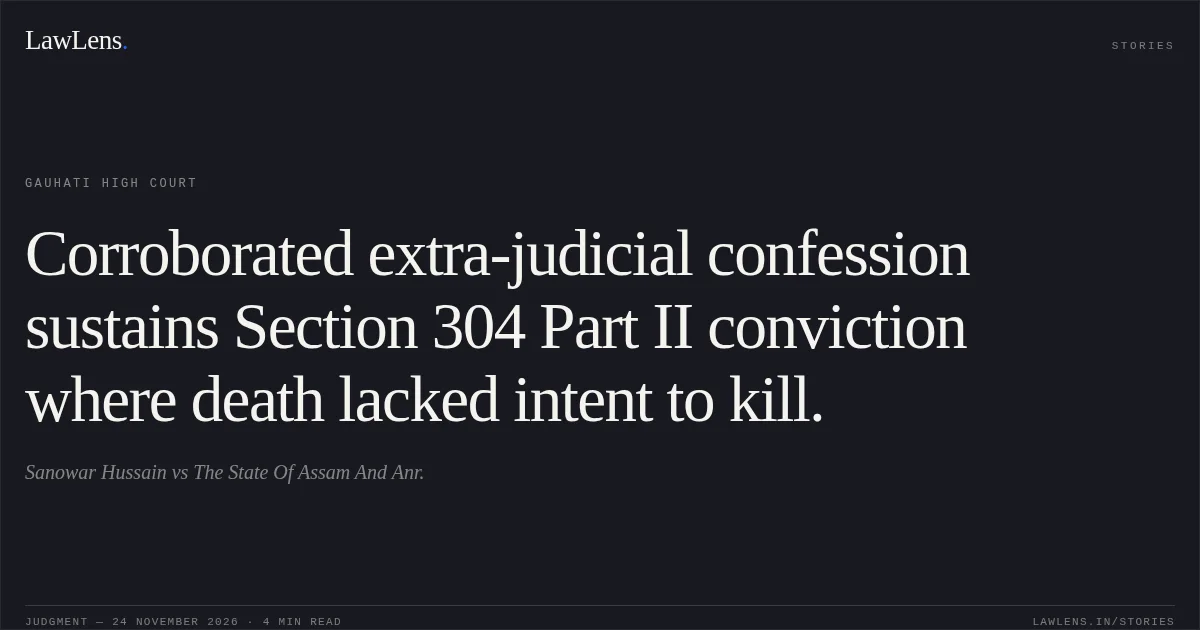
¶ 3On 18.07.2025, the Sessions Judge, Goalpara, convicted the appellant under Section 304 Part II IPC and sentenced him to 7 years' RI and a fine of Rs. 5,000/- (default: 4 months' SI).
p. 1 · ¶ 34The trial court relied on a chain of circumstances: marital relationship and co-residence; injury marks on the neck; the autopsy finding of ligature strangulation; extra-judicial confessions to villagers (PWs 2 and 6); and the appellant's admission under Section 313 CrPC.
¶ 4In his Section 313 statement, the appellant said he found the deceased in a compromising position with her brother-in-law, grabbed the brother-in-law, and then held the deceased's neck during a scuffle in which she became unconscious and later died.
¶ 18The appellant had been in custody for about 3 months during trial and, as of the date of judgment, had served about 1 year 7 months since the 18.07.2025 conviction.
¶ 3502Issues
i.1. Whether the circumstantial evidence forms a complete, unbroken chain excluding every hypothesis other than the appellant's guilt, so as to sustain the conviction.
¶ 20 · ¶ 22–23ii.2. Whether the extra-judicial confession, as corroborated, is reliable and can form a basis for conviction.
¶ 29–32iii.3. Whether the appellant's act was committed without intention or knowledge of causing death, such that the offence falls under Section 304 Part II IPC (or Section 325 IPC), and whether the sentence should be modified.
¶ 20 · ¶ 33–3603Law Applied
The court relied on Section 302 IPC (murder) and Section 304 Part II IPC (culpable homicide not amounting to murder) as the framework for the offence, with Section 325 IPC raised by the defence.
¶ 20The court applied the five "panchsheel" principles of Sharad Birdhichand Sarda v. State of Maharashtra, AIR 1984 SC 1622, which require that circumstances be fully established, consistent only with guilt, conclusive in nature, exclusive of every other hypothesis, and forming a chain leaving no reasonable ground for innocence.
¶ 22–23On extra-judicial confessions, the court applied the principles in Sahadevan v. State of Tamil Nadu, (2012) 6 SCC 403: such confessions are weak evidence requiring greater care, must be voluntary, truthful, and inspire confidence, and need corroboration and freedom from material discrepancies.
¶ 29The court considered the Section 313 CrPC statement as corroborative material.
¶ 32, 36Procedurally, the appeal was filed under Section 415 BNSS, 2023.
p. 2Provisions in the judgment · 6 · Linked ones open on LawLens
Bharatiya Nagarik Suraksha Sanhita, 2023 Section 415
Indian Penal Code, 1860 Section 302Section 304Section 325Section 34
Code of Criminal Procedure, 1973 Section 313
04Reasoning
The court first held that the appellant and deceased were living together under one roof, a fact established beyond doubt through the father's testimony, neighbours' evidence of the hue and cry, and the brothers' evidence.
¶ 24–25Injury marks on the neck were deposed to by PWs 1, 10 and 11, and the autopsy surgeon (PW-7) found ligature marks consistent with ligature strangulation, which the court treated as showing death from the neck injury.
¶ 26–27PWs 2 and 6 gave consistent accounts of the appellant narrating a scuffle with the deceased and her brother-in-law, in which he grabbed her neck. Their accounts were corroborated by PW-3 and PW-4, the father's evidence of the deceased's illicit relationship as the motive for the quarrel, and the appellant's own Section 313 explanation.
¶ 28, 31–32The court found that the confession was voluntary, given before villagers during burial, and not contradicted by the autopsy, so it met the Sahadevan criteria.
¶ 29–32From this, the court inferred that the act arose in a sudden quarrel rather than with intent to kill, and that the appellant lacked knowledge that grabbing the neck would cause death. It relied on the fact that water was poured on the deceased and a pharmacist was called, which the court read as inconsistent with a planned killing.
¶ 33The court therefore treated the case as falling within Section 304 Part II IPC rather than Section 302 IPC.
¶ 34, 36The judgment does not expressly analyse the Section 304 Part II test or the defence-cited authorities (Premchand, Sanjeev Nanda, Shanti Devi, etc.), and the reasoning on Section 325 IPC is not separately addressed.
¶ 2005Holding
The court held that the appellant had neither intention nor knowledge of causing death or of causing bodily injury likely to cause death, and that the sentence imposed by the trial court should be modified to the period already undergone.
¶ 36Relief granted: the sentence is reduced to the period of incarceration already served (about 1 year 7 months).
¶ 35–36The appellant is to be released forthwith if not required in any other case, and the TCR is to be sent down.
¶ 37, 38The operative paragraphs do not expressly set aside the Section 304 Part II conviction, so it appears to stand, with only the sentence modified.
Original Court PDF
Sanowar HussainvsThe State Of Assam And Anr.
Click to open original judgment
Original judgment, available to read, download and summarize on LawLens.in