01Facts
The appellant was convicted by the Special Judge (POCSO), Dhemaji, in Special POCSO Case No. 39/2021 (arising from Silapathar P.S. Case No. 374/2021) under Section 448 IPC read with Section 6 POCSO Act, and sentenced to 25 years' rigorous imprisonment under Section 6.
¶ 2The prosecution case is that on 01.08.2021, at about 1 p.m., the appellant entered the informant's house while the victim was alone, took her to her father's bed, removed her panty and penetrated her.
¶ 13The informant (PW-2), returning home, allegedly saw the act, and the appellant fled after pushing him.
¶ 4, 14The victim was examined by PW-8 (Medical Officer) the same day. Findings included a ruptured/non-intact hymen, no injuries or violent marks, positive pregnancy test, a single intrauterine early pregnancy of 4 weeks 4 days on USG, and radiological age below 12 years.
¶ 19The informant's cross-examination disclosed a general strained relationship with the appellant but no specific enmity.
¶ 14The birth certificate was not exhibited, though a seizure list recorded the victim's date of birth as 05.05.2009.
¶ 20, 31In Section 313 Cr.P.C. examination, the appellant gave a blanket denial.
¶ 21The defence contended that medical evidence did not show injuries or recent intercourse, that the Section 164 statement was inconsistent with the father's testimony, that the mother was not examined, that the victim did not raise an alarm, and that the pregnancy was not proved to be the appellant's.
¶ 902Issues
i.1. Whether the prosecution proved beyond reasonable doubt that the appellant committed penetrative sexual assault on the victim on 01.08.2021, notwithstanding the absence of injuries and the defence objections to the medical evidence.
¶ 9, 25, 30ii.2. Whether the non-examination of the mother, the absence of an outcry, and the alleged inconsistencies vitiate the prosecution case.
¶ 9, 24, 26–28iii.3. Whether the conviction under Section 6 POCSO is sustainable, given that the victim's date of birth in the seizure list would place her above 12 years, so that Section 5(m) is not attracted.
¶ 31–32iv.4. Whether the victim's age may be determined by radiological/ossification evidence with a margin of error, and whether, on that basis, the offence falls under Section 4(2) POCSO.
¶ 33–3703Law Applied
The Court applied Section 448 IPC (house trespass) and Sections 4(2), 5(m) and 6 of the POCSO Act, under which penetrative sexual assault on a child below 12 years attracts Section 5(m) and Section 6, while penetrative sexual assault on a child below 16 years attracts Section 4(2) (punishment of not less than 20 years).
¶ 2, 31–32The Court relied on the principle that no injury on private parts is necessary to prove rape, and that a victim's failure to cry out does not negate rape.
¶ 27, 30The Court applied Section 313 Cr.P.C. and Raj Kumar v. State of Madhya Pradesh, (2014) 5 SCC 353, holding that complete denial and non-explanation of incriminating evidence permit an adverse inference.
¶ 29On age, the Court applied Mahadeo v. State of Maharashtra, (2013) 14 SCC 637, holding that ossification tests may be used for a rape victim's age, and the margin of error recognised in Jaya Mala v. Home Secretary, J&K, (1982) 2 SCC 538, Ram Suresh Singh v. Prabhat Singh, (2009) 6 SCC 681, Karan v. State of M.P., (2023) 5 SCC 504, Pawan Kumar v. State of U.P., (2023) 15 SCC 683, Vinod Katara v. State of U.P., (2023) 15 SCC 210, and Rajni v. State of U.P., AIR 2025 SC 2787.
¶ 33–36The Court also referred to the analogous Section 94 of the Juvenile Justice (Care and Protection of Children) Act, 2015.
¶ 33Provisions in the judgment · 9 · Linked ones open on LawLens
Indian Penal Code, 1860 Section 448Section 447Section 376
Protection of Children from Sexual Offences Act, 2012 Section 6Section 4Section 5
Code of Criminal Procedure, 1973 Section 313Section 164
Juvenile Justice (Care and Protection of Children) Act, 2015. Section 94
04Reasoning
The Court found that the victim's testimony was corroborated by her Section 164 statement and by the father's eyewitness account. The father's description of a cricket match, as against the victim's reference to a football match, was treated as a minor discrepancy not going to the root of the case.
¶ 23–24The medical evidence of a ruptured hymen, pregnancy and under-12 radiological age was held to corroborate penetrative assault, and the Court held that the pregnancy's paternity was not in issue on the 01.08.2021 incident.
¶ 25The absence of injuries was not treated as fatal. The mother's non-examination was held immaterial because she was absent at the time of the incident. The lack of outcry was held not to negate the offence in a child victim, and the father's general statement about poor relations did not render the case false.
¶ 26–28, 30The blanket denial under Section 313 Cr.P.C., together with the absence of any defence suggestion that the appellant was not present or that someone else committed the act, supported an adverse inference.
¶ 29–30The Court observed that the birth certificate was not exhibited and that, if the seizure-list date were accepted, the victim would have been over 12, so Section 5(m) would not apply. The charge had been framed on the basis of the 01.08.2021 incident and Section 5(m).
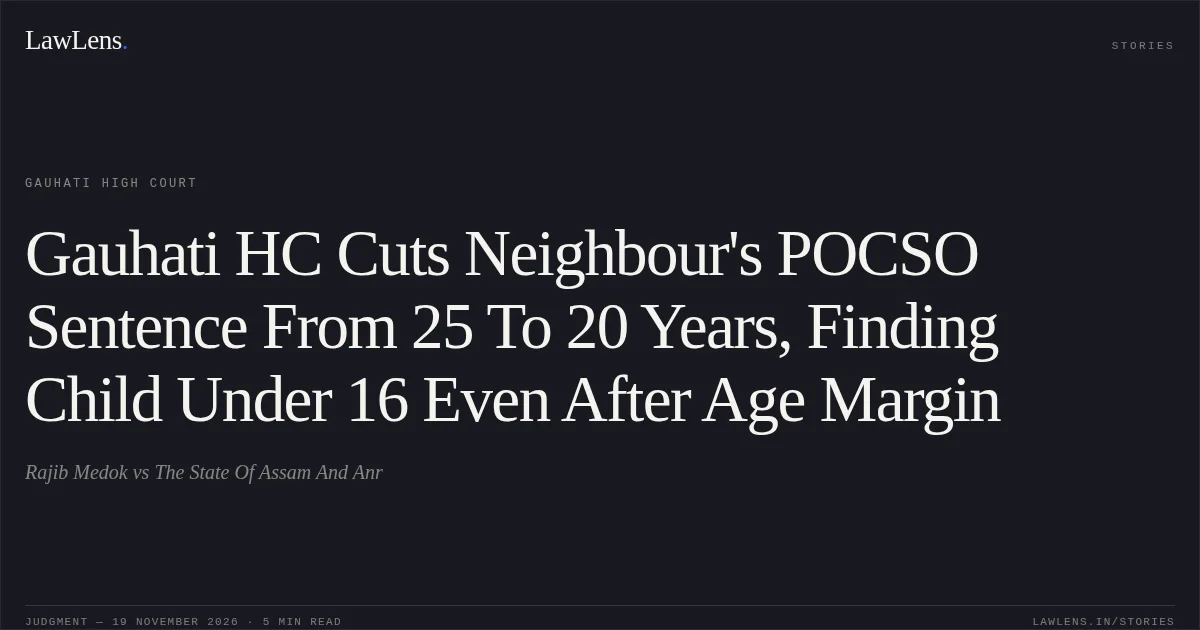
¶ 31However, the radiological evidence showed age below 12, and after the margin of error of one to two years was added, the victim was below 14 and, in any event, below 16. The Court therefore held that Section 4(2) applied on the facts, even though Section 5(m) did not.
¶ 33, 36–3705Holding
The Court held that the prosecution proved beyond reasonable doubt that the appellant committed penetrative sexual assault on the victim on 01.08.2021.
¶ 25, 30The conviction and sentence under Section 6 POCSO were set aside because Section 5(m) was not attracted. The appellant was convicted under Section 4(2) POCSO, the charge was altered accordingly, and he was sentenced to 20 years' rigorous imprisonment with a fine of Rs. 20,000/- (default: 2 years' rigorous imprisonment). The conviction and sentence under Section 448 IPC were not interfered with, and the sentences were directed to run concurrently. The appeal was disposed of, the TCR was ordered to be returned, and the Gauhati High Court Legal Services Committee was directed to pay the fees of the appellant's legal aid counsel.
¶ 31, 38–41Original Court PDF
Rajib MedokvsThe State Of Assam And Anr
Click to open original judgment
Original judgment, available to read, download and summarize on LawLens.in