01Facts
The appellant was convicted under Sections 448 and 302 IPC by the Additional Sessions Judge-2 (FTC), Tinsukia, in Sessions Case No. 81(T)/2018 (judgment dated 25.05.2023). He was sentenced to six months' imprisonment under Section 448 IPC and life imprisonment with a fine of Rs. 10,000 under Section 302 IPC, with sentences to run concurrently.
¶ 2The prosecution case is that the appellant dragged his brother from inside the house, cut his neck with a dao (pruning knife), and killed him in the courtyard at about 7:00 p.m. on 10.02.2018.
¶ 3The informant, the deceased's wife (PW-1), lodged the FIR on 11.02.2018, leading to Doom Dooma P.S. Case No. 36/2018 under Sections 448/302 IPC.
¶ 3The charge-sheet was filed after investigation by PW-6.
¶ 4Six prosecution witnesses were examined. The appellant denied the charges under Section 313 Cr.P.C.
¶ 5–6, 16PW-2, the appellant's brother, was declared hostile.
¶ 11PW-3, a sentry at Talap Outpost, testified that the appellant surrendered with the dao and made an extra-judicial confession to him.
¶ 12, 20PW-4 testified that the appellant told him he had killed the deceased.
¶ 13PW-5, the doctor, found the head separated from the body and multiple lacerations, with death due to shock and haemorrhage from sharp-weapon injuries.
¶ 14The defence argued that PW-1 was not an eyewitness, that the clothes were unmarked and the weapon was not produced at trial, and that the extra-judicial confession was weak and uncorroborated.
¶ 702Issues
i.1. Whether PW-1, the deceased's wife, is a credible eyewitness to the assault, notwithstanding PW-2's testimony that she was not present at the house at the time of the incident.
¶ 7, 10, 17ii.2. Whether the delay in lodging the FIR is adequately explained.
¶ 18iii.3. Whether the extra-judicial confession made to PW-3 (and PW-4's testimony) can be relied upon and is sufficiently corroborated.
¶ 20–24iv.4. Whether non-production of the weapon in Court and the failure to mark the seized clothes constitute defects fatal to the prosecution case.
¶ 26–28v.5. Whether the prosecution has proved the appellant's guilt under Sections 448 and 302 IPC beyond reasonable doubt, such that the conviction must be sustained.
¶ 31–3203Law Applied
The Court applied Sections 302 and 448 IPC as the charged offences.
¶ 2The Court relied on Section 134 of the Evidence Act, under which a single wholly reliable witness may suffice, and on the principle that natural, cogent and trustworthy direct ocular evidence prevails over other evidence, as stated in Balku Oram v. State of Odisha, 2026 INSC 852.
¶ 21The Court applied Kumar v. State of Tamil Nadu, (2013) 12 SCC 699, holding that a voluntary extra-judicial confession made in a fit state of mind may be relied upon along with other material, though it is a weak form of evidence requiring scrutiny of the witness's credibility.
¶ 22The Court followed Mritunjoy Biswas v. Pranab @ Kuti Biswas, (2013) 12 SCC 796, holding that non-recovery of the weapon is not fatal where direct evidence of the crime exists.
¶ 27The Court applied the principle, drawn from Arvind Kumar @ Nemichand v. State of Rajasthan (2021 SCC OnLine SC 1099) and C. Muniappan v. State of Tamil Nadu, (2010) 9 SCC 567, that a defective investigation does not automatically lead to acquittal unless the defect goes to the root of the prosecution case and causes prejudice to the accused.
¶ 28–30Provisions in the judgment · 3 · Linked ones open on LawLens
Indian Penal Code, 1860 Section 448Section 302
Code of Criminal Procedure, 1973 Section 313
04Reasoning
The Court discounted PW-2's testimony that PW-1 was absent. PW-2 admitted he was not at home during the incident, so he could not know whether PW-1 was present. His house was about 20 ft from PW-1's, which made the inference weaker still.
¶ 17, 19The delay in the FIR was held explained. PW-1 screamed but, out of fear and given the gruesome nature of the killing, could not approach the body. The appellant also remained in the courtyard through the night.
¶ 18PW-1's testimony was accepted as natural and trustworthy, which the Court found sufficient under Balku Oram.
¶ 21PW-3's testimony of the extra-judicial confession, made when the appellant surrendered with the dao, was accepted as corroborated by PW-1's eyewitness account and was held sufficient under Kumar.
¶ 20, 22PW-4's testimony was disregarded. He admitted he did not see the incident, and the Court found it unclear how he could know PW-1's whereabouts.
¶ 23–24PW-5's medical evidence was held to corroborate PW-1 and PW-3 and to establish that the appellant alone inflicted the fatal injuries with a dao.
¶ 25On the weapon, PW-3 identified the seized dao (M. Ext. 1) in Court, so the defence objection was met on the record.
¶ 26Even if the weapon were not produced, Mritunjoy Biswas would not defeat the case given the eyewitness.
¶ 27The unmarked clothes were held to be a non-fatal investigative lapse that did not go to the core of the case or prejudice the appellant.
¶ 28–3105Holding
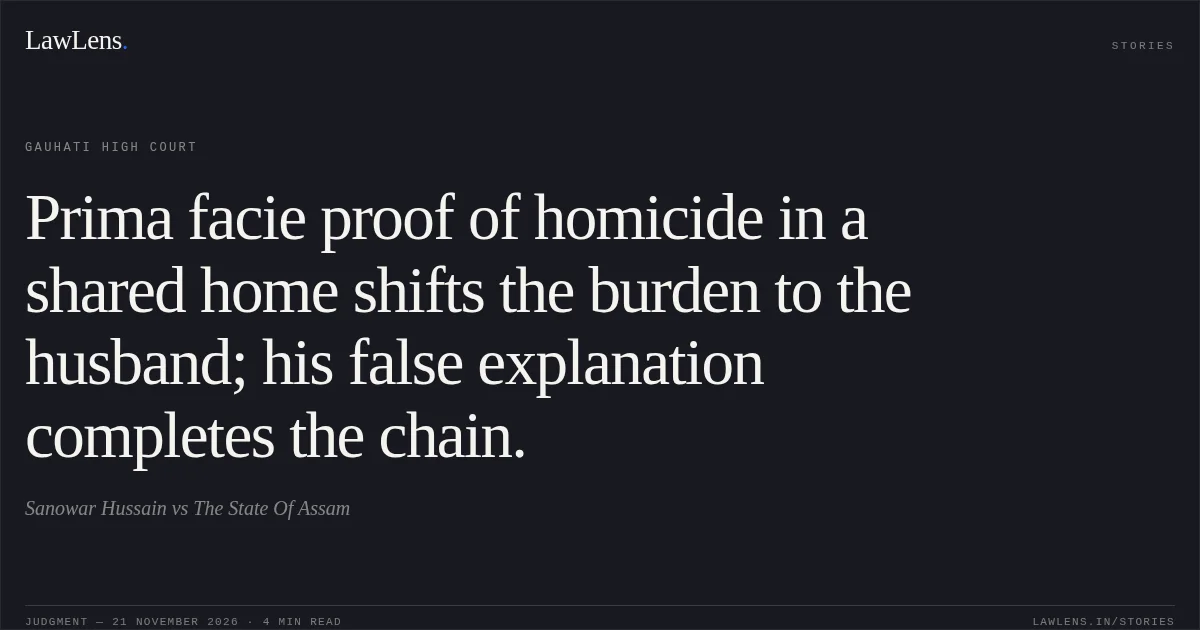
The Court held that the prosecution had proved beyond reasonable doubt that the appellant committed offences under Sections 448 and 302 IPC. The eyewitness testimony of PW-1 was truthful and was corroborated by PW-3 and PW-5, and the investigative defects did not go to the root of the case.
¶ 31–32The appeal was dismissed and the conviction and sentence were upheld.
¶ 32The Trial Court Record is to be returned.
¶ 33The fees of the appellant's legal aid counsel are to be paid by the Gauhati High Court Legal Services Committee as per norms.
¶ 34Original Court PDF
Suresh GuwalavsThe State Of Assam
Click to open original judgment
Original judgment, available to read, download and summarize on LawLens.in