01Facts
The appellant, a married neighbour of the victim's family, was convicted by the Special Judge (POCSO), Bijni, on 16.12.2022 in Sessions Case No. 110(B)/2018 (arising from Bijni P.S. Case No. 133/2013) under Section 376 IPC read with Section 6 POCSO Act, and sentenced to rigorous imprisonment for life with a fine of Rs. 10,000.
¶ 2, 7The prosecution case is that the appellant sexually assaulted the victim, then aged about 15 (as stated in the complaint), from 15.12.2012 for several days, under a promise of marriage.
¶ 3, 12The victim became pregnant. Her father (PW-2) disclosed the matter to the village Women's Committee, which, without the family's consent, arranged a marriage between the victim and the appellant, though the appellant already had a wife.
¶ 3, 14, 16The victim lived in the appellant's house for a short period, alleged ill-treatment, and returned to her parents.
¶ 12, 14The complaint was filed on 18.06.2013, about six months after the first alleged incident, with the delay explained by threats, the marriage, and ill-treatment.
¶ 3, 27PW-7 (first I.O.) could not arrest the appellant, and PW-6 (second I.O.) arrested him only on 10.06.2015.
¶ 4–5, 22, 29The ossification test placed the victim's age between 16 and 18 years.
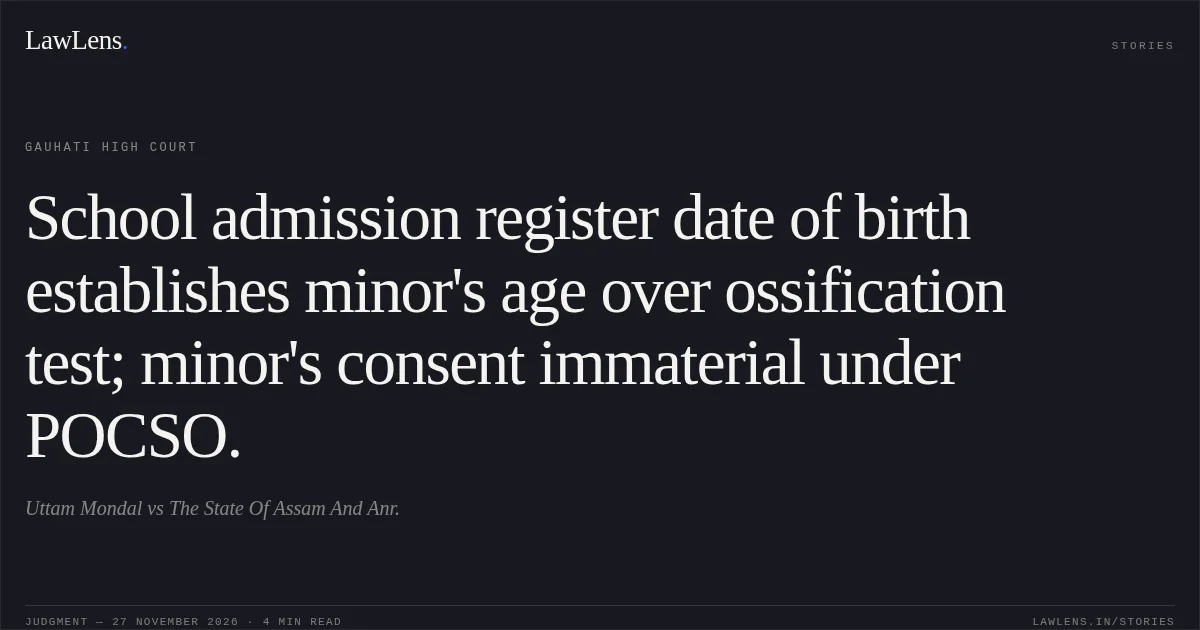
¶ 20CW-1, Headmaster of Bhetagaon M.E. School, proved from the admission register, based on a transfer certificate, that her date of birth was 11.02.1998.
¶ 23The appellant denied the allegations under Section 313 Cr.P.C., asserting false implication to obtain land.
¶ 24He did not undergo a DNA test, and he refused to do so when asked at the hearing.
¶ 31–3202Issues
i.1. Whether the victim was a minor at the time of the alleged sexual intercourse, such that consent was legally immaterial.
¶ 8, 10, 30ii.2. Whether the delay of about six months in lodging the complaint, and the alleged consensual cohabitation following the village-arranged marriage, vitiate the prosecution case and warrant acquittal.
¶ 8–9, 27iii.3. Whether the appellant's refusal to undergo a DNA test, and his admission before PW-4, permit an adverse inference regarding paternity and commission of the offence.
¶ 31–35iv.4. Whether the sentence of life imprisonment imposed by the Trial Court should be modified.
¶ 3703Law Applied
The Court applied Section 376 IPC and Section 6 POCSO Act, 2012, read with Section 42 POCSO Act (alternative punishment provision), which govern aggravated penetrative sexual assault on a child.
¶ 2, 7Under the scheme of these provisions, a person below 18 years is a child and cannot give valid consent to sexual intercourse, so the victim's minority, rather than consent, was the determinative inquiry.
¶ 10, 30The Court relied on the statutory evidentiary value of school admission records, as proved through a Court Witness, to determine age over medical ossification evidence.
¶ 23, 30It also applied the rule that a victim's testimony, if credible and corroborated, can sustain conviction, with corroboration drawn from medical evidence and her Section 164 Cr.P.C. statement.
¶ 30, 36The Court further recognised that delay in reporting is explicable where threats and subsequent coercion are shown.
¶ 27Finally, it drew an adverse inference from the accused's refusal to undergo a DNA test; no specific statutory provision or precedent is cited for this inference.
¶ 34 · no citationThe Court also noted that a second marriage during a subsisting marriage is not valid under the Hindu Marriage Act, 1955.
¶ 26Provisions in the judgment · 7 · Linked ones open on LawLens
Indian Penal Code, 1860 Section 376Section 417
Protection of Children from Sexual Offences Act, 2012 Section 6Section 42
Code of Criminal Procedure, 1973 Section 313Section 156Section 164
04Reasoning
The Court found that the medical evidence (hymen torn, pregnancy of a 30-week fetus) corroborated the victim's account.
¶ 20, 30It held that the ossification range (16 to 18 years) was not conclusive, because the school admission register, proved by CW-1, established the victim was below 18 at the time of the incident.
¶ 23, 30On that basis, her purported consent was irrelevant, and the appellant's defence of consensual relations failed.
¶ 9, 30The Court treated the village-arranged marriage as coerced and legally invalid, and not as evidence of consent, given the subsisting marriage of the appellant and the victim's ill-treatment.
¶ 26–27The six-month delay was explained by initial threats, the forced marriage, and subsequent ill-treatment, and was therefore not held to undermine the prosecution case.
¶ 27The appellant's absconding, evidenced by PW-7's inability to arrest him and his arrest only in 2015, was treated as indicating a guilty conscience.
¶ 28–29The Court held that the refusal to undergo a DNA test gave rise to an adverse inference of paternity.
¶ 32–34Independently of paternity, the Court found that PW-4's uncontradicted testimony that the appellant admitted impregnating the victim, which was not challenged in cross-examination, established penetrative sexual intercourse.
¶ 34–35Accordingly, the Court found no ground to doubt the victim's testimony.
¶ 36On sentence, the Court considered the life term excessive and reduced it to 20 years' rigorous imprisonment, retaining the fine and default term.
¶ 3705Holding
The Court held that the victim was a minor at the time of the offence, that her consent was therefore immaterial, and that the appellant's conviction under Section 6 POCSO Act (in view of Section 42) was sustained.
¶ 30, 36The appeal against conviction is dismissed.
¶ 36, 39The sentence is modified from rigorous imprisonment for life to rigorous imprisonment for 20 years, with a fine of Rs. 10,000 and, in default, simple imprisonment for six months.
¶ 37–38The Trial Court's judgment and sentence order is modified accordingly, and the TCR is to be sent back.
¶ 38, 40Original Court PDF
Uttam MondalvsThe State Of Assam And Anr.
Click to open original judgment
Original judgment, available to read, download and summarize on LawLens.in