01Facts
The petitioner, M/s Cubes Entertainments, instituted an injunction suit before the Principal Munsiff Court, Ernakulam, concerning reviews of its film Kattalan allegedly posted on the online ticketing platform operated by the first respondent, BookMyShow.
¶ 2 · pp. 3–4The persons who posted the reviews were unidentified and were therefore impleaded as the second defendant through a “John Doe”/“Ashok Kumar” description.
¶ 2 · pp. 3–4The Principal Munsiff Court refused to number the suit on the ground that the plaintiff had not complied with Order VI Rule 14A and Order VII Rule 1(c) of the Code of Civil Procedure, 1908.
¶ 1–2 · pp. 3–4The petitioner consequently filed an application seeking exemption from those requirements, but the application was rejected by order dated 5 June 2026.
¶ 1–2 · pp. 3–4The petitioner challenged that order under Article 227 of the Constitution.
¶ 11 · p. 802Issues
i.Whether the Principal Munsiff Court was justified in refusing to number a suit seeking “John Doe” relief for non-compliance with Order VI Rule 14A and Order VII Rule 1(c) of the CPC, when the identities and addresses of the alleged reviewers were unknown?
¶ 4 · p. 5ii.Whether the High Court should exercise its supervisory jurisdiction under Article 227 to set aside the refusal and direct numbering of the suit?
¶ 11 · p. 803Law Applied
Order VI Rule 14A of the CPC requires every pleading to be accompanied by a statement, in the prescribed form, containing the address of the party for service of notice.
¶ 4 · p. 5However, in “John Doe” or “Ashok Kumar” proceedings, the exact identity and address of the defendants may be inherently unknown, making literal compliance with that provision impossible.
¶ 5, 10 · pp. 5, 7–8The Court relied on the development of John Doe jurisprudence in Taj Television v. Rajan Mandal, E.S.P.N. Software India Pvt. Ltd. v. Tudu Enterprises and UTV Software Communications Ltd. v. 1337X.to.
¶ 7–9 · pp. 6–7It held that procedural rules are handmaidens of justice and should not become technical barriers to substantive relief; courts should adopt a progressive approach in such proceedings and may require an undertaking to implead the actual wrongdoer once identified.
¶ 9–11 · pp. 7–804Reasoning
The High Court found that insisting upon the physical address and complete particulars of the unidentified reviewers would create a procedural paradox, because the inability to provide those particulars was the very basis for invoking John Doe jurisdiction.
¶ 5–6 · pp. 5–6Since the reviews were allegedly posted by unknown persons through the first respondent’s platform, strict compliance with Order VI Rule 14A would effectively defeat the suit before its interlocutory relief could be considered.
¶ 10 · p. 8The trial court failed to appreciate this procedural conflict and the urgency of the plaintiff’s grievance.
The High Court therefore exercised Article 227 jurisdiction to correct the procedural infirmity and preserved procedural fairness by noting that the plaintiff could be required to implead the actual persons once their identities became known.
¶ 11 · p. 805Holding
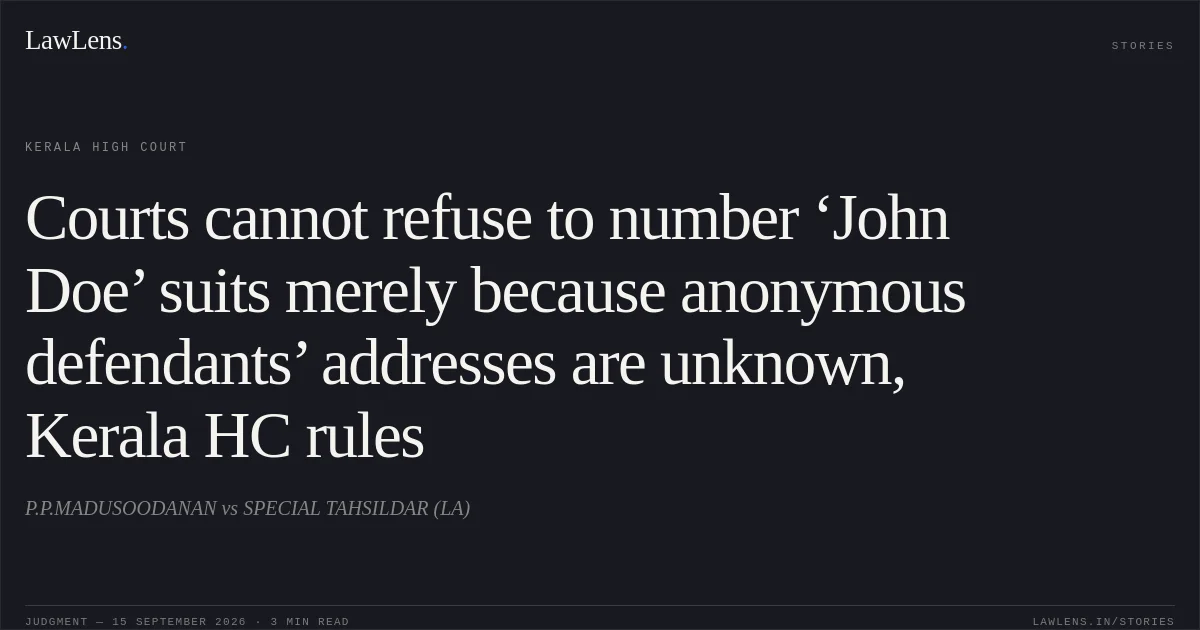
The High Court held that the Principal Munsiff Court was not justified in refusing to number the suit merely because the unidentified John Doe defendants’ addresses could not be furnished.
¶ 11 · p. 9The original petition was allowed, the impugned order dated 5 June 2026 was set aside, and the Principal Munsiff Court, Ernakulam, was directed to number the suit upon production of the certified copy of the judgment and to consider the interlocutory application forthwith.
¶ 11 · p. 9Original Court PDF
P.P.MADUSOODANANvsSPECIAL TAHSILDAR (LA)
Click to open original judgment
Original judgment, available to read, download and summarize on LawLens.in