01Facts
The plaintiffs' predecessor, Sher Singh, sold land to the defendants' father by sale deed dated 10.11.1941.
¶ 2The sale was challenged in two suits, including one by plaintiff Baldev Singh. By judgment and decree dated 05.10.1945, the Additional Sub Judge, Moga, set aside the sale on payment of Rs.976/-, which was the sale consideration.
¶ 2The plaintiffs could take the benefit of that decree only after the vendor's death.
¶ 2Sher Singh died on 26.08.1985, and the plaintiffs then sued for possession of 7 kanals 14 marlas and 5 kanals 15 marlas, which the defendants held under the 1941 sale.
¶ 2 · ¶ 5The defendants pleaded limitation, non-joinder of Sher Singh's daughter, non-maintainability, and res judicata.
¶ 3The trial court decreed the suit.
¶ 5On appeal, the First Appellate Court (Additional District Judge, Faridkot, judgment dated 06.12.1994) reversed that decree and dismissed the suit.
¶ 5The plaintiffs' suit rested on customary rights under the Punjab Customs (Power to Contest) Act, 1920.
¶ 702Issues
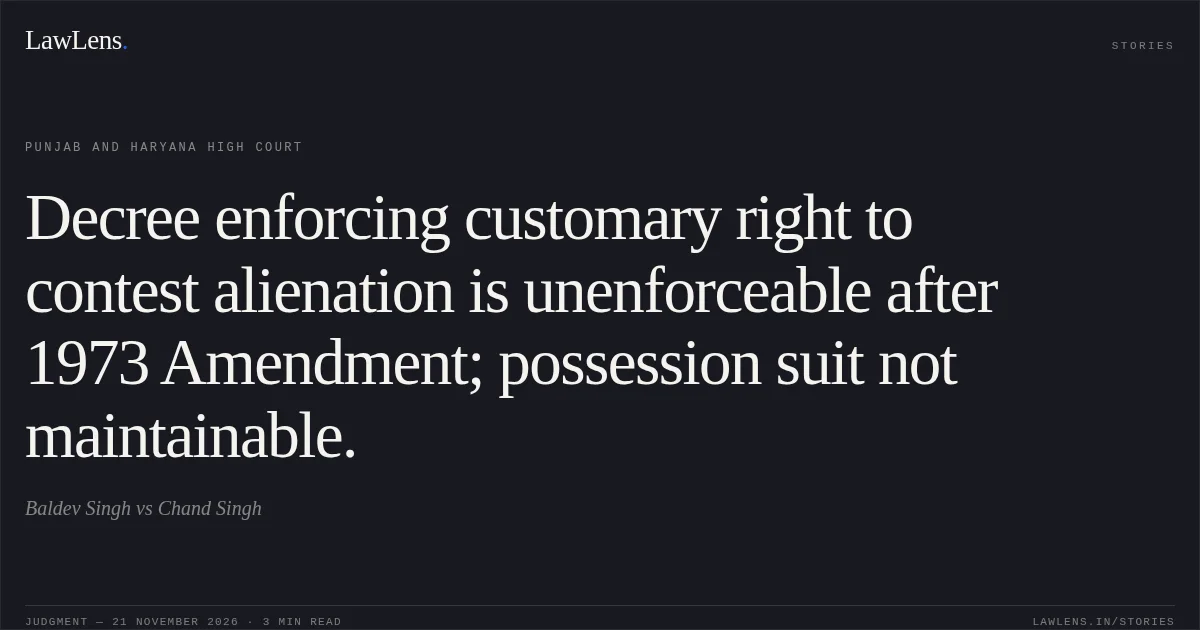
i.1. Whether a suit for possession based on the 1945 decree, which was passed under the Punjab Customs (Power to Contest) Act, 1920, is maintainable when the customary right was abolished with retrospective effect by the 1973 Amendment Act.
¶ 8 · ¶ 16ii.2. Whether the 1945 decree has lost its enforceability by virtue of the 1973 Amendment, so that it cannot support a suit for possession filed in 1985.
¶ 8 · ¶ 17iii.3. Whether the First Appellate Court misread the Paimaish Khatoni and the evidence on identifiability of the suit land.
¶ 6 · ¶ 1803Law Applied
The Punjab Customs (Power to Contest) Act, 1920, as amended in 1973, abolished the customary right to contest alienations with retrospective effect and applies to pending proceedings, as relied upon in Darshan Singh v. Ram Pal Singh, AIR 1991 SC 1654.
¶ 9A declaratory decree contrary to the law prevailing when it is sought to be enforced is not res judicata, and the defendant may challenge it, as relied upon in Shakuntla Devi v. Kamla (2005).
¶ 10A decree passed in violation of the amended law is a nullity that can be challenged even at the execution stage, as held in Kesar Singh v. Sadhu (1996) 7 SCC 711.
¶ 11The finality of a customary-law declaratory decree was removed by the 1973 Amendment, so a suit for possession on such a decree is not maintainable, as held by the Division Bench in Kamakar Singh v. Didar Singh (2011).
¶ 12Single Bench decisions in Satvir Singh v. Arjan Singh (2011), Bhajan Singh v. Jagir Singh and Baldev Singh v. Makhan Singh (2012) followed the same view.
¶ 13 · ¶ 15Teg Singh v. Charan Singh (1977) 2 SCC 732 was held inapplicable, since the donor there died before the 1973 Amendment and execution was sought before it.
¶ 14Provisions in the judgment · 2 · Linked ones open on LawLens
Punjab Laws Act, 1872 Section 5
Code of Civil Procedure, 1908 Section 11
04Reasoning
Sher Singh died in 1985, after the 1973 Amendment had abolished the customary right on which the 1945 decree was founded. No enforceable customary right therefore subsisted when the plaintiffs sued, and the decree could not be enforced by a fresh suit for possession.
¶ 16-17The principle in Shakuntla Devi and Kesar Singh allowed the defendants to challenge the decree's legal efficacy despite the res judicata plea.
¶ 10-11Teg Singh did not assist the plaintiffs because its facts differed on two material points: the donor died before 1973, and execution was sought before the Amendment.
¶ 14Because the suit was not maintainable, the court found it unnecessary to decide the plaintiffs' evidentiary challenge to the First Appellate Court's findings on identifiability, since that ground could not change the outcome.
¶ 1805Holding
The court answered the maintainability question in the negative. The 1945 decree had lost its enforceability after the 1973 Amendment with retrospective effect, and a suit for possession filed in 1985 on that basis was not maintainable.
¶ 16-18The regular second appeal was dismissed, and the judgment of the First Appellate Court dismissing the suit was upheld.
¶ 19The court did not decide the evidentiary question on identifiability of the suit land.
¶ 18Original Court PDF
Baldev SinghvsChand Singh
Click to open original judgment
Original judgment, available to read, download and summarize on LawLens.in