01Facts
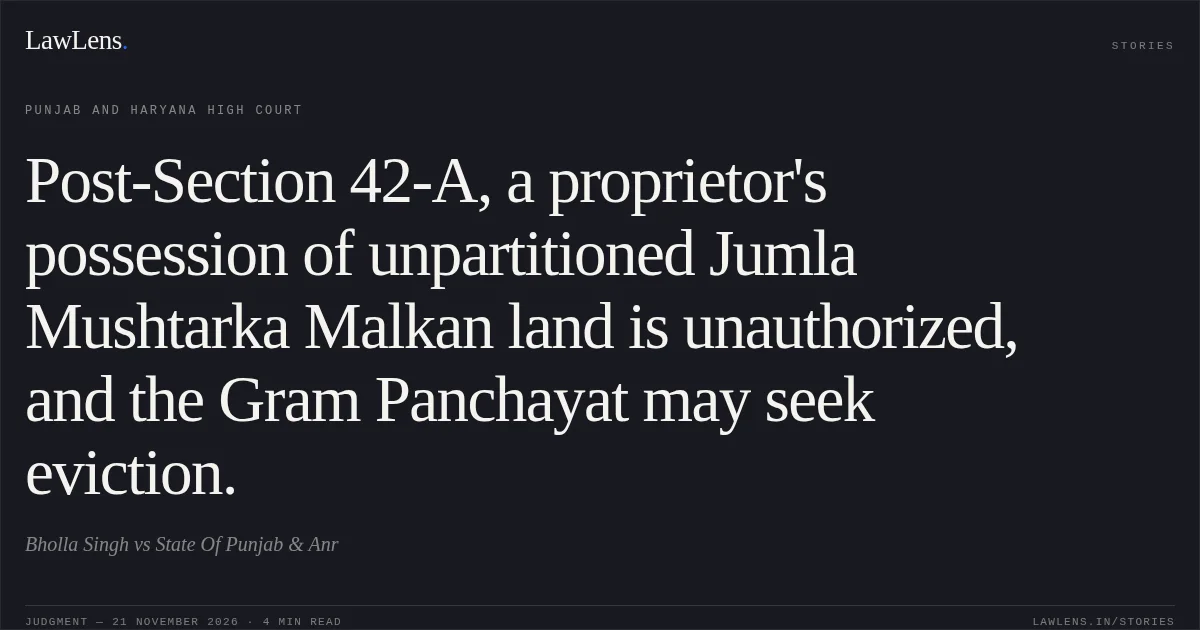
The petitioners claim to be proprietors of village Hassanpur and assert that the disputed land, recorded as "Jumla Mushtarka Malkan," belongs to the village proprietors and not to the Gram Panchayat, so their possession cannot be unauthorized under the Punjab Public Premises and Land (Eviction and Rent Recovery) Act, 1973 ("1973 Act").
¶ 2The land (398 Kanal 0 Marla pool, including the disputed land) was carved out of proprietors' holdings pro rata during consolidation in 1960-61.
¶ 4, 8Mutation No. 1106 (1964) transferred the land to the Gram Panchayat.
¶ 4By order dated 01.10.1982, the Additional Director Consolidation directed distribution of the land among co-sharers; the Gram Panchayat's challenge (writ and SLP) failed, and the petitioner remained in possession.
¶ 4, 4.1The Gram Panchayat's proceedings under the Punjab Village Common Lands (Regulation) Act, 1961 were relegated to civil court on title; its Section 7 application was dismissed (26.05.1986); its civil suit for declaration was dismissed (24.08.1979); and its 1973 Act application was dismissed by the Collector (18.01.1988).
¶ 4.2On appeal, the Joint Director Panchayats remanded (24.01.1989), and the District Development and Panchayat Officer ordered eviction (25.08.1989). The Commissioner dismissed the petitioner's appeal (13.10.1995).
¶ 4.3The petitioner contended long possession since time immemorial, no payment of chakota or rent, and res judicata from earlier dismissals.
¶ 5, 5.1The respondent Gram Panchayat contended that the land was regularly auctioned for village benefit, including during the petitioner's own tenure as Sarpanch, so he is estopped from claiming possession.
¶ 6Counsel for the petitioner did not dispute that the land had not been partitioned among proprietors to date.
¶ 8.102Issues
i.1. Whether the disputed land is "bachat" land that does not vest in the Gram Panchayat, such that the petitioner's possession is authorized and cannot be the subject of eviction under the 1973 Act.
¶ 2, 5.2, 8ii.2. Whether the dismissal of the Gram Panchayat's earlier suit and eviction applications operates as res judicata against fresh eviction proceedings.
¶ 5.1, 11.4iii.3. Whether Section 42-A of the East Punjab Holdings (Consolidation and Prevention of Fragmentation) Act, 1948 ("1948 Act"), inserted by Punjab Act No. 6 of 2007, governs the status of unpartitioned bachat land and the petitioner's possession.
¶ 9.1, 10.1, 11iv.4. Whether the petitioner's claim of long possession and ownership, and the Gram Panchayat's management rights, defeat eviction.
¶ 5, 6, 11.1–11.3, 11.503Law Applied
Section 23A of the East Punjab Holdings (Consolidation and Prevention of Fragmentation) Act, 1948, vests management and control of lands reserved for common purposes in the Panchayat, while ownership remains with proprietors.
¶ 9Section 2(bb) of the 1948 Act (definition of "common purpose").
¶ 10Section 42-A of the 1948 Act bars partition of common-purpose land among proprietors, notwithstanding any judgment, decree, or order, and requires such land to be utilized for common purposes.
¶ 9.1The Division Bench in Mahatam Singh v. State of Punjab upheld the vires and retrospective operation of Section 42-A, subject to the State's 04.08.2010 affidavit exempting cases where partition was implemented before 22.05.2007.
¶ 10, 10.1Under Mohinder Singh, Gujjar Singh, and Gram Panchayat Mangwal, unpartitioned mushtarka malkan land is managed by the Gram Panchayat, which may seek eviction of an unauthorized occupant, even a proprietor, under Sections 4 and 5 of the 1973 Act, and bachat status must be raised under Section 11 of the 1961 Act.
¶ 10.3, 10.4, 11.3Pardeep Kumar holds that a collusive ex parte decree does not bind the panchayat.
¶ 11.1The court distinguished State of Haryana v. Jai Singh (Haryana law), Gurjant Singh, Bhagwan Singh, Labh Singh, Sadhu Singh, Gram Panchayat, Amir Khas, and Gram Panchayat, Village Balad Kalan as pre-dating or not considering Section 42-A.
¶ 10.1, 10.2Provisions in the judgment · 10
Punjab Public Premises and Land (Eviction and Rent Recovery) Act, 1973 Section 4Section 5
Punjab Village Common Lands (Regulation) Act, 1961 Section 7Section 11
East Punjab Holdings (Consolidation and Prevention of Fragmentation) Act, 1948 Section 2Section 18Section 23Section 42Section 42Section 43
04Reasoning
Even if the land were bachat, it had not been partitioned before Section 42-A took effect. Possession therefore could not be regarded as authorized, and the petitioner was liable to eviction under the 1961 or 1973 Act.
¶ 11Reliance on Gurjant Singh and the 1982 consolidation order was rejected, because those authorities predate Section 42-A and the order had not been implemented, a fact the petitioner did not dispute.
¶ 8.1, 10.1On res judicata, the earlier dismissals could not bind the Gram Panchayat because the legal position had changed through the amendment.
¶ 11.4The civil court's finding that the Gram Panchayat is not the owner was accepted, but it did not defeat the panchayat's statutory management rights under Section 23A, which permit eviction of unauthorized occupants.
¶ 11.2The petitioner's claim of long possession was rejected on the factual finding that the land was auctioned during his tenure as Sarpanch and the income was used for the village, and no material showed that finding to be perverse.
¶ 11.505Holding
The land is unpartitioned mushtarka malkan land, Section 42-A bars partition and was validly applied, and the petitioner's possession is unauthorized.
¶ 11–11.5The Gram Panchayat was entitled to seek eviction for management of the land, and prior dismissals did not operate as res judicata.
¶ 11–11.5The court found no reason to interfere with the eviction orders and dismissed both writ petitions (CWP No. 15623 of 1992 and CWP No. 2594 of 1996), with pending applications disposed of.
¶ 12, 13A copy of the order was directed to be kept on the file of the connected case.
¶ 14Original Court PDF
Bholla SinghvsState Of Punjab & Anr
Click to open original judgment
Original judgment, available to read, download and summarize on LawLens.in