Facts
The Revenue appealed against the ITAT’s order dated 4 June 2025 concerning Assessment Year 2017–18.
Source reference: p. 1, para. 2It sought condonation of a 20-day delay in filing the appeal, explaining that approval to appeal was granted on 28 November 2025 and the appeal was filed the following day.
Source reference: p. 2, paras. 4–5; p. 6, para. 17The respondent disputed the explanation and contended that the limitation period ran from pronouncement of the ITAT order.
Source reference: p. 2, paras. 7–8The Revenue also sought condonation of a 309-day delay in re-filing, attributing it to counsel’s personal and medical difficulties, registry defects, and the time taken to obtain signed papers.
Source reference: p. 6, paras. 19–20Issues
1. Whether sufficient cause existed to condone the 20-day delay in filing the appeal.
Source reference: p. 2, paras. 4–9; pp. 5–6, paras. 14–182. Whether sufficient cause existed to condone the 309-day delay in re-filing the appeal.
Source reference: p. 6, paras. 19–213. Whether the ITAT was right to accept the assessee’s computation of actuarial surplus, including deductions for future appropriations and allocation of bonus to policyholders.
Source reference: p. 6, para. 23(i)4. Whether the ITAT was right to apply the rule of consistency in accepting the assessee’s case.
Source reference: p. 7, para. 23(ii)Law Applied
Section 260A(2A) of the Income Tax Act, 1961 empowers the High Court to admit an appeal after the 120-day period where sufficient cause for the delay is established; Section 5 of the Limitation Act, 1963 was also invoked in the applications.
Source reference: p. 1, para. 1; p. 3, para. 10“Sufficient cause” is assessed in a justice-oriented and pragmatic manner, balancing substantial justice against the conduct of the party and the circumstances of the delay.
Source reference: no citationIn Esha Bhattacharjee v. Managing Committee of Raghunathpur Nafar Academy, (2013) 12 SCC 649, the Supreme Court set out principles including a liberal but reasonable approach, attention to bona fides and negligence, and some acceptable latitude for the State or a public body.
Source reference: pp. 3–5, paras. 11, 13Shivamma (Dead) by LRs. v. Karnataka Housing Board & Ors., 2025 SCC OnLine SC 1969, likewise emphasised that “sufficient cause” may be construed liberally to advance substantial justice.
Source reference: p. 3, para. 12Reasoning
The Court considered the filing delay to be short and noted that the appeal was filed the day after approval was granted.
Source reference: pp. 5–6, paras. 14–17In light of the State’s decision-making process, the absence of evidence that the machinery had been lethargic, and the limited duration of the delay, it found sufficient cause to condone it.
Source reference: pp. 5–6, paras. 14–17As to re-filing, the Court accepted the stated reasons, including counsel’s difficulties and the time required to cure defects and obtain signed papers; the respondent did not oppose that application.
Source reference: p. 6, paras. 20–21The Court did not determine the merits of the actuarial-surplus or consistency questions; it framed them for consideration on appeal.
Source reference: pp. 6–7, paras. 22–23Holding
The Court condoned the 20-day delay in filing and the 309-day delay in re-filing.
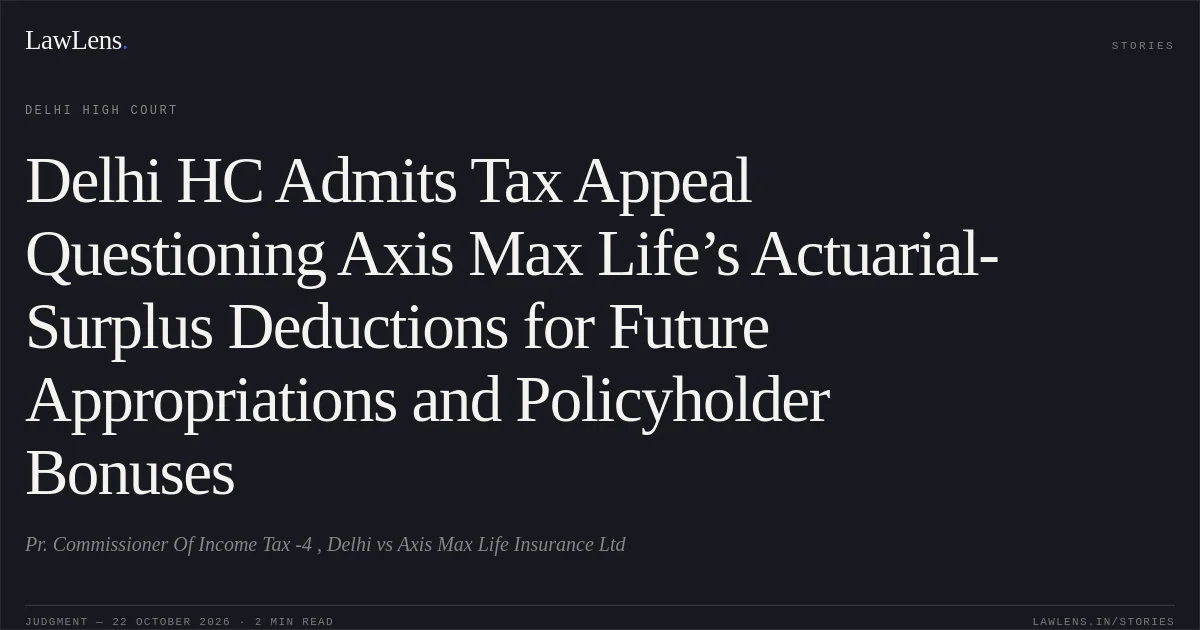
It admitted the appeal and framed two substantial questions of law concerning the actuarial-surplus computation and the ITAT’s application of the rule of consistency.
Source reference: pp. 6–7, paras. 22–23Acts & Sections Cited
1 provisions across 1 statute referred to in this judgment. Each provision opens on LawLens.
Limitation Act, 19631
Original Court PDF
Pr. Commissioner Of Income Tax -4 , DelhivsAxis Max Life Insurance Ltd
Click to open original judgment
Original judgment, available to read, download and summarize on LawLens.in