Facts
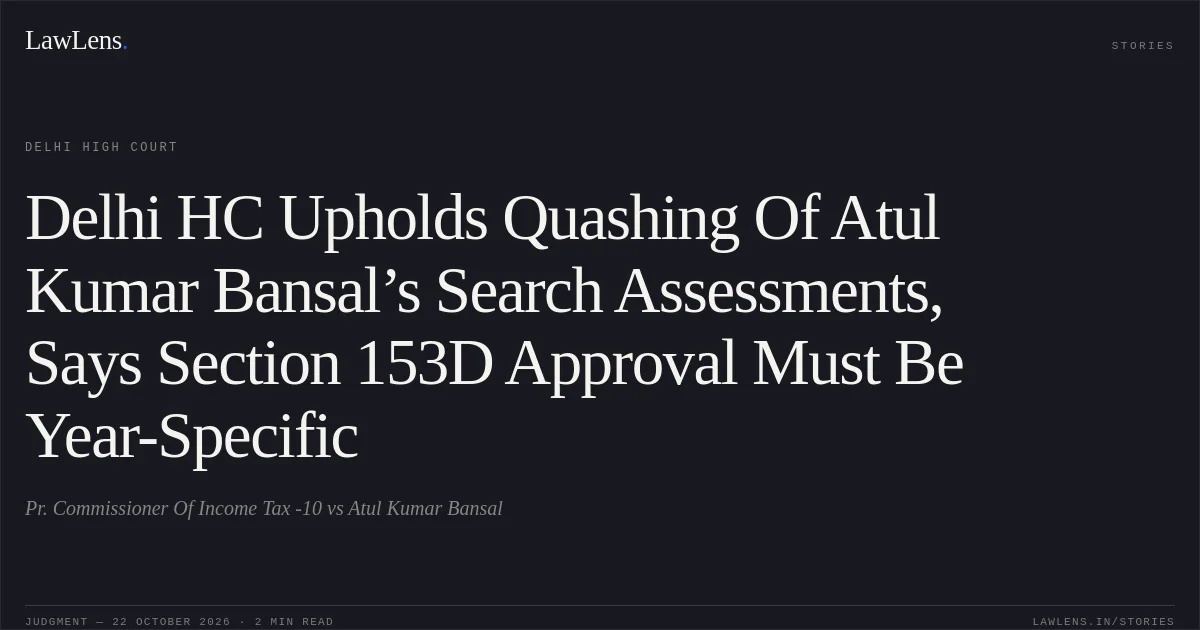
The Revenue appealed under Section 260A of the Income-tax Act, 1961, against the ITAT’s common order concerning assessment years 2008–09 to 2013–14.
Source reference: pp. 3–6The assessments followed a search during which documents relating to alleged accommodation-entry activity were seized; the Assessing Officer made additions for unexplained bank credits and commission income
Source reference: pp. 3–6The ITAT quashed the assessments after finding that the Additional Commissioner had granted a consolidated Section 153D approval covering multiple assessment years.
Source reference: pp. 6, 9–13The Revenue challenged that conclusion before the High Court
Source reference: pp. 6, 9–13Issues
1. Whether the ITAT was correct in quashing the assessments under Sections 153A and 143(3) because the approval under Section 153D was consolidated rather than granted separately for each assessment year
Source reference: p. 6, para. 52. Whether the issue raised a substantial question of law warranting interference under Section 260A, particularly in light of another coordinate Bench having framed questions on the validity and effect of common approvals
Source reference: pp. 20–21, paras. 20–24Law Applied
Section 153D requires prior approval by the Joint Commissioner before an Assessing Officer below that rank passes a search assessment; read with Sections 153A and 153B, the approval must relate to each assessment year
Source reference: pp. 7–8, paras. 6–8The approving authority must apply its mind to the material and draft assessment for each relevant year; approval cannot be a mechanical formality or rubber stamp
Source reference: pp. 14–17, paras. 11–15The Court relied on *PCIT v. Shiv Kumar Nayyar*, *PCIT v. Sapna Gupta*, *ACIT v. Serajuddin and Co.*, and *PCIT v. Anuj Bansal* for those principles
Source reference: pp. 14–17, paras. 12–15It also applied the principle that where a statute prescribes how a power must be exercised, it must be exercised in that manner, relying on *Taylor v. Taylor*, *Nazir Ahmad v. King-Emperor* and *Captain Sube Singh v. Lieutenant Governor of Delhi*
Source reference: pp. 19–20, para. 18Reasoning
The Court accepted that the approval in this case covered several assessment years through a consolidated order.
Source reference: pp. 13–14, 18–20, paras. 11, 16–19It held that Section 153D’s requirement of approval for each assessment year is inconsistent with an omnibus approval that does not separately address the circumstances and material for each year; such an approach would render the year-specific requirement ineffective
Source reference: pp. 13–14, 18–20, paras. 11, 16–19The Revenue pointed to a coordinate Bench order that had framed questions concerning common approvals, but the Court found that order did not cast doubt on the earlier authorities interpreting Section 153D.
Source reference: pp. 20–21, paras. 20–24In the Court’s view, its existing interpretation was consistent with the Allahabad and Orissa High Courts, leaving no substantial question of law for determination in these appeals
Source reference: pp. 20–21, paras. 20–24Holding
The Court held that the consolidated Section 153D approval did not satisfy the statutory requirement of approval for each assessment year.
It dismissed the Revenue’s appeals under Section 260A because no substantial question of law arose for consideration; the ITAT’s order quashing the assessments therefore remained undisturbed
Source reference: p. 21, paras. 23–25Acts & Sections Cited
17 provisions across 1 statute referred to in this judgment. Linked provisions open on LawLens.
Income Tax Act, 1961
Original Court PDF
Pr. Commissioner Of Income Tax -10vsAtul Kumar Bansal
Click to open original judgment
Original judgment, available to read, download and summarize on LawLens.in