01Facts
Petitioner no. 3 and respondent no. 2 married on 11 March 2020 and began living separately on 17 November 2020.
p. 1 · ¶ 1The wife’s complaint led to registration of FIR No. 542/2020 under Sections 376/498A/506/34 IPC.
p. 1 · ¶ 1Although the FIR included allegations of rape against petitioner no. 1, the trial court discharged all accused under Sections 376 and 506 IPC; proceedings remained pending under Sections 498A/34 IPC.
p. 2 · ¶ 2–3The marriage was dissolved by mutual-consent decree on 7 August 2025.
pp. 2, 4–5 · ¶ 3, 5–6The parties had entered into a settlement dated 10 June 2025, and the wife affirmed in court that it was voluntary and that she no longer wished to pursue the case.
pp. 2, 4–5 · ¶ 3, 5–6The petitioners also stated that none of the 15 prosecution witnesses had been examined.
p. 7 · ¶ 1002Issues
i.1. Whether the High Court should exercise its inherent jurisdiction under Section 528 of the BNSS to quash the FIR and proceedings arising from a matrimonial dispute after the parties have settled and the marriage has been dissolved.
pp. 1, 5–7 · ¶ 1, 5–9ii.2. Whether the pending proceedings should be quashed where the complainant supports the settlement and the possibility of conviction is considered remote.
pp. 5, 7–8 · ¶ 6, 10–1203Law Applied
Section 528 of the Bharatiya Nagarik Suraksha Sanhita, 2023, which the Court treated as pari materia to Section 482 CrPC, confers inherent power to quash proceedings to secure the ends of justice or prevent abuse of process.
p. 1 · ¶ 1 · p. 6 · ¶ 8Under Gian Singh v. State of Punjab, non-compoundable proceedings may be quashed where the dispute is predominantly private or matrimonial, the parties have settled, and continuation would defeat justice; serious offences ordinarily cannot be quashed merely on settlement.
pp. 5–6 · ¶ 7Narinder Singh v. State of Punjab directs courts to consider the ends of justice, the predominantly civil or matrimonial character of the dispute, and whether the likelihood of conviction is remote.
pp. 6–8 · ¶ 8, 11Jitendra Raghuvanshi v. Babita Raghuvanshi recognises that Section 320 CrPC does not bar quashing of non-compoundable offences arising from a genuinely and voluntarily settled matrimonial dispute.
p. 7 · ¶ 9The Court also relied on Navneesh Aggarwal v. State of Haryana regarding the risk that prosecution may become harassment after a matrimonial relationship has ended.
p. 8 · ¶ 12Provisions in the judgment · 6 · Linked ones open on LawLens
Bharatiya Nagarik Suraksha Sanhita, 2023 Section 528
Code of Criminal Procedure, 1973 Section 482Section 320
Indian Penal Code, 1860 Section 376Section 506Section 34
04Reasoning
The Court treated the dispute as matrimonial in nature: the parties had settled, the marriage had been dissolved, and the complainant confirmed that the settlement was voluntary and that she did not wish to continue the case.
pp. 2, 4–5 · ¶ 3, 5–6It also noted that the rape and criminal-intimidation charges had already resulted in discharge, leaving only the Section 498A/34 proceedings, and that no prosecution witness had been examined.
p. 2, 7 · ¶ 2, 10Applying the settlement principles in the cited authorities and considering the remote prospect of conviction and the potential for continued proceedings to cause prejudice, the Court found no impediment to quashing.
pp. 7–8 · ¶ 11–1305Holding
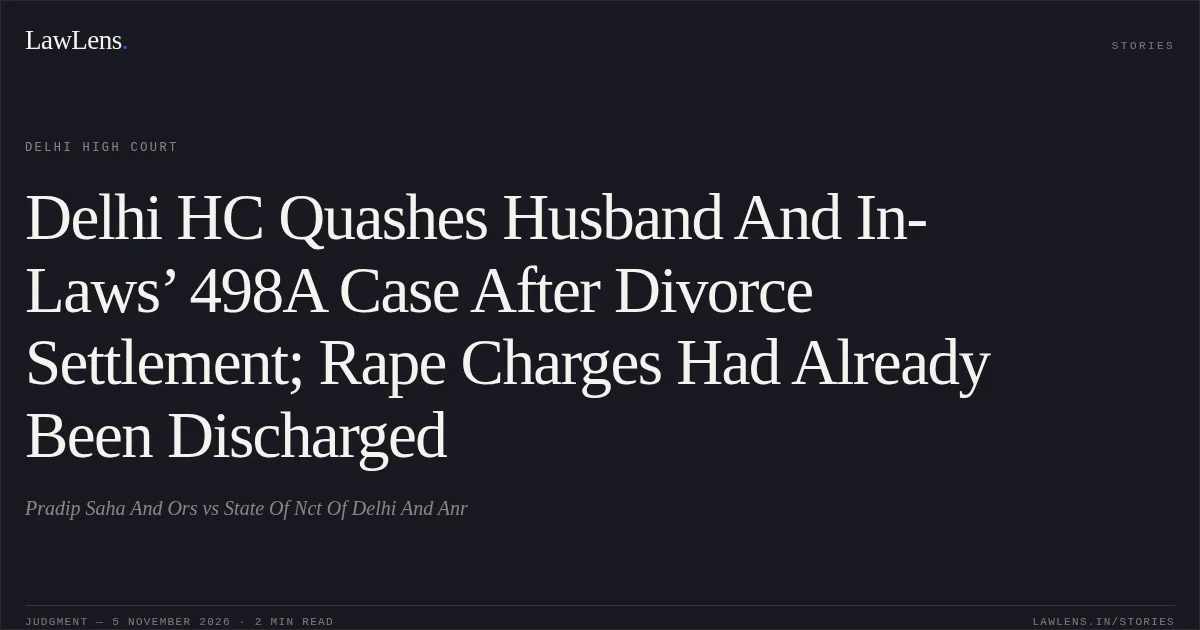
The Court allowed the petition and quashed FIR No. 542/2020, registered under Sections 376/498A/506/34 IPC, and all proceedings arising from it, qua all petitioners.
p. 8 · ¶ 13The petition and pending application were disposed of, with the petitioners directed to pay a cumulative cost of ₹15,000 to the Delhi High Court Legal Services Committee within four weeks and file proof of deposit.
p. 9 · ¶ 14–15Original Court PDF
Pradip Saha And OrsvsState Of Nct Of Delhi And Anr
Click to open original judgment
Original judgment, available to read, download and summarize on LawLens.in