01Facts
The appellant was the successful bidder in a tender of the Madhya Pradesh Rural Road Development Authority. The parties signed an MOU dated 18.10.2007, under which the work would go to the respondent upon acceptance of the bid, and the work was awarded to the respondent on a back-to-back basis on 07.12.2007.
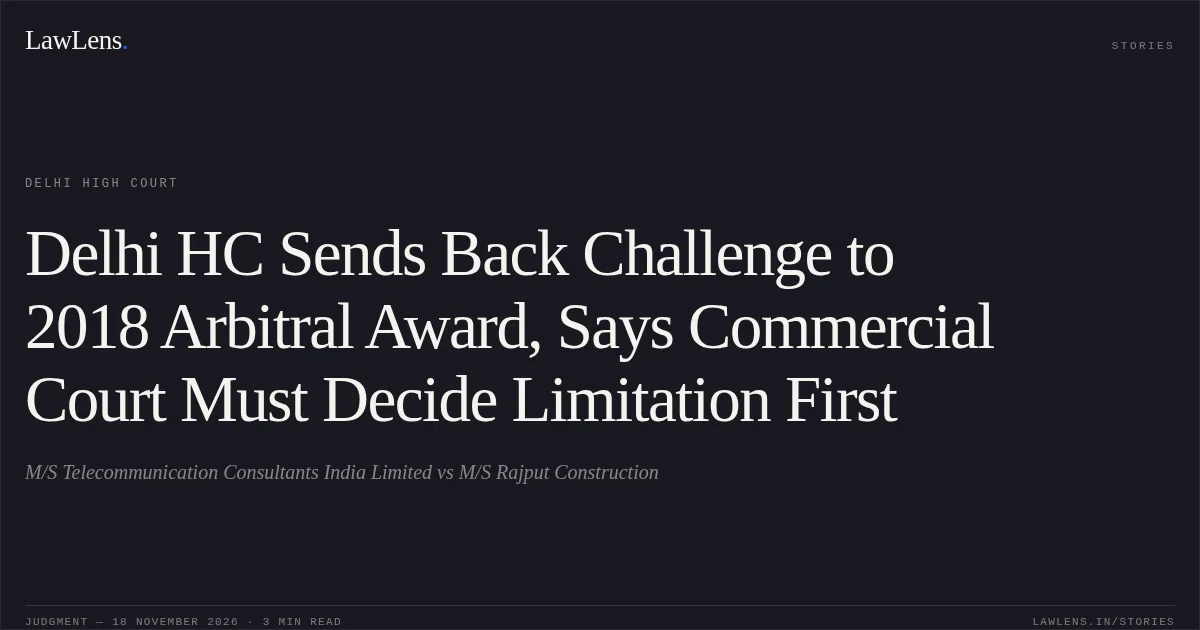
¶ 2The appellant invoked arbitration on 07.04.2014, a sole arbitrator was appointed, and an ex parte award was passed on 15.05.2018.
¶ 2.1The respondent filed objections under s. 34 of the Arbitration and Conciliation Act, 1996 on 27.05.2019. It claimed that it first received a copy of the award on 01.03.2019 under the RTI Act, 2005, and it challenged the unilateral appointment of the arbitrator.
¶ 2.2The appellant raised limitation as a preliminary objection.
¶ 2.2The Commercial Court allowed the objections on the ground that the award was made by a unilaterally appointed arbitrator, without deciding limitation.
¶ 2.3That judgment, dated 13.04.2023, is challenged in this appeal.
¶ 102Issues
i.1. Whether the objections under s. 34 were filed within the period prescribed by s. 34(3), including the condonable 30-day extension, such that the Commercial Court could entertain them.
¶ 3, 6, 8ii.2. Whether the Commercial Court was required to decide the question of limitation before adjudicating the challenge based on s. 12(5) (unilateral appointment of the arbitrator).
¶ 3, 803Law Applied
The court relied on s. 34(3) of the Arbitration Act, which fixes a three-month limitation period from receipt of the award, with a proviso allowing a further 30 days on sufficient cause and no further extension.
¶ 5, 6Because s. 34(3) falls within s. 29(2) of the Limitation Act, 1963, s. 5 of that Act is excluded, and the court may condone delay only up to 30 days.
¶ 6This position rests on Consolidated Engineering Enterprises v. Principal Secretary, Irrigation Department (2008) 7 SCC 169, Singh Enterprises v. CCE (2008) 3 SCC 70, Commissioner of Customs & Central Excise v. Hongo India (P) Ltd. (2009) 5 SCC 791, and Chhattisgarh State Electricity Board v. CERC (2010) 5 SCC 23, which hold that where a special statute prescribes a limitation period with a capped extension, the general power under s. 5 stands excluded.
¶ 7.1, 7.2, 7.3, 7.4The respondent relied on s. 12(5) of the Act and Bhadra International (India) Pvt. Ltd. v. Airports Authority of India, 2026 INSC 6, for the proposition that an award by an ineligible arbitrator is a nullity. The judgment does not analyse this authority.
¶ 4Provisions in the judgment · 8 · Linked ones open on LawLens
Arbitration and Conciliation Act, 1996 Section 34Section 12Section 33
Limitation Act, 1963 Section 29Section 5
Central Excise Act, 1944 Section 35
Electricity Act, 2003 Section 125Section 111
04Reasoning
The court held that limitation under s. 34(3) is a threshold question that must be decided before the merits of any ground, including s. 12(5), can be considered.
¶ 8The Commercial Court set aside the award without first determining whether the 27.05.2019 filing was within time, which was a contested issue on the respondent's claimed date of receipt, 01.03.2019.
¶ 2.2, 8Because the Commercial Court did not record a finding on limitation, the court did not reach the merits of the s. 12(5) challenge or the respondent's nullity argument.
¶ 8The court therefore set aside the impugned judgment and remitted the matter for fresh consideration in accordance with law.
¶ 905Holding
The appeal is allowed. The Commercial Court erred in entertaining and allowing the s. 34 objections without first deciding whether they were filed within the period under s. 34(3).
¶ 8The impugned judgment dated 13.04.2023 is set aside, and the objections are remitted to the Commercial Court for fresh decision. The parties or their representatives are to appear before the Commercial Court on 14.12.2026, and the Commercial Court is directed to decide the objections as expeditiously as possible, given that the award dates from 2018.
¶ 9, 10, 11Original Court PDF
M/S Telecommunication Consultants India LimitedvsM/S Rajput Construction
Click to open original judgment
Original judgment, available to read, download and summarize on LawLens.in