01Facts
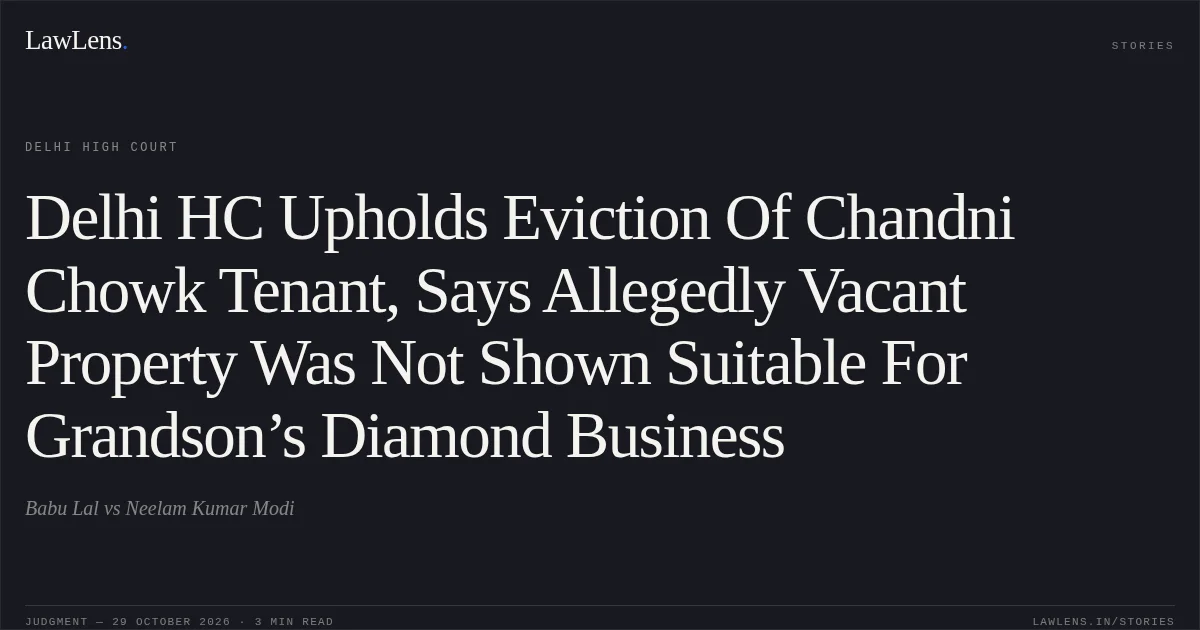
The landlord sought eviction under Section 14(1)(e) of the Delhi Rent Control Act, 1958 (“DRC Act”), claiming bona fide commercial need for a ground-floor shop in Maliwara, Chandni Chowk, including for his grandson’s proposed jewellery/diamond business.
¶ 2–4He relied on a registered sale deed and asserted that the tenant had continued in occupation after the landlord acquired the premises.
¶ 2–4The tenant sought leave to defend, disputing the landlord-tenant relationship, pointing to differences between the parties’ site plans, challenging rent receipts signed by the tenant’s brothers, and alleging that other properties—including Property No. 1072—were available to the landlord.
¶ 5, 7The Additional Rent Controller dismissed the leave application and ordered eviction. The tenant challenged that decision in revision under the proviso to Section 25B(8).
¶ 6–702Issues
i.1. Whether the difference between the parties’ site plans created a triable issue concerning the identity or extent of the tenanted premises
¶ 18–24ii.2. Whether rent receipts signed by the tenant’s brothers raised a triable issue as to the landlord-tenant relationship
¶ 25–35iii.3. Whether Property No. 1072 or other alleged premises constituted reasonably suitable alternative accommodation, and whether the landlord’s pleaded commercial requirement was bona fide
¶ 36–48, 49–57iv.4. Whether the Additional Rent Controller’s order disclosed an error warranting interference under the High Court’s revisional jurisdiction
¶ 14–17, 58–6203Law Applied
Section 14(1)(e) of the DRC Act permits eviction where the landlord establishes a bona fide requirement and the absence of other reasonably suitable accommodation; mere availability or vacancy of another property does not suffice unless it is reasonably suitable for the pleaded need.
¶ 40–45 · Shiv Sarup Gupta v. Dr. Mahesh Chand Gupta, (1999) 6 SCC 222 · M.M. Quasim v. Manohar Lal Sharma, (1981) 3 SCC 36A bona fide business requirement need not amount to absolute or compelling necessity, and the landlord is ordinarily the best judge of the premises suited to that requirement.
¶ 46, 52–53 · Raghunath G. Panhale v. M/s Chaganlal Sundarji & Co., (1999) Supp. 3 SCR 629 · Ragavendra Kumar v. Firm Prem Machinery & Co., (2000) 1 SCC 679At the leave-to-defend stage under Section 25B, the tenant must disclose material facts which, if proved, could disentitle the landlord to eviction; unsupported assertions do not suffice.
¶ 29, 45, 56, 61 · Abid-Ul-Islam v. Inder Sain Dua, (2022) 6 SCC 30For Section 14(1)(e), the landlord need not establish absolute title as in a title suit, and a tenant is generally estopped under Section 116 of the Evidence Act from denying the landlord’s title while continuing in possession.
¶ 26, 31–33 · Rajender Kumar Sharma v. Leela Wati, 2008 SCC OnLine Del 1085Revision under the proviso to Section 25B(8) is supervisory, not appellate; interference is limited to jurisdictional error, manifest illegality, material irregularity, perversity, or an error apparent in the decision-making process.
¶ 14–16 · Abid-Ul-Islam, supra · Hindustan Petroleum Corp. Ltd. v. Dilbahar Singh, (2014) 9 SCC 78Provisions in the judgment · 3 · Linked ones open on LawLens
delhi rent control act, 1958 Section 13Section 14Section 27
04Reasoning
The Court found that the competing site plans concerned the graphical depiction of the same identified shop and that the tenant showed no uncertainty, enlargement of the premises, or resulting prejudice.
¶ 20–24The signatures of the tenant’s brothers on rent receipts did not establish that the tenancy was theirs; the tenant offered no alternative explanation for his possession or material showing that another person was the tenant.
¶ 27–35As to alternative accommodation, the tenant did not provide material demonstrating that Property No. 1072 was available to the landlord and reasonably suitable for the specific commercial use pleaded; vacancy alone was insufficient.
¶ 40–47The proposed jewellery/diamond business was connected to the landlord’s existing business interests, and the tenant produced no material showing that the stated need was a pretext.
¶ 50–57The Controller had considered the material issues, and no basis for supervisory interference was established.
¶ 58–6005Holding
The High Court held that none of the tenant’s objections disclosed a triable issue that could warrant leave to defend or any error justifying revision.
¶ 62–64It dismissed the revision petition, affirmed the eviction order for Shop No. 1069, and disposed of any pending applications. Execution remained subject to the statutory protection under Section 14(7) of the DRC Act, if applicable.
¶ 62–64Original Court PDF
Babu LalvsNeelam Kumar Modi
Click to open original judgment
Original judgment, available to read, download and summarize on LawLens.in