01Facts
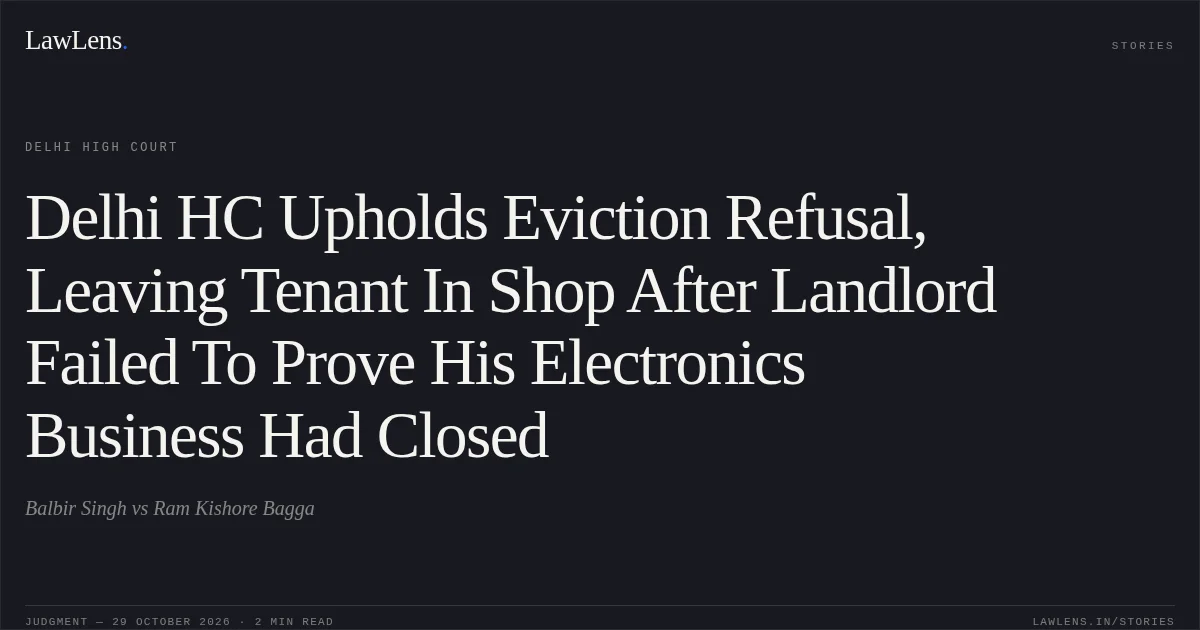
The landlord sought eviction under Section 14(1)(e) of the Delhi Rent Control Act, 1958, from a ground-floor shop at Property No. 21, Masigarh, claiming it was required to run his electronics business.
pp. 2–5He contended that his business, M/s Ashish Electronics, had closed at Shop No. 166/7, Sarai Julena, following DDA proceedings.
pp. 2–5The tenant admitted the landlord–tenant relationship but disputed the bona fides of the requirement, relying, among other things, on VAT returns showing the Sarai Julena address.
pp. 2–5After leave to defend was granted and evidence was led, the Additional Rent Controller dismissed the eviction petition, finding the alleged closure unproved.
pp. 7–9The landlord challenged that decision in revision.
pp. 7–902Issues
i.1. Whether the Additional Rent Controller’s finding that the landlord had not established closure of M/s Ashish Electronics at Sarai Julena—and consequently had not proved the pleaded bona fide requirement—was affected by an error warranting revision under the proviso to Section 25B(8) of the DRC Act.
pp. 6–7, 9–10ii.2. Whether the tenant’s allegedly inconsistent assertions about the location from which the business operated undermined the basis for dismissing the eviction petition.
pp. 16–1703Law Applied
Section 14(1)(e) of the DRC Act permits eviction where the statutory requirements, including the landlord’s bona fide requirement, are established.
pp. 10–12Under Shiv Sarup Gupta v. Dr. Mahesh Chand Gupta, bona fide requirement must be a genuine, sincere need, objectively assessed in light of the facts; it is more than a mere desire.
pp. 10–12Under Abid-Ul-Islam v. Inder Sain Dua, the High Court’s jurisdiction under the proviso to Section 25B(8) is supervisory, not appellate: it examines the legality of the decision-making process and does not reappraise evidence merely because another view is possible.
pp. 5–7The Court also referred to Ved Prakash v. Gay Dry Cleaners for the principle that a landlord’s asserted requirement must be assessed against the evidence and surrounding circumstances, including conduct concerning other commercial premises.
pp. 13–16Provisions in the judgment · 1 · Linked ones open on LawLens
delhi rent control act, 1958 Section 14
04Reasoning
The DDA show-cause notice and fine receipt did not establish that the Sarai Julena shop had actually closed; no closure order or other cogent proof of cessation was produced.
pp. 12–13Conversely, the admitted VAT returns identified M/s Ashish Electronics at the Sarai Julena address through 2011.
pp. 12–13The landlord’s explanation that the business material had been shifted was uncorroborated, and his brother, who could have supported that account, was not examined.
pp. 12–13The Controller also considered that other commercial portions of the property had been let to successive tenants rather than used for the claimed business, a circumstance relevant alongside the unproved closure.
pp. 13–14Although the tenant’s assertions about the business’s location were said to be inconsistent, that inconsistency did not itself prove that the business had ceased at Sarai Julena.
pp. 16–17On the cumulative evidence, the High Court found no perversity or material infirmity in the Controller’s conclusion and declined to reassess the evidence in revision.
pp. 16–1705Holding
The High Court held that the landlord had not demonstrated a revisional ground to disturb the dismissal of the eviction petition.
p. 18The revision petition was dismissed, and the petition and any pending applications were disposed of accordingly.
p. 18Original Court PDF
Balbir SinghvsRam Kishore Bagga
Click to open original judgment
Original judgment, available to read, download and summarize on LawLens.in