01Facts
The Ministry of Tourism (MoT, Respondent No. 2) appointed WAPCOS (Appellant) as executing agency for the construction of a Convention Centre at Aizawl, Mizoram.
¶ 2WAPCOS awarded the work to M.P. Khaitan (Respondent No. 1, "contractor") by LOA dated 10.03.2022. The agreement dated 13.04.2022 included GCC and SCC, with a completion deadline of 24.06.2023.
¶ 3About 90% of the work was completed after three extensions, the last to 31.08.2024. Payment disputes arose over running account bills, and the contractor suspended work from 27.08.2024.
¶ 4By letter dated 20.07.2024, the contractor claimed Rs. 2,65,72,565.06 and sought foreclosure under Sections 51, 53, 54 and 55 of the Indian Contract Act, 1872.
¶ 20 · ¶ 33(i)WAPCOS's letter dated 26.07.2024 admitted the dues, stated that MoT had not released funds, and said that if payment was not resolved within one month, WAPCOS would itself issue the foreclosure recommendation. It also relied on a "New Clause 7A" of the SCC to contend that Sections 51, 53–55 were inapplicable.
¶ 33(ii)Similar assurances followed on 09.05.2025 and 23.05.2025, and no payment had been made by the date of the judgment.
¶ 34The contractor's Section 9 petition (O.M.P.(I)(COMM) 538/2025) was disposed of on 24.12.2025. The matter was referred to arbitration, treated as a Section 17 application, MoT was impleaded, and joint measurement was ordered.
¶ 5Joint measurement was conducted on 10–12.01.2026.
¶ 6By order dated 16.04.2026, the Tribunal deleted MoT as a non-necessary party, directed MoT to issue a foreclosure certificate and take over the site, and permitted the contractor to remove its plant and machinery.
¶ 7WAPCOS appealed under Section 37(2)(b).
¶ 802Issues
i.1. Whether the Tribunal was justified in directing the issuance of a foreclosure certificate and the foreclosure of the contract at the contractor's instance, when Clause 13 of the GCC vests foreclosure power in WAPCOS alone.
¶ 10–12 · ¶ 32–38ii.2. Whether the direction requiring WAPCOS to take over the project directly from the contractor is contrary to the contract, specifically Clause 2(6) of the Additional Conditions of the SCC.
¶ 17 · ¶ 39–41iii.3. Whether the Tribunal was justified in deleting MoT (Respondent No. 2) from the array of parties.
¶ 13–16 · ¶ 42–4503Law Applied
The Court applied the restricted scope of appellate review under Section 37(2)(b) of the Arbitration and Conciliation Act, 1996. Interim orders under Section 17 may be interfered with only if they are perverse, patently illegal, or suffer from jurisdictional infirmity, a standard drawn from Nikhil Kumar Anand, Perfect Diesel, World Window Infrastructure, Lava International, Dinesh Gupta v. Anand Gupta, and Sanjay Arora v. Rajan Chadha.
¶ 30–31The Court relied on the principle that Section 17 and Section 9 powers are co-equal.
¶ 30, quoting World Window · ¶ 82On foreclosure, the Court considered Clause 13 of the GCC, which empowers WAPCOS to foreclose, and Sections 51, 53, 54 and 55 of the Indian Contract Act, 1872, which govern the contractual consequences of prevention, impossibility and default.
¶ 12 · ¶ 22 · ¶ 35On the takeover direction, the Court considered Clause 2(6) of the Additional Conditions of the SCC, which requires handover to the "Owner/Client" after completion of each component and excludes partial handover.
¶ 40On joinder, the Court applied the doctrine of privity of contract, under which a non-signatory is not bound by contractual terms absent its consent or ratification. It also considered the scope of Section 5 of the Act, which limits judicial interference with the arbitral process.
¶ 30 · ¶ 40 · ¶ 44Provisions in the judgment · 9 · Linked ones open on LawLens
Arbitration and Conciliation Act, 1996 Section 5Section 9Section 17Section 34Section 37
Indian Contract Act, 1872 Section 51Section 53Section 54Section 55
04Reasoning
On foreclosure, the Court held that Clause 13 is an enabling clause for WAPCOS and does not expressly bar the contractor from seeking foreclosure.
¶ 35Read with Sections 51, 53–55 of the Contract Act and WAPCOS's own admissions of liability, non-payment, and lack of funds, the Tribunal's view that the contractor was not wholly precluded from seeking foreclosure was plausible. The Court also noted that WAPCOS did not rely on Clause 13 before the Tribunal and raised it for the first time in appeal.
¶ 34–35 · ¶ 36Because the takeover direction followed as a consequence of foreclosure, the foreclosure certificate direction also stood.
¶ 37On the takeover direction under Clause 2(6), the Court accepted the Tribunal's prima facie reasoning that the clause binds WAPCOS, the party to the contract, and that MoT's role is limited, as the handover was intended to be made to the Government and not to a third-party contractor.
¶ 40–41On deletion of MoT, the Tribunal found there was no privity between MoT and the contractor, and that MoT did not agree to Clause 2(6) or any other contractual term. The Court observed that whether Clause 2(6) binds a non-signatory like MoT is "prima facie, doubtful," and held that the Tribunal's reasoning was based on facts and was not perverse or beyond jurisdiction.
¶ 40, quoting Tribunal paras. 7–9 · ¶ 44–45Note for practitioners: the judgment does not expressly reconcile WAPCOS's reliance on "New Clause 7A" to exclude Sections 51 and 53–55 with the Tribunal's reliance on those same sections.
¶ 33(ii) · ¶ 22 · ¶ 3505Holding
The Court held that the Tribunal's directions on foreclosure, foreclosure certificate and takeover are plausible and not perverse, patently illegal, or beyond jurisdiction.
¶ 38 · ¶ 41The deletion of MoT as a non-necessary party was upheld, as the reasoning was based on facts and not perverse.
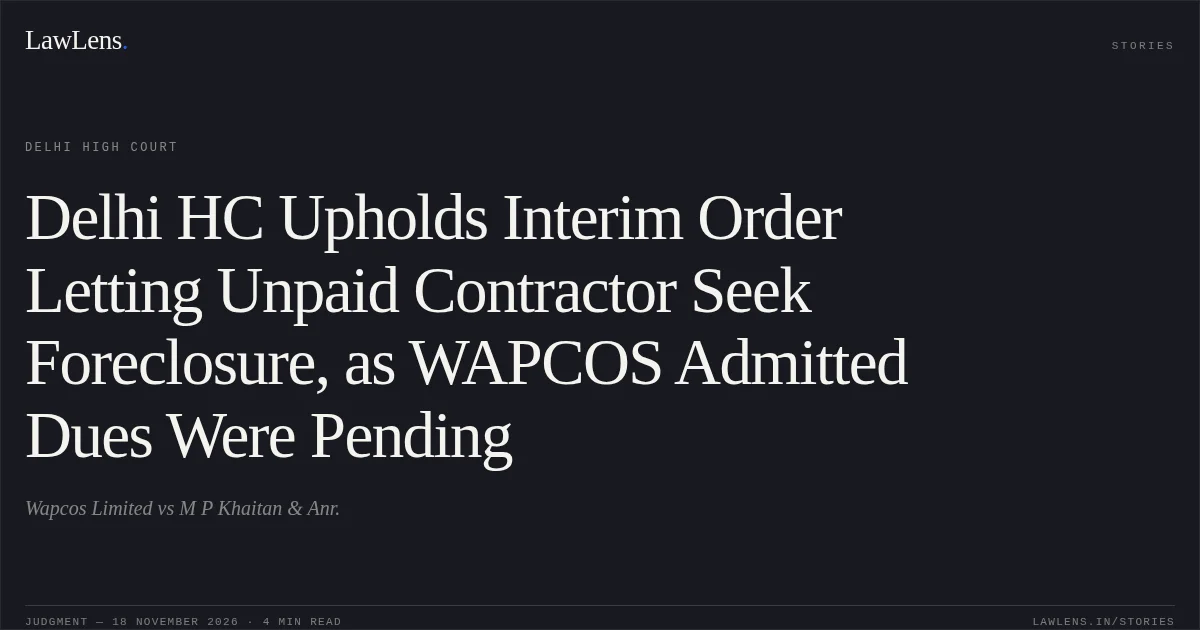
¶ 44–45The appeal was dismissed without costs. The impugned interim order dated 16.04.2026 therefore stands, requiring the issuance of a foreclosure certificate, WAPCOS's takeover of the site, and removal of the contractor's plant and machinery.
¶ 46 · ¶ 7Original Court PDF
Wapcos LimitedvsM P Khaitan & Anr.
Click to open original judgment
Original judgment, available to read, download and summarize on LawLens.in