01Facts
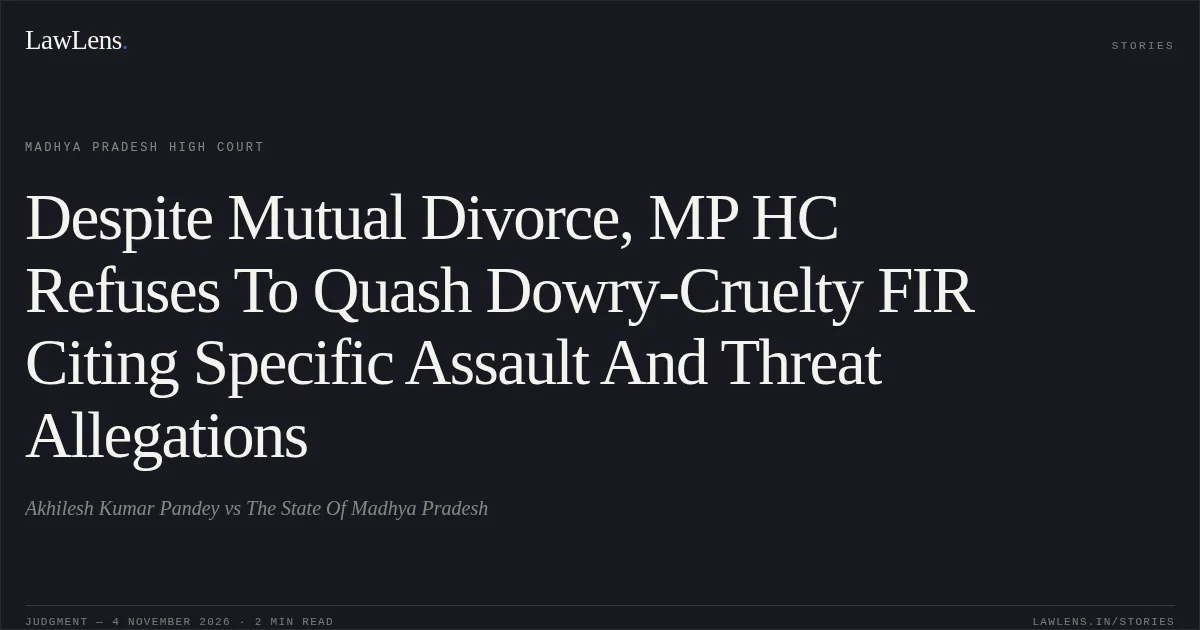
The complainant alleged that her husband, father-in-law (petitioner No. 1) and brother-in-law subjected her to physical and mental cruelty, demanded dowry, assaulted her, and expelled her and her two daughters from the matrimonial home.
¶ 2The resulting FIR, registered at Mahila Thana, Gwalior, alleged offences under Sections 498-A, 506 and 34 IPC and Section 4 of the Dowry Prohibition Act.
¶ 2The petitioners sought quashing under Section 482 CrPC, relying on a mutual-consent divorce decree and an asserted settlement of the matrimonial dispute.
¶ 3–5The State opposed quashing; respondent No. 2 did not appear despite service.
¶ 6–902Issues
i.1. Whether the FIR and consequential proceedings should be quashed under Section 482 CrPC because the matrimonial dispute had been settled and a mutual-consent divorce decree had been granted.
¶ 3–5, 10ii.2. Whether the allegations, taken at face value, disclosed cognizable offences requiring the matter to proceed to trial.
¶ 11–1303Law Applied
Section 482 CrPC confers inherent power to prevent abuse of the process of a court or secure the ends of justice, but that power must be exercised sparingly and with circumspection.
¶ 11At the FIR-quashing stage, the court considers whether the allegations, taken at face value, disclose a cognizable offence; it does not weigh evidence or assess the accused’s defence.
¶ 11The Court also considered the offences alleged under Sections 498-A, 506 and 34 IPC and Section 4 of the Dowry Prohibition Act.
¶ 1, 6It held that a subsequent mutual-consent divorce does not, by itself, extinguish criminal liability for alleged cruelty and dowry harassment, while the effect of a claimed settlement and disputes about the allegations’ truth or scope are matters for trial.
¶ 12–13Provisions in the judgment · 4 · Linked ones open on LawLens
Code of Criminal Procedure, 1973 Section 482
Indian Penal Code, 1860 Section 506Section 34
Dowry Prohibition Act, 1961 Section 4
04Reasoning
The Court found that the FIR contained specific allegations of continuing physical cruelty, mental harassment, dowry demands, assault, threats and expulsion from the matrimonial home.
¶ 12Those allegations, taken at face value, disclosed offences and could not be rejected at the quashing stage.
¶ 12The divorce decree did not automatically erase the alleged criminal conduct, and the petitioners’ challenges to the allegations and reliance on settlement raised matters for evidentiary assessment.
¶ 12–13The absence of a joint compromise application expressing respondent No. 2’s no-objection also weighed against quashing.
¶ 1305Holding
The Court declined to exercise its inherent jurisdiction and dismissed the petition, finding no manifest illegality or abuse of process in the FIR or prosecution.
¶ 14–15It directed the trial court to proceed expeditiously and in accordance with law, uninfluenced by the order’s observations; pending interlocutory applications were disposed of.
¶ 15–16Original Court PDF
Akhilesh Kumar PandeyvsThe State Of Madhya Pradesh
Click to open original judgment
Original judgment, available to read, download and summarize on LawLens.in