01Facts
The Petitioner was commissioned as a Short Service Commissioned Officer in the Army Medical Corps on 12.04.2005 and promoted to Major on 12.10.2008.
¶ 4The Petitioner is a postgraduate in Nuclear Medicine, graded as a Specialist in that field, and during postings was exposed to radiation while treating patients with radiation therapy.
¶ 4The Petitioner was medically fit at entry, with no note of pre-existing illness.
¶ 6During his annual medical check-up in 2013–14, the Petitioner was diagnosed with Primary Hypertension, Impaired Fasting Glucose (IFG) and Hypothyroidism.
¶ 5 · ¶ 6His tenure was extended to 12.04.2019 on condition that he attain SHAPE-1 by 12.10.2015. He failed to attain the required medical category and was released from service with effect from 12.10.2015.
¶ 5His claim for disability pension was rejected on 29.01.2016 on the ground that the disabilities were neither attributable to nor aggravated by service under Regulation 37, Part-I, Pension Regulations 2008.
¶ 5The first appeal was rejected on 12.04.2017.
¶ 5The Armed Forces Tribunal dismissed OA 1495/2016 by judgment dated 06.08.2026 insofar as it related to disability pension, and granted liberty to pursue promotion to Lt. Col. separately.
¶ 5The Respondents contended that the disabilities were idiopathic lifestyle diseases with strong genetic predisposition, arose at a peace station (Delhi) in May 2014, and relied on the Release Medical Board (RMB) findings of 12.10.2015.
¶ 9The Tribunal held that the radiation certificates were mere working certificates, that no TLD badge records were produced, and that the causal link was speculative.
¶ 11 · ¶ 12The Petitioner challenged this under Article 226.
¶ 102Issues
i.1. Whether, in the absence of any note of pre-existing disease at entry, the Petitioner's disabilities (IFG, Primary Hypertension, Hypothyroidism) are presumed attributable to or aggravated by military service, and whether the onus of rebutting that presumption lies on the employer.
¶ 6 · ¶ 13 · ¶ 14ii.2. Whether the Tribunal erred in rejecting the claim on the ground that there was no objective, quantified radiation data (TLD records) or medical literature establishing a causal nexus, and in placing the burden of proof on the Petitioner.
¶ 12 · ¶ 15–16iii.3. Whether the onset of the disabilities at a peace station is a valid ground for denying disability pension.
¶ 17 · ¶ 1803Law Applied
The Court relied on Dharamvir Singh v. Union of India, (2013) 7 SCC 316, which holds that a member entering service without any note of pre-existing illness is presumed to be in sound health, so that a subsequently contracted disability is presumed attributable to service unless the employer rebuts it.
¶ 6 · ¶ 13The Court applied Union of India v. Col. NC Isaac (Retd), 2026 SCC OnLine SC 1895, which holds that the removal of the entry presumption under Rule 5 of the Entitlement Rules 2008 does not alter the core beneficial scheme. Under Rule 7 of the Entitlement Rules 2008 (carrying forward Rule 9 of the 1982 Rules), the onus of proving non-attributability remains on the employer, and where the cause is unknown and the presumption is not rebutted, the disability is attributable to service.
¶ 13 (quoting Isaac · ¶ 30.1–30.7)Rule 11 of the 2008 Rules, which deems aggravation where service conditions hasten onset or worsen the course, was also noted.
¶ 13Regulation 423 of the Regulations for the Medical Services of the Armed Forces 2010 provides that whether the cause arose in a field or peace area is immaterial, and that the test is a causal connection with service conditions, with benefit of reasonable doubt to the individual.
¶ 17The Court followed Union of India v. Col. Balbir Singh (Retd), 2025 SCC OnLine Del 7873, holding that military service at peace stations is inherently stressful and that a mere statement that a disease is lifestyle-related cannot defeat a claim absent proper medical examination.
¶ 17 (quoting Balbir Singh · ¶ 66–74)The Court followed HFL Youdhisthir Singh (Retd) v. Union of India, 2026 SCC OnLine Del 2747 (hypertension claim; peace-station onset argument rejected).
¶ 17The Court followed the Co-ordinate Bench decision in Union of India v. WO Binod Kumar Sah (Retd), W.P.(C) 3918/2025, holding that the RMB bears an onerous burden to establish non-attributability after long service.
¶ 17 (quoting Binod Kumar Sah · ¶ 13–14)04Reasoning
The Court found the presumption of attributability applicable because the Petitioner was medically fit at entry and the disabilities surfaced about a decade later in 2013–14.
¶ 13The Respondents did not discharge the onus of showing a cause extraneous to service or to the individual. The Tribunal's requirement of a "clear and objective causal nexus" was held to be contrary to this presumption.
¶ 14The Court found that the HOD Nuclear Medicine certificates established that the Petitioner administered high-dose radioactive isotopes (including ¹³¹I, ¹³¹I-MIBG, ⁹⁰Y-Colloids and ¹⁵³Sm) during specified postings, which was sufficient to establish a causal connection.
¶ 14The Tribunal's characterisation of these certificates as mere working certificates was held to be an erroneous appreciation.
¶ 15The Court rejected the reliance on the absence of TLD records: the badge measures acute external exposure, whereas thyroid dysfunction may result from chronic low-dose and internal exposure, a position supported by medical literature on record. The Petitioner could not produce the TLD records, and the burden of production lay on the Respondents.
¶ 16On the peace-station argument, the Court held that under Regulation 423 and the Balbir Singh and HFL Youdhisthir Singh line, the place of onset is immaterial, and the RMB's reliance on "lifestyle disease" labelling was insufficient absent cogent evidence of a non-service cause.
¶ 17 · ¶ 1805Holding
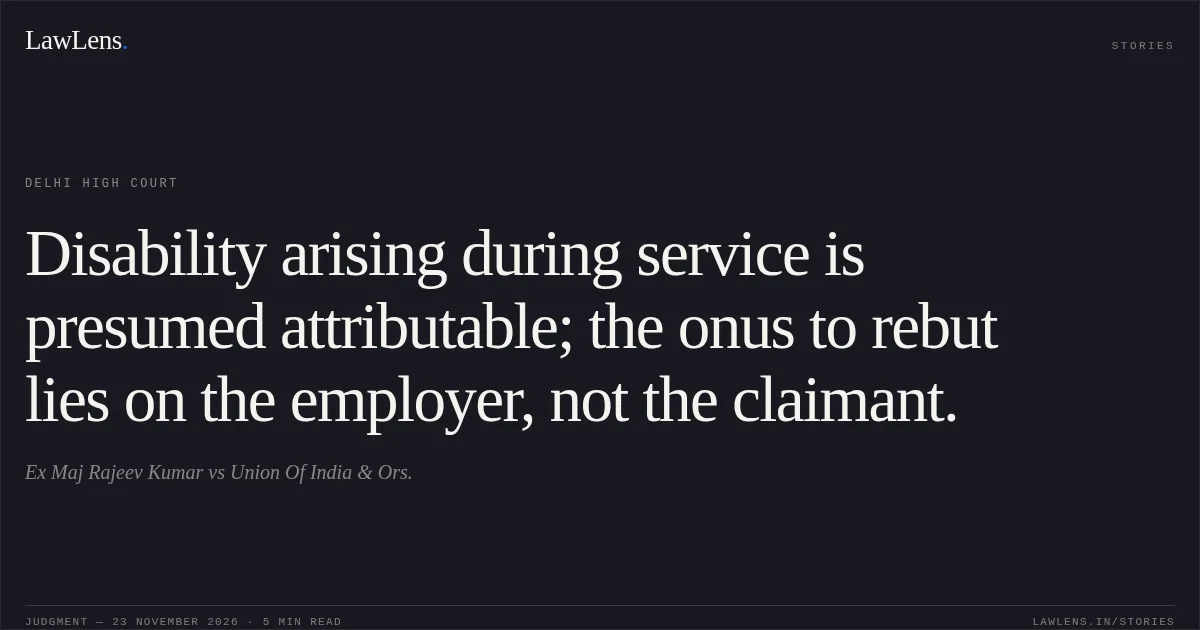
The Court answered all three issues in the Petitioner's favour. The presumption of attributability under Dharamvir Singh and Col. NC Isaac applied, the onus lay on the Respondents, and the Tribunal erred in demanding objective radiation data and in treating peace-station onset as disqualifying.
¶ 13 · ¶ 14 · ¶ 15 · ¶ 16 · ¶ 17 · ¶ 18The writ petition was allowed. The Tribunal's judgment dated 06.08.2026 in OA 1495/2016, and the orders dated 29.01.2016 and 12.04.2017 rejecting the disability pension claim, were set aside. The Respondents were directed to grant disability pension to the Petitioner with effect from 13.10.2015 (as stated in the judgment). Arrears are to be paid within three months, failing which interest at 6% per annum is payable until actual payment.
¶ 19Original Court PDF
Ex Maj Rajeev KumarvsUnion Of India & Ors.
Click to open original judgment
Original judgment, available to read, download and summarize on LawLens.in