01Facts
The petitioners, brothers employed by respondent No. 2 (complainant, Basant Lal Sonkar, a jewellery businessman and Managing Director of M/s Chetna Assaying and Hallmarking Centre), managed his offices at Bank Street and Beadon Pura, Karol Bagh.
¶ 4On 15.10.2025, verification of accounts revealed missing gold and cash: 82.900 gms of gold from the Bank Street locker, and 187 gms of gold and Rs. 6,00,000 from the Beadon Pura locker.
¶ 4The complainant further alleged that the petitioners had collected client payments in his name, bringing the alleged total to 270.56 gms of gold and about Rs. 10,00,000.
¶ 4FIR No. 1460/2025 was registered on 09.12.2025 at P.S. Karol Bagh under Sections 316(4)/3(5) BNS.
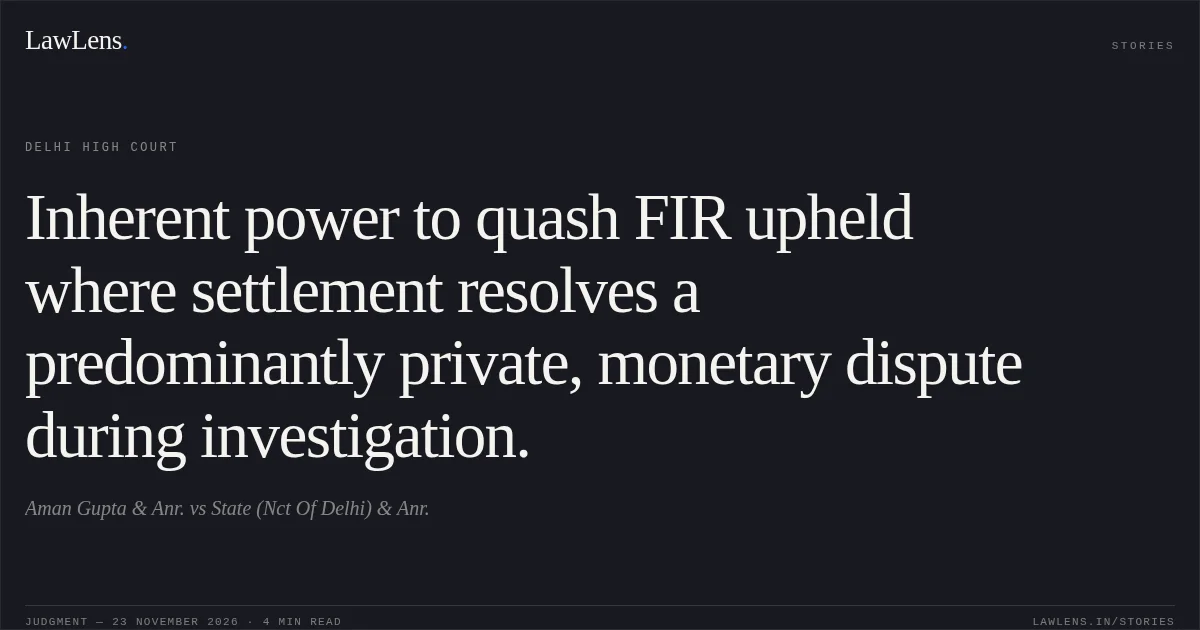
p. 1 / para. 3The petitioners filed this petition under Article 226 read with Section 528 BNSS seeking quashing of the FIR and all consequential proceedings on the basis of a settlement.
pp. 1–2 / para. 3Under a Settlement Agreement dated 20.05.2026, the petitioners agreed to deliver 100 gms of gold (30 gms on signing, 70 gms on filing the quashing petition) and to cooperate in recovering Rs. 4,90,000 from the complainant's customers.
pp. 2–3 / para. 5The complainant filed a no-objection affidavit stating that all dues were received and nothing further is payable.
p. 3 / para. 5The chargesheet is yet to be filed.
p. 3 / para. 5The petitioners and the complainant were identified by the IO, and the complainant confirmed, virtually, that the settlement was voluntary.
p. 3 / para. 6The Court noted that the offence under Section 316(4) BNS is compoundable with the permission of the Court under Section 359(2) BNSS.
p. 3 / para. 702Issues
i.1. Whether the FIR and all proceedings arising from an employer–employee dispute over misappropriated gold and cash may be quashed under inherent jurisdiction on the basis of a settlement between the accused and the complainant, where the investigation is pending and no chargesheet has been filed.
pp. 3–4 / para. 8 · p. 5 / para. 10ii.2. Whether the dispute, being predominantly private, monetary and civil in nature, falls within the category of cases where the High Court may quash criminal proceedings despite the gravity of the offence.
pp. 4–5 / para. 9 · p. 5 / para. 1003Law Applied
Section 528 BNSS preserves the High Court's inherent power to prevent abuse of process and secure the ends of justice, and Article 226 of the Constitution was invoked alongside it.
p. 1 / para. 3Section 316(4) BNS (criminal breach of trust by a clerk or servant) and Section 359(2) BNSS apply, under which the offence is compoundable with the Court's permission.
p. 3 / para. 7Gian Singh v. State of Punjab, (2012) 10 SCC 303 holds that inherent power to quash is distinct from statutory compounding, must be exercised to secure the ends of justice or prevent abuse of process, and must account for the nature and gravity of the offence; heinous or mentally depraved offences and offences under special statutes or by public servants cannot be quashed on compromise.
pp. 3–4 / para. 8Narinder Singh v. State of Punjab, (2014) 6 SCC 466 permits quashing of criminal cases with an overwhelmingly civil or commercial character, where the parties have fully settled, the possibility of conviction is remote and bleak, and continuation would cause oppression or injustice; where the settlement precedes the chargesheet and investigation is ongoing, the High Court may be liberal in accepting it.
pp. 4–5 / para. 9Provisions in the judgment · 6 · Linked ones open on LawLens
Bharatiya Nagarik Suraksha Sanhita, 2023 Section 528Section 359
Bharatiya Nyaya Sanhita, 2023 Section 316Section 3
Code of Criminal Procedure, 1973 Section 320Section 482
04Reasoning
The Court identified the dispute as arising from employment and concerning gold and cash entrusted to the petitioners in that capacity, and characterised it as "essentially private and monetary in nature".
p. 5 / para. 10This placed the case within the Narinder Singh category of cases with a predominantly civil or commercial flavour, rather than offences of mental depravity or offences against society.
pp. 4–5 / para. 9 · p. 5 / para. 10The Court assessed the settlement's bona fides and completeness: the complainant had confirmed the settlement voluntarily before the Court, the IO had identified the parties, and the complainant had filed a no-objection affidavit acknowledging receipt of all amounts and articles.
pp. 3 / paras. 5–6The settlement was reached before the chargesheet was filed and while investigation remained pending, a factor that Narinder Singh treats as favouring a liberal approach to quashing.
p. 5 / para. 10 · p. 5 / para. 9 (para. 29.7)Continuing the prosecution after full settlement would serve no purpose and would amount to an abuse of process, so the Court found no impediment to quashing.
p. 5 / para. 10The Court did not separately discuss the statutory compounding requirement under Section 359(2) BNSS, nor the status of the offence as one involving a servant's breach of trust.
p. 3 / para. 705Holding
The dispute was essentially private and monetary and was settled before the chargesheet was filed, so there was no impediment to quashing under Gian Singh and Narinder Singh.
p. 5 / para. 10The Court quashed FIR No. 1460/2025 dated 09.12.2025 (P.S. Karol Bagh, Sections 316(4)/3(5) BNS) and all proceedings emanating from it, directing that the parties remain bound by the Settlement Agreement dated 20.05.2026. The petition was disposed of accordingly.
p. 5 / para. 11 · p. 5 / para. 12Original Court PDF
Aman Gupta & Anr.vsState (Nct Of Delhi) & Anr.
Click to open original judgment
Original judgment, available to read, download and summarize on LawLens.in