01Facts
The petitioner sought quashing under Section 482 CrPC of FIR No. 216/2019 (PS Udyog Vihar, Gurugram), registered on 4 June 2019 under Sections 385/389/467/468/469/471/473/420/506/120B IPC, along with Criminal Case No. 6504/2022 pending before the MM, Patiala House Courts.
¶ 1The FIR arose from a complaint by Ashok Sehrawat, Chief General Manager of Indiabulls, alleging forgery, extortion, criminal intimidation and threats.
¶ 2.1The case was transferred to Delhi by the Supreme Court order dated 25 February 2021 in Transfer Petition (Crl.) No. 374/2020.
¶ 3The complainant's Authorised Representative filed a supporting affidavit, and an earlier affidavit by the former AR also appears on record.
¶ 4–5A Police Closure Report dated 28 August 2023 in respect of the other co-accused records no evidence against them and that no witness or other complainant has come forward.
¶ 6–9, 17The complainant (Respondent No. 2) stated, through counsel, that the parties had settled, that he does not wish to pursue the matter, and that he had applied before the Trial Court to that effect.
¶ 2.2, 10The affidavits state that the complaint was filed under a misconception of certain facts.
¶ 16Of more than 15 cross-cases between the parties, all have been settled except the present one.
¶ 11The State, through the APP, had no serious objection.
¶ 12The State counsel submitted that the allegations of forgery, extortion and criminal intimidation are serious.
¶ 13The petitioner had already been in custody for about 11 months.
¶ 2202Issues
i.1. Whether the FIR and consequential criminal proceedings for offences that are not compoundable and are alleged to involve forgery, extortion and criminal intimidation can be quashed under Section 482 CrPC on the basis of a settlement between the parties.
¶ 15, 18–20ii.2. Whether the gravity of the alleged offences and the State's objection preclude quashing, or whether the predominantly civil and private character of the dispute, together with the absence of evidence against co-accused, justifies quashing.
¶ 13–14, 17, 19–2103Law Applied
Section 482 CrPC preserves the High Court's inherent power to prevent abuse of process and secure the ends of justice, and can be invoked even for non-compoundable offences, distinct from compounding under Section 320 CrPC.
¶ 19, Parbatbhai · ¶ 16.1–16.2Following Gian Singh v. State of Punjab, (2012) 10 SCC 303, the High Court may quash proceedings on settlement where the offences predominantly carry a civil flavour (such as arising from civil, commercial, financial or similar transactions), where the continuation would be futile and the possibility of conviction is remote, but not for serious offences such as murder, rape, dacoity, or offences involving mental depravity or moral turpitude under special statutes.
¶ 18, Gian Singh · ¶ 58Under Parbatbhai Aahir v. State of Gujarat, (2017) 9 SCC 641, the court must weigh the nature and gravity of the offence, whether the dispute is essentially civil, and whether continuation would cause oppression or prejudice, with no exhaustive list of principles.
¶ 19, Parbatbhai · ¶ 16.3–16.9The Delhi High Court's decision in Deepak Kumar v. State (NCT of Delhi), 2024 SCC OnLine Del 1305, confirms that regard must be had to the nature and gravity of the offence and its impact on society.
¶ 20Provisions in the judgment · 11 · Linked ones open on LawLens
Code of Criminal Procedure, 1973 Section 482Section 320
Indian Penal Code, 1860 9 provisions
Section 385Section 389Section 467Section 468Section 469Section 471Section 473Section 420Section 50604Reasoning
The Court treated the complainant's affidavits, which state that the complaint arose from a misconception of facts, together with his consistent stance before the Court and the Trial Court, as establishing a genuine settlement.
¶ 15–16The Closure Report in respect of the co-accused, which records that no witness or further complainant has come forward, reinforced the conclusion that the prosecution has no realistic prospect of conviction.
¶ 17, 21The Court also noted that the case was one of more than 15 cross-cases, nearly all of which have been settled, indicating that the dispute is essentially inter-party and commercially or civilly rooted.
¶ 11Although the State highlighted the seriousness of the allegations, the Court evaluated the offences against the Gian Singh and Parbatbhai framework and found that they fell within the category of disputes with a predominantly civil character where settlement is material.
¶ 13–14, 18–19The Court held that continuing the trial would serve no useful purpose, and that the petitioner's prolonged custody of about 11 months weighed in favour of quashing.
¶ 21, 2205Holding
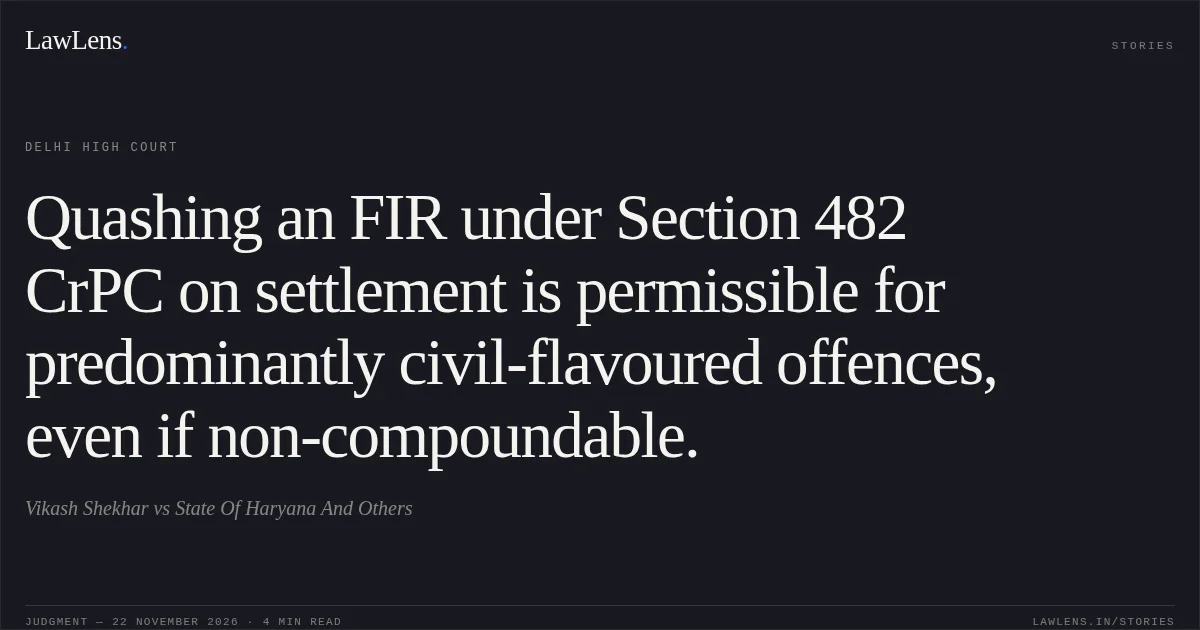
A settlement between the parties can justify quashing under Section 482 CrPC even for non-compoundable offences where the dispute is predominantly civil and no useful purpose would be served by continuing the trial.
¶ 19–21, 23The petition was allowed, and FIR No. 216/2019 (PS Udyog Vihar, Gurugram) along with all consequential proceedings, including CC No. 6504/2022 before the MM, Patiala House Courts, was quashed.
¶ 23–25The pending applications were disposed of.
¶ 25Original Court PDF
Vikash ShekharvsState Of Haryana And Others
Click to open original judgment
Original judgment, available to read, download and summarize on LawLens.in