01Facts
The petitioner sought directions under Section 528 of the BNSS for expeditious disposal of a case arising from FIR No. 369/2007 (dated 06.03.2007, PS Sultan Puri, North West Delhi), registered under Sections 468/471/420/120B IPC and pending before the CMM, Rohini Courts.
¶ 1The petitioner submitted that the proceedings had continued for almost two decades, causing hardship, mental agony, and financial burden.
¶ 2 / p.1–2Of 34 witnesses cited in the chargesheet, only 14 had been examined.
¶ 3 / p.2Charges were framed against respondent no. 2 on 06.11.2012, and the other accused were discharged.
¶ 4 / p.2Prosecution evidence commenced on 03.05.2013. The complainant's testimony began on 20.02.2015 and concluded on 16.09.2026.
¶ 5 / p.2The petitioner alleged no delay on the complainant's part and attributed the prolongation to adjournments sought by respondent no. 2.
¶ 6 / p.2The State, through the APP, contended that 20 of 34 witnesses remained to be examined, so the trial would take time, and did not oppose directions to expedite.
¶ 7–8 / p.202Issues
i.1. Whether the prolonged pendency of the trial, with 20 of 34 prosecution witnesses unexamined after nearly two decades, amounts to inordinate delay violating the accused's and the petitioner's right to a speedy trial under Article 21 of the Constitution.
¶ 9 / p.2 · ¶ 12–14 / p.3ii.2. Whether, in the circumstances, the Trial Court should be directed to expedite the proceedings and complete them within a fixed period.
¶ 15 / p.3–403Law Applied
Article 21 of the Constitution guarantees a right to a speedy trial as part of the right to life and personal liberty, extending to investigation, inquiry, and trial.
¶ 9 / p.2Section 309(1) CrPC, corresponding to Section 346 BNSS, requires proceedings to be held as expeditiously as possible.
¶ 9 / p.2Relying on Ranjan Dwivedi v. CBI, (2012) 8 SCC 495, although speedy trial is not expressly a fundamental right, the Supreme Court has consistently held that a "reasonably" expeditious trial is an integral and essential part of Article 21, a principle first recognised in Hussainara Khatoon (1980) 1 SCC 81.
¶ 10 / p.3Relying on Hussain v. Union of India, (2017) 5 SCC 702, timely delivery of justice is a human right, and denial of speedy justice threatens public confidence in the administration of justice.
¶ 11 / p.3Provisions in the judgment · 6 · Linked ones open on LawLens
Bharatiya Nagarik Suraksha Sanhita, 2023 Section 528Section 346
Indian Penal Code, 1860 Section 468Section 471Section 420
Code of Criminal Procedure, 1973 Section 309
04Reasoning
The Court first treated the speedy-trial guarantee as applicable to the entire criminal process, and then applied the record to that standard. The FIR dated 2007 had been pending for roughly two decades. Prosecution evidence began in 2013, yet 20 of 34 witnesses were still unexamined, and the complainant's deposition alone spanned over eleven years.
¶ 5, 9, 12 / p.2–3The Court also weighed the petitioner's personal circumstances, namely that she is a woman and a senior citizen aged about 63, who had suffered extensively from the prolonged proceedings. On this basis, the Court concluded that there had been inordinate delay in the trial.
¶ 13–14 / p.3The Court did not decide the allegation that the accused caused the adjournments, nor did it examine the merits of the charges. Its concern was the delay itself, and it addressed the remedy through a time-bound direction rather than by quashing or any other relief.
¶ 6, 14–15 / p.2–405Holding
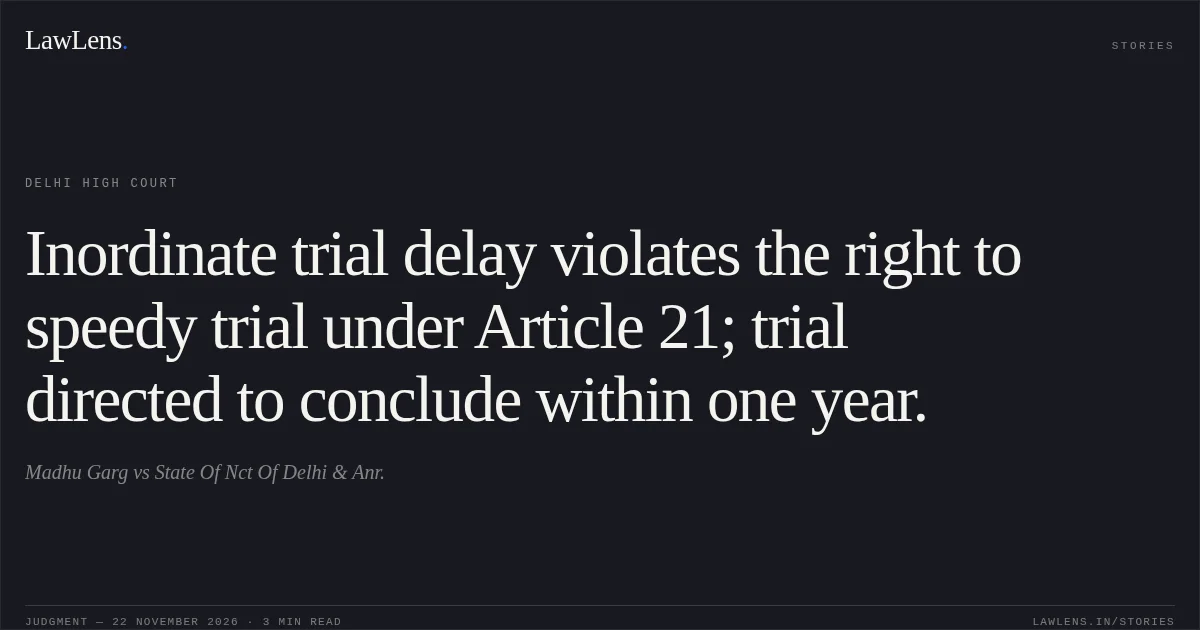
The trial had suffered inordinate delay in violation of the right to a reasonably expeditious trial under Article 21, as elaborated in Ranjan Dwivedi and Hussain.
¶ 9–14 / p.2–3The Trial Court was directed to expedite the trial in FIR No. 369/2007 and to complete it, preferably within one year. The petition and the pending application were disposed of accordingly.
¶ 15–17 / p.3–4Original Court PDF
Madhu GargvsState Of Nct Of Delhi & Anr.
Click to open original judgment
Original judgment, available to read, download and summarize on LawLens.in