01Facts
The petitioner sought regular bail under Section 483 BNSS (corresponding to Section 439 CrPC) in FIR No. 79/2016, PS Model Town, registered under Sections 365/302/201/202/212 IPC.
p. 1The trial (SC No. 59185/2016, Additional Sessions Judge-04, Rohini Courts) is at the prosecution evidence stage.
p. 2 · ¶ 2The petitioner had earlier filed four bail applications before the Trial Court, all dismissed, the latest on 08 August 2026.
p. 2 · ¶ 3The petitioner had earlier filed two bail applications before the High Court, dismissed on 12 September 2023 and 09 July 2024.
p. 2 · ¶ 4The prosecution case is that the petitioner, after a dispute over his impending marriage, strangled his 21-year-old acquaintance in his car, concealed her body in a ventilation shaft, and had the car washed on the advice of family members.
pp. 2-3 · ¶ 5.1-5.10The post-mortem report recorded asphyxia from ligature strangulation.
p. 3 · ¶ 5.8FSL found DNA matching the victim's blood on exhibits from the scene.
p. 3 · ¶ 5.11Charges under Sections 302/201 IPC were framed against the petitioner alone; four co-accused were discharged.
p. 4 · ¶ 5.13The petitioner relied on his poor background, two jail appreciation letters, no other cases, no risk of tampering, nearly eight years in custody, five witnesses still to be examined, and earlier interim bail during Covid-19 without misuse.
pp. 4-5 · ¶ 6.1-6.6The State opposed bail, citing the brutality of the offence, 28 of 33 witnesses examined, an imminent conviction, and a risk of harm to the victim's family, who live nearby.
p. 5 · ¶ 7.1-7.4The Legal Representatives of the victim made similar submissions on gravity, role, recovered evidence, and threat to witnesses.
pp. 5-6 · ¶ 8.1-8.502Issues
i.1. Whether the petitioner is entitled to regular bail pending trial in a case of alleged murder (Sections 302/201 IPC) involving a brutal, premeditated strangulation and concealment of the body, given the gravity of the offence and the role attributed to him.
pp. 6-7 · ¶ 10 · p. 10 · ¶ 12, 14ii.2. Whether the period of incarceration already undergone (over eight years), the good jail conduct, and the pendency of five witnesses justify bail despite the gravity of the offence.
pp. 8-9 · ¶ 11 · pp. 4-5 · ¶ 6.2, 6.5 · p. 10 · ¶ 14iii.3. Whether successive bail applications without any material change in circumstances warrant reconsideration.
p. 10 · ¶ 1303Law Applied
The court applied Section 483 BNSS (corresponding to Section 439 CrPC) as the statutory source of the power to grant regular bail.
p. 1 · ¶ 1Ajwar v. Waseem, (2024) 10 SCC 768, lists the factors for bail in serious offences: the nature of the accusations, the manner of commission, gravity, the accused's role, criminal antecedents, the risk of tampering with witnesses or repeating the offence, the likelihood of absconding, the risk of obstructing proceedings, and the overall desirability of bail.
pp. 6-7 · ¶ 10State of Karnataka v. Sri Darshan, (2026) 8 SCC 223, holds that prolonged incarceration does not by itself entitle an accused to bail where the offence is grave, and that post-bail conduct cannot cure an order passed without regard to gravity and the risk to witnesses.
pp. 8-10 · ¶ 11Sri Darshan follows State of U.P. v. Amarmani Tripathi, (2005) 8 SCC 21, and Kalyan Chandra Sarkar v. Rajesh Ranjan, (2004) 7 SCC 528, which hold that incarceration and delay alone do not warrant bail for severe offences, and that a vague threat of tampering is insufficient unless the accused's character or conduct shows a real risk.
pp. 8-9 · ¶ 11Provisions in the judgment · 13 · Linked ones open on LawLens
Bharatiya Nagarik Suraksha Sanhita, 2023 Section 483
Code of Criminal Procedure, 1973 Section 439
Indian Penal Code, 1860 11 provisions
Section 365Section 302Section 201Section 202Section 212Section 147Section 148Section 149Section 307Section 352Section 50404Reasoning
The court weighed the factors in Ajwar against the facts. It treated the case as serious because the petitioner allegedly strangled a young woman and concealed her body, and it noted that the offence is a grave one.
p. 10 · ¶ 12The court addressed the petitioner's third bail application, observing that the Trial Court had refused bail four times and that no material change in circumstances had occurred since those orders.
p. 10 · ¶ 13On custody, the court applied Sri Darshan and Kalyan Chandra Sarkar: more than eight years in custody, good jail conduct, and the pending five witnesses did not outweigh the gravity of a Section 302 charge.
pp. 8-9 · ¶ 11 · p. 10 · ¶ 14The court did not separately address the arguments on tampering, the family's apprehension, or the Covid-19 interim bail history, and it did not rely on the State's witness-based submissions or the Legal Representatives' synopsis beyond the seriousness of the allegations.
pp. 4-6 · ¶ 6.3-8.5 · p. 10 · ¶ 12-14The reasoning rests on gravity, the repeated refusals, and the absence of changed circumstances.
05Holding
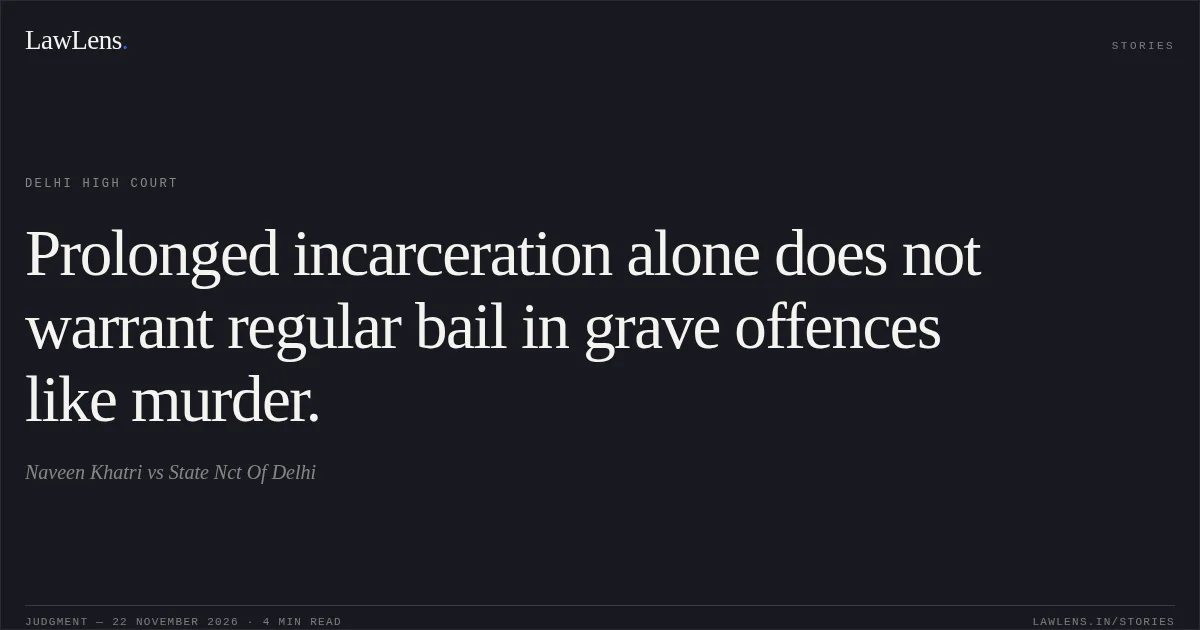
Given the gravity of the alleged offence, the serious allegations, the repeated refusals by the Trial Court and this Court, and the absence of any material change in circumstances, the case was not fit for regular bail.
p. 10 · ¶ 12-14The application for regular bail is dismissed.
p. 10 · ¶ 15The observations are confined to the bail application and do not express any opinion on the merits or affect the trial.
p. 10 · ¶ 16Original Court PDF
Naveen KhatrivsState Nct Of Delhi
Click to open original judgment
Original judgment, available to read, download and summarize on LawLens.in