Facts
The petitioner-hospital challenged separate Awards dated 6 January 2005 and 3 December 2004 passed by Industrial Tribunal-II in complaints under Section 33A of the Industrial Disputes Act, 1947 (“ID Act”) filed by Om Prakash and Chander Pal Singh, respectively.
Source reference: p.1, para.1Om Prakash had been appointed as a safai karamchari in 1974, while Chander Pal Singh had been appointed as a Helper-cum-Bearer in 1993.
Source reference: p.2, para.2Industrial Disputes Nos. 86/1998, 115/1998 and 11/1999 were pending when the workmen were removed from service and subsequently dismissed—Chander Pal Singh on 31 October 2000 and Om Prakash on 5 April 2000—without the management obtaining approval under the proviso to Section 33(2)(b) of the ID Act.
Source reference: pp.2–4, paras.3, 6–7The Tribunal held that the dismissals were non-est and inoperative for want of approval and directed reinstatement with continuity of service and full back wages.
Source reference: pp.3–4, paras.6–7In Chander Pal Singh’s case, the Tribunal also found the domestic enquiry vitiated because he had been denied representation by trade-union office-bearers.
Source reference: p.3, para.6During the writ proceedings, Chander Pal Singh was re-employed from 20 October 2008, while Om Prakash had superannuated, though the record contained inconsistent dates regarding his superannuation.
Source reference: pp.5, 11–14, paras.11–12, 24, 33–34Issues
1. Whether the pending proceedings constituted “industrial disputes” concerning the workmen so as to attract the protection and approval requirement under Section 33(2)(b) of the ID Act.
Source reference: pp.4–6, paras.9, 13, 19, 29–302. Whether the workmen’s dismissals, effected during the pendency of those disputes without an application for approval under Section 33(2)(b), were void, non-est and inoperative.
Source reference: pp.6–10, paras.16–173. Whether the Tribunal erred in granting reinstatement and full back wages without separately adjudicating the validity of the domestic enquiry and the justification for dismissal.
Source reference: pp.4–5, 10–11, paras.10, 21–224. What relief ought to be granted in view of Chander Pal Singh’s re-employment and Om Prakash’s subsequent superannuation.
Source reference: pp.11–14, paras.24–35Law Applied
Section 33 of the ID Act operates as a statutory safeguard preserving industrial peace during the pendency of an industrial dispute. Under the proviso to Section 33(2)(b), an employer seeking to discharge or dismiss a workman concerned in the pending dispute must pay one month’s wages and apply to the authority before which the dispute is pending for approval of the action; these requirements are mandatory.
Source reference: pp.6–8, para.16In Jaipur Zila Sahakari Bhoomi Vikas Bank Ltd. v. Ram Gopal Sharma, AIR 2002 SC 643, the Supreme Court held that dismissal without such approval is void, non-est and inoperative, and that the workman is deemed to have continued in service with consequential benefits; making no application, or withdrawing one before decision, constitutes contravention of Section 33(2)(b).
Source reference: pp.7–10, para.16Section 33A provides a mechanism for challenging a contravention of Section 33 before the authority adjudicating the pending dispute.
Source reference: pp.8–10, para.16In exercising jurisdiction under Articles 226 and 227 of the Constitution, the High Court does not function as an appellate court and ordinarily interferes only for patent perversity, findings based on no evidence, or conclusions which no reasonable tribunal could reach.
Source reference: p.6, para.15Reasoning
The Tribunal had recorded, on the basis of the record and admissions by the management witnesses, that the three industrial disputes were pending when the workmen were dismissed and that no approval application under Section 33(2)(b) had been filed.
Source reference: pp.3–4, 10–13, paras.6–7, 19, 29The High Court found no material demonstrating that the hospital was not a party to those disputes or that the workmen were not “concerned workmen”; the fact that references had been made and were pending was sufficient to attract the statutory protection.
Source reference: pp.10–13, paras.19–20, 29–30Applying Jaipur Zila, the Court held that the dismissals had no legal efficacy because the mandatory approval requirement had been ignored.
Source reference: pp.7–10, 16–17, 22The challenge based on the disciplinary enquiries also failed: in Chander Pal Singh’s case, the enquiry was independently found unfair because union representation had been denied.
Source reference: p.11, para.21In any event, once the dismissals were held void and inoperative for breach of Section 33(2)(b), reinstatement with consequential benefits followed as a legal consequence, and the Tribunal’s findings were not perverse or amenable to correction under Articles 226 and 227.
Source reference: pp.10–11, paras.21–22However, because Chander Pal Singh had already been re-employed and Om Prakash had superannuated, the Court considered lump-sum compensation preferable to further computation of disputed wages, increments, revisions and pensionary benefits.
Source reference: pp.11–14, paras.24–26, 33–34Holding
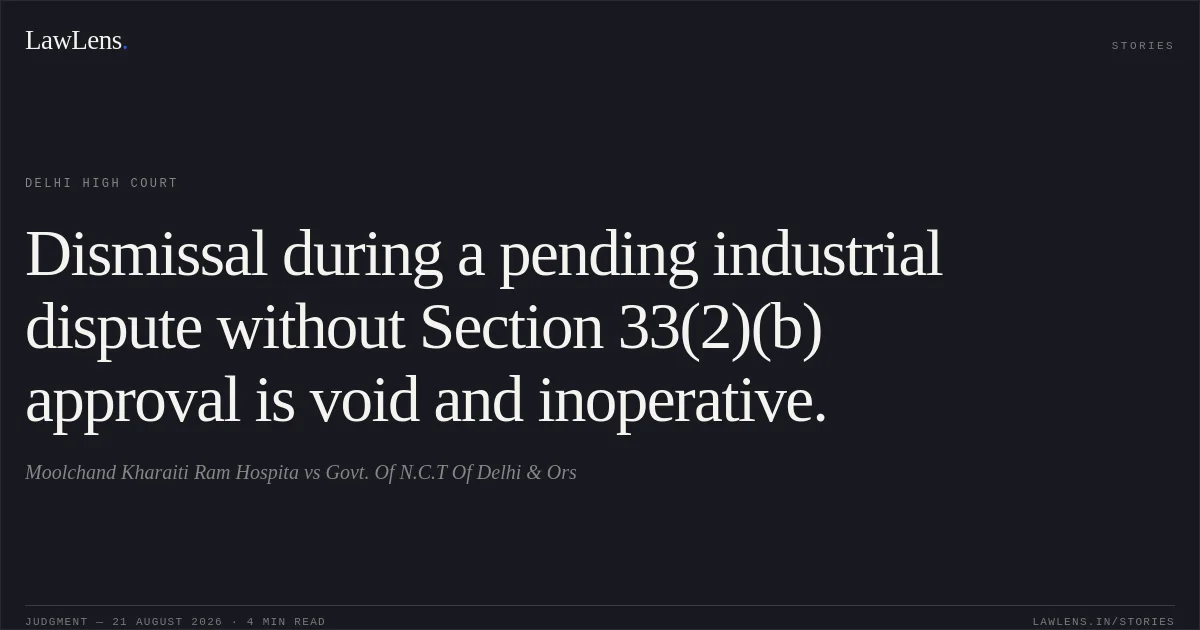
The High Court rejected the hospital’s challenge and upheld the Tribunal’s finding that both dismissals were void and inoperative for non-compliance with Section 33(2)(b) of the ID Act.
In W.P.(C) No. 21917/2005, concerning Chander Pal Singh, the Award was modified to provide a lump-sum payment of ₹2,00,000 towards full and final settlement of claims arising from the Award, payable within eight weeks; the hospital remained liable for any unpaid amount due under subsisting Section 17B/minimum-wage orders.
Source reference: pp.11–12, paras.24–28In W.P.(C) No. 21650/2005, concerning Om Prakash, reinstatement was treated as incapable of implementation due to his superannuation, and the Award was modified to provide ₹7,00,000 towards full and final settlement of claims arising from the Award, payable within eight weeks, subject to payment of any unpaid Section 17B/minimum-wage dues.
Source reference: pp.13–15, paras.33–36Both writ petitions and pending applications were disposed of accordingly.
Source reference: pp.12, 15, paras.28, 36Acts & Sections Cited
4 provisions across 1 statute referred to in this judgment. Linked provisions open on LawLens.
Industrial Disputes Act, 19474
Original Court PDF
Moolchand Kharaiti Ram HospitavsGovt. Of N.C.T Of Delhi & Ors
Click to open original judgment
Original judgment, available to read, download and summarize on LawLens.in