01Facts
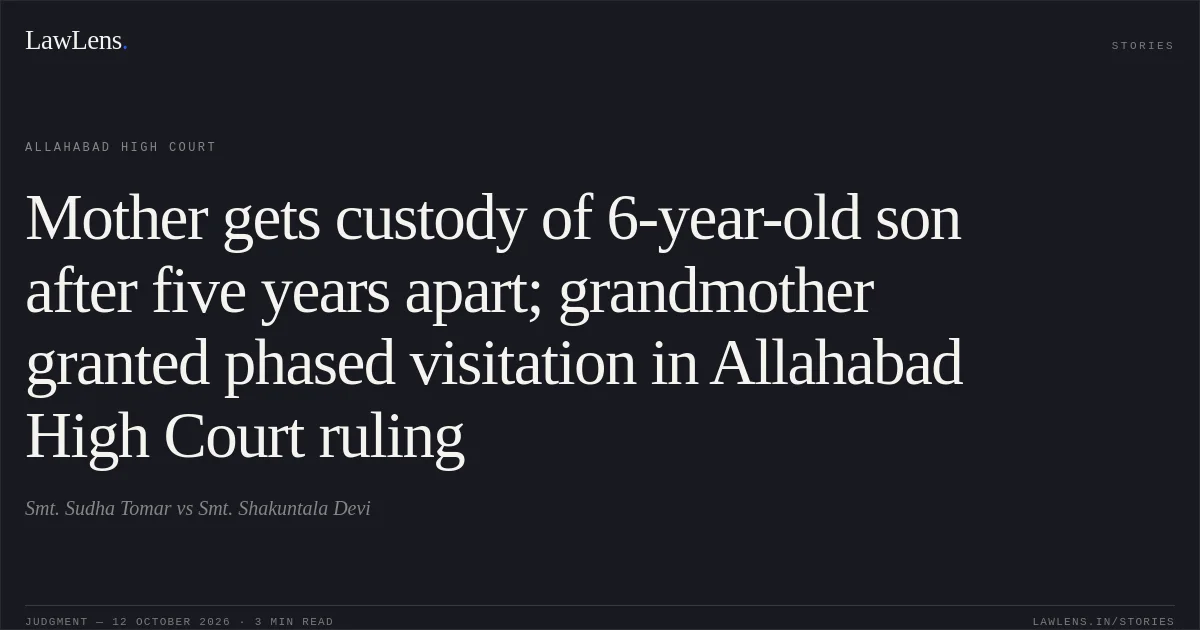
The parties married in 2007 and had two sons. In April 2016, the respondent father took the elder son, Yathartha, while the appellant mother remained with the younger son.
¶ 3–6, 20The father’s divorce petition was dismissed, and the mother’s petition for restitution of conjugal rights was decreed in 2022, but the father did not resume cohabitation.
¶ 3–6, 20In proceedings under Section 25 of the Guardians and Wards Act, 1890, the Family Court declined to grant the mother custody and provided her visitation rights by judgment dated 23 July 2024.
¶ 2, 18The mother appealed.
The High Court noted that the father had not complied with the visitation order, had evaded service in the appeal, and had not entered the witness box for cross-examination; his evidence at trial was essentially an affidavit, with no other evidence establishing the child’s welfare, education, or living circumstances.
¶ 9, 17–19, 39–4202Issues
i.1. Whether the child’s welfare required custody to be transferred from the father to the mother, having regard to the parties’ conduct and the circumstances of the child’s care.
¶ 22–25, 46–47ii.2. Whether the Family Court could rely on the father’s untested affidavit and refuse custody to the mother principally because she lacked independent income.
¶ 36–4203Law Applied
Section 25 of the Guardians and Wards Act, 1890 permits an order for a ward’s return only where the court considers that return to be in the ward’s welfare; the child’s welfare, rather than parental rights, is paramount.
¶ 23–25The Court relied on Mausami Moitra Ganguli v. Jayant Ganguli, (2008) 7 SCC 673, Sheoli Hati v. Somnath Das, (2019) 7 SCC 490, Rosy Jacob v. Jacob A. Chakramakkal, (1973) 1 SCC 840, and Gaurav Nagpal v. Sumedha Nagpal, (2009) 1 SCC 42, for the principles that welfare includes the child’s physical, moral, educational, and developmental interests, and that a parent cannot benefit from retaining custody through disobedience of court orders.
¶ 26–29, 35Financial resources are relevant but not determinative of custody.
¶ 26, 37Under Section 14 of the Family Courts Act, 1984, Family Courts may receive material outside the strict rules of evidence, but must observe basic fairness and natural justice; the opportunity for effective cross-examination is part of those requirements, as explained in Ayaaubkhan Noorkhan Pathan v. State of Maharashtra, (2013) 4 SCC 465.
¶ 41–43Athar Hussain v. Syed Siraj Ahmed was cited for the proposition that a parent’s second marriage is a relevant, though not conclusive, custody consideration.
¶ 45Provisions in the judgment · 10 · Linked ones open on LawLens
Family Courts Act, 1984 Section 19Section 14
Guardians and Wards Act, 1890 Section 47Section 25Section 17
Hindu Marriage Act, 1955 Section 13Section 9
Hindu Minority and Guardianship Act, 1956 Section 13
Code of Criminal Procedure, 1973 Section 97Section 125
04Reasoning
The High Court found that the Family Court had not adequately assessed the child’s welfare: it relied on the mother’s lack of independent income while the record contained no meaningful evidence about the father’s income, the child’s education, or his overall well-being.
¶ 36–40It also treated the mother’s lack of contact with the child as adverse to her, although the Court found that the father had prevented contact and had flouted the visitation order.
¶ 18–19, 33–35The father’s non-compliance with court orders, evasion of proceedings, and the evidence of his second marriage were relevant to assessing the child’s welfare.
¶ 30–32, 44–46Further, reliance on the father’s affidavit without his being available for cross-examination was contrary to natural justice.
¶ 40–43On the full record, the Court concluded that the child’s welfare would be better served in the mother’s care.
¶ 4705Holding
The appeal was allowed, and the Family Court’s judgment dated 23 July 2024 was set aside.
¶ 48The father was directed to hand over Yathartha’s custody to the mother within one month.
¶ 48The father was granted visitation every Saturday from 3:00 p.m. to 5:00 p.m. at the premises of the District Legal Services Authority, Varanasi, with liberty for either party to seek modification of visitation arrangements from the Trial Court.
¶ 49Original Court PDF
Priti SharmavsPraveen Prakash Sharma
Click to open original judgment
Original judgment, available to read, download and summarize on LawLens.in