01Facts
The Special Land Acquisition Officer, National Highway Authority (Respondent No. 2), lodged a complaint dated 17.06.2020 alleging that Re-survey No. 57/2, though agricultural land, was falsely shown as converted to non-agricultural use.
¶ 3It was alleged that the petitioner produced a false conversion document to obtain higher compensation, and that she failed to repay the excess despite repeated demands.
¶ 3Crime No. 32/2020 was registered at RMC Yard Police Station, Davanagere, under Sections 465, 468, 471 and 420 IPC.
¶ 3The petitioner sought quashing under Section 482 CrPC. She contended that the FIR was registered belatedly, after more than nine years.
¶ 4She relied on a Davanagere Mahanagara Palike resolution dated 29.01.2011, which held the property not converted and cancelled its khata numbers. She argued that the resolution was never communicated to her and that she was not heard before it was passed.
¶ 4The Court had earlier directed production of the conversion order. Counsel for the petitioner stated he could not obtain it, and the order was not produced even at the final hearing.
¶ 5, 8Respondent No. 2 maintained that no conversion had occurred and that the petitioner had fabricated the document and produced it before the Arbitrator.
¶ 6The Additional SPP submitted that the petitioner could produce any conversion order before the Investigating Officer.
¶ 702Issues
i.1. Whether the FIR under Sections 465, 468, 471 and 420 IPC should be quashed under Section 482 CrPC where the complaint alleges fabrication of a conversion order to obtain higher compensation, and the petitioner relies on delay, a non-communicated municipal resolution and a claimed lack of hearing as grounds for quashing.
¶ 8ii.2. Whether the complaint discloses the commission of a cognizable offence, such that the High Court should not exercise its inherent power to quash the FIR.
¶ 8 · ¶ 903Law Applied
Section 482 CrPC, which preserves the High Court's inherent power to quash proceedings.
Dineshbhai Chandubhai Patel v. State of Gujarat, (2018) 3 SCC 104, at para. 30, for the principle that the High Court should not quash an FIR where the complaint discloses the commission of an offence.
¶ 9The ingredients of Section 471 IPC (using a forged document as genuine) are attracted where a fabricated document is used before an Arbitrator, particularly in conjunction with Sections 420 (cheating) and 468 IPC (forgery for cheating).
¶ 8Whether the impugned document is genuine is a question of fact for investigation, not for determination at the quashing stage.
¶ 8 · ¶ 9Provisions in the judgment · 5 · Linked ones open on LawLens
Code of Criminal Procedure, 1973 Section 482
Indian Penal Code, 1860 Section 465Section 468Section 471Section 420
04Reasoning
The petitioner had not produced the conversion order despite repeated opportunities, so the foundation of her defence remained unproven.
¶ 8The complaint made a specific accusation of creating and fabricating a document and using it before the Arbitrator to obtain higher compensation.
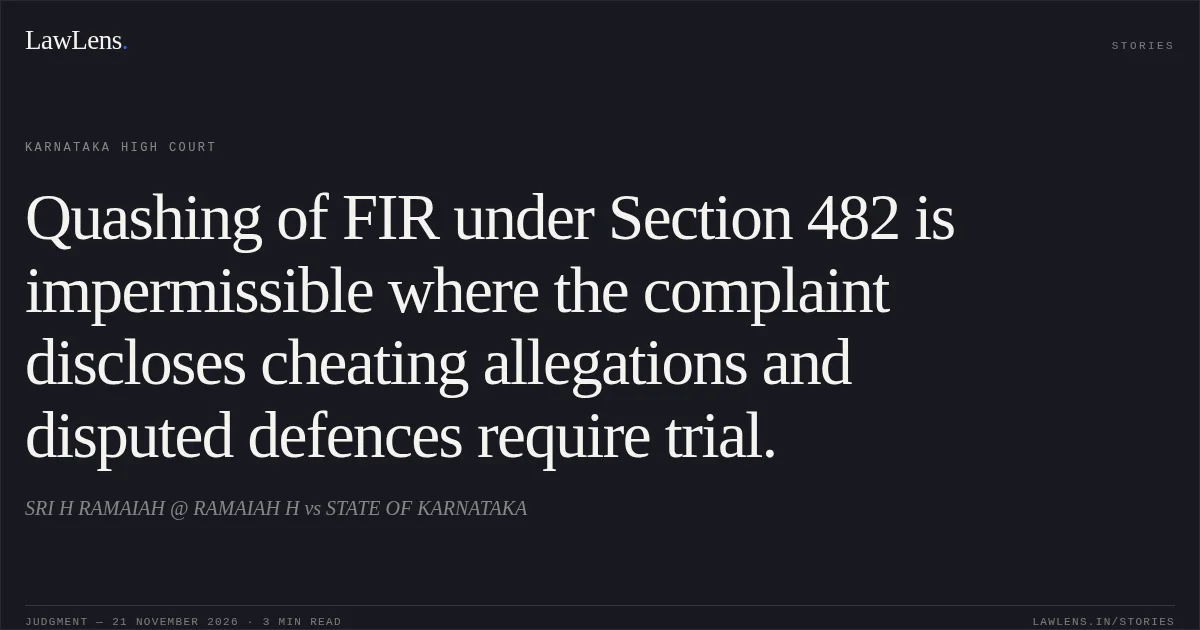
¶ 6 · ¶ 8Because these allegations, on their face, disclosed the ingredients of Sections 471, 420 and 468 IPC, the bar in Dineshbhai applied and quashing was impermissible.
¶ 9The petitioner's objections on delay, the 2011 resolution and lack of notice were treated as matters of defence, to be examined by the investigating agency, and were not grounds for quashing at this stage.
¶ 4 · ¶ 9The Court accepted the State's suggestion that the petitioner could place any genuine conversion order before the Investigating Officer, whose findings would determine whether a B or A report is filed.
¶ 7 · ¶ 905Holding
The complaint disclosed cognizable offences under Sections 420, 468, 471 and 465 IPC, and there was no ground to quash the FIR.
¶ 9The criminal petition was dismissed. The investigation in Crime No. 32/2020 shall proceed. If the petitioner produces a valid conversion order before the Investigating Officer, a B report may follow. If no such order is produced, an A report may be filed.
¶ 9 · ¶ 10The Court expressed no opinion on the merits of the allegations.
Original Court PDF
SMT. GEETHA SHIVAMURTHIvsSTATE OF KARNATAKA
Click to open original judgment
Original judgment, available to read, download and summarize on LawLens.in