01Facts
The de facto complainant (R2) runs business as M/s. Technics Industries. In 2021, the petitioner was introduced to him through his father-in-law.
The petitioner allegedly proposed merging the complainant's business (run by his wife and mother-in-law as M/s. GASP Engineering Pvt. Ltd.) with the petitioner's company, M/s. Newtech Precision Products Pvt. Ltd., assuring loan repayment, 35% shareholding, Rs. 2,50,000 monthly remuneration, and other benefits for a payment of Rs. 3 crores.
p. 2Relying on these assurances, the complainant transferred Rs. 3,28,80,002 to the petitioner's company, but the promised 38% shareholding was not transferred.
pp. 2–3A Memorandum of Understanding was executed after mediation, which the complainant considered unreasonable.
p. 3The petitioner then leased the complainant's premises for his company, paid Rs. 20,00,000 as advance, and agreed to Rs. 10,00,000 monthly rent, but defaulted on rent and electricity charges.
p. 3When the complainant visited on 23.06.2024, he found machinery missing; he was told that valuable components had been removed and sold and that the premises were under the petitioner's control.
pp. 3–4On 06.07.2024, he learned that further machinery had been shifted to another plant.
p. 4Alleging cheating and misappropriation, he lodged a complaint, leading to Crime No. 111 of 2025 under Sections 406 and 420 IPC.
p. 4The petitioner sought quashing under Section 528 BNSS, contending innocence and a baseless FIR.
p. 4The APP stated that investigation was almost complete and only the final report remained to be filed.
p. 5, para 502Issues
i.1. Whether the FIR in Crime No. 111 of 2025 for offences under Sections 406 and 420 IPC discloses a cognizable offence such that it should be quashed at the threshold under Section 528 BNSS.
p. 5, para 7ii.2. Whether allegations that are predominantly of a civil or commercial nature bar criminal proceedings and justify quashing of the FIR.
pp. 5–6, para 803Law Applied
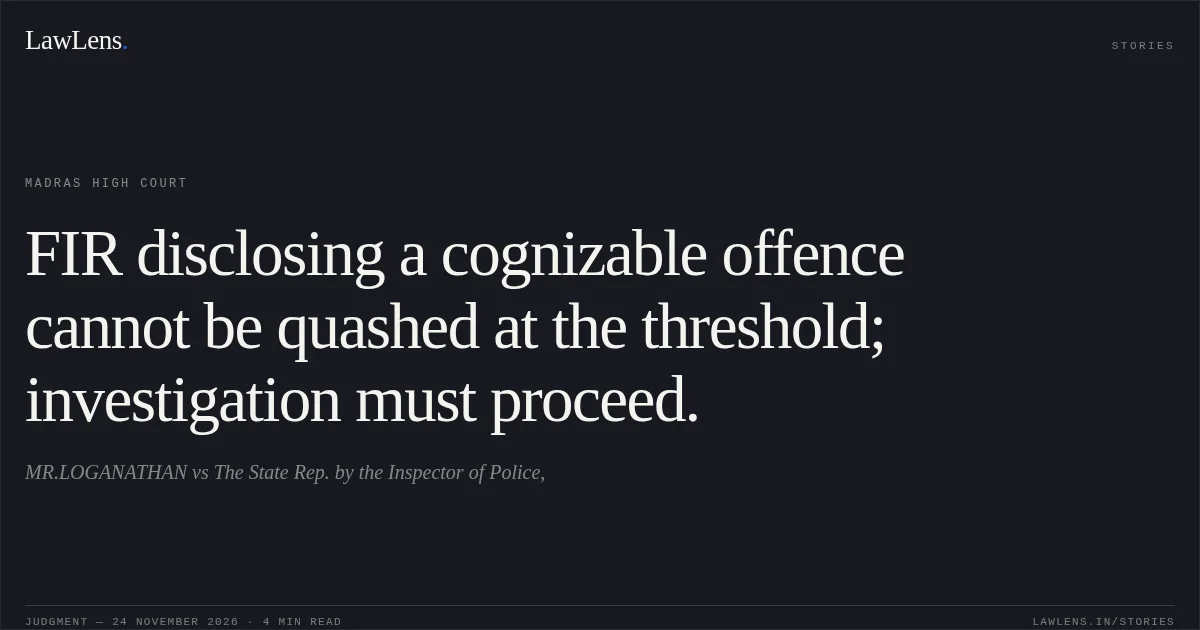
An FIR is not an encyclopaedia and need not contain all facts, and it cannot be quashed at the threshold where it discloses a prima facie cognizable offence, in which case the investigating machinery must be allowed to act.
p. 5, para 7Sau. Kamal Shivaji Pokarnekar v. State of Maharashtra (2019) 14 SCC 350: quashing is warranted only where the complaint does not disclose any offence or is frivolous, vexatious, or oppressive; a criminal complaint cannot be quashed merely because the allegations appear civil in nature; and if the ingredients of the offence are prima facie made out, proceedings should not be interdicted.
pp. 5–6, para 8M/s. Neeharika Infrastructure Pvt. Ltd. v. State of Maharashtra (2021 SCC OnLine SC 315): criminal proceedings should not be scuttled at the initial stage, quashing is an exception, courts should not examine the merits of FIR allegations while investigation is pending, and at the quashing stage the court need only determine whether the FIR discloses a cognizable offence.
pp. 6–8, para 9The Neeharika principles were framed under the corresponding Section 482 Cr.P.C., and the Court noted this although the petition was filed under Section 528 BNSS.
pp. 6–7, para 9Provisions in the judgment · 4 · Linked ones open on LawLens
Bharatiya Nagarik Suraksha Sanhita, 2023 Section 528
Indian Penal Code, 1860 Section 406Section 420
Code of Criminal Procedure, 1973 Section 482
04Reasoning
The Court examined the FIR and found specific allegations against the petitioner, including inducement through assurances, receipt of Rs. 3.28 crores, non-transfer of promised shares, unauthorised removal and sale of machinery, and shifting of equipment, which required in-depth investigation.
p. 5, para 7Applying the Neeharika test, the Court held that it was not required to assess the merits of the defence or whether the allegations would ultimately lead to conviction, and that the petitioner's claim of innocence could not be adjudicated at this stage.
pp. 7–8, para 9Relying on Kamal Shivaji Pokarnekar, the Court rejected the implicit contention that the dispute was civil in nature, because the existence of a civil dispute alone does not bar a criminal prosecution where the ingredients of the offence are prima facie made out.
pp. 5–6, para 8Because the FIR disclosed a prima facie cognizable offence, the Court declined to interfere with the investigation. Given that the crime was registered in 2025 and investigation was almost complete, the Court directed time-bound completion and directed the police to consider the complainant's documents, consistent with the investigative autonomy recognised in Neeharika.
pp. 8, paras 10–1105Holding
The FIR in Crime No. 111 of 2025 discloses a prima facie cognizable offence under Sections 406 and 420 IPC and is not quashed at the threshold.
p. 8, para 10The 1st respondent is directed to complete the investigation and file a final report before the jurisdictional Magistrate within 12 weeks of receipt of the order, if not already filed; the police are further directed to consider all relevant documents produced by the de facto complainant (R2). The Criminal Original Petition is dismissed and the connected Crl.M.P. is closed.
pp. 8, paras 10–12Original Court PDF
MR.LOGANATHANvsThe State Rep. by the Inspector of Police,
Click to open original judgment
Original judgment, available to read, download and summarize on LawLens.in