01Facts
On 02.03.2021, the 2nd respondent, a Village Administrative Officer, noticed two political party flagpoles erected in a public place near the Kaliyappagoundanpudur Bus Stop.
p. 2He allegedly did so in violation of the Model Code of Conduct, which took effect on 26.02.2021 for the 2021 Tamil Nadu Legislative Assembly election.
p. 2He identified the petitioners, an Organising Secretary of a political party and a union coordinator of another, as the persons responsible.
p. 2He photographed the flagpoles, and his written complaint with four printed photographs led to Crime No. 107 of 2021 under Section 188 IPC and Section 4(1) of the Tamil Nadu Open Places (Prevention of Disfigurement) Act, 1959.
p. 2After investigation, a charge sheet was filed before the Judicial Magistrate No. I, Pollachi, and cognizance was taken in S.T.C. No. 3477 of 2023.
pp. 2–3The petitioners contended that they were falsely implicated, that the right to assemble and express views under Article 19 is restricted only through fair procedure, that Section 195(1)(a) CrPC bars cognizance of Section 188 IPC offences absent a public servant's written complaint, and that there was no material showing they erected the flagpoles or did so without the owner's written consent.
p. 3The State contended that Section 188 IPC is cognizable, so the police may register an FIR and investigate even though cognizance is barred.
p. 402Issues
i.1. Whether the registration of a case under Section 188 IPC by the police is permissible in law, given the bar under Section 195(1)(a)(i) CrPC.
p. 5 · ¶ 7ii.2. Whether the prosecution under Section 4(1) of the Tamil Nadu Open Places (Prevention of Disfigurement) Act, 1959 can be sustained on the allegations, where the only material is the erection of political flagpoles in a public place.
pp. 9–11 · ¶ 9–1003Law Applied
Section 188 IPC penalises disobedience of an order promulgated by a lawfully empowered public servant that causes or tends to cause obstruction, annoyance, or injury, or danger, riot, or affray.
pp. 5–6Section 195(1)(a)(i) CrPC provides that no court may take cognizance of offences under Sections 172–188 IPC except on the written complaint of the concerned public servant or a superior public servant.
pp. 6–7Jeevanandham v. State rep. by Inspector of Police, Karur (2018) 2 L.W. (Crl.) 606 holds that a police officer cannot register an FIR for offences under Sections 172–188 IPC; the police role is confined to preventive action under Section 41 CrPC, followed by referral to the public servant for a written complaint; and the complaint must disclose the statutory ingredients.
pp. 7–9 · ¶ 25(a)–(d), (g)Mahaboob Basha v. Sambanda Reddiar, 1994 (1) Crimes 477, cited by the petitioners, was also referred to by the Court.
p. 6Under Section 4(1) of the 1959 Act, the offence requires an advertisement affixed or exhibited on a place open to public view without the written consent of the owner, occupier, or person in management of the property.
p. 9Provisions in the judgment · 22 · Linked ones open on LawLens
Bharatiya Nagarik Suraksha Sanhita, 2023 Section 528
Indian Penal Code, 1860 17 provisions
Section 172Section 173Section 174Section 175Section 176Section 177Section 178Section 179Section 180Section 181Section 182Section 183Section 184Section 185Section 186Section 187Section 188Tamil Nadu Open Places (Prevention of Disfigurement) Act, 1959 Section 4
Code of Criminal Procedure, 1973 Section 195Section 41
Police Act, 1861 Section 30
04Reasoning
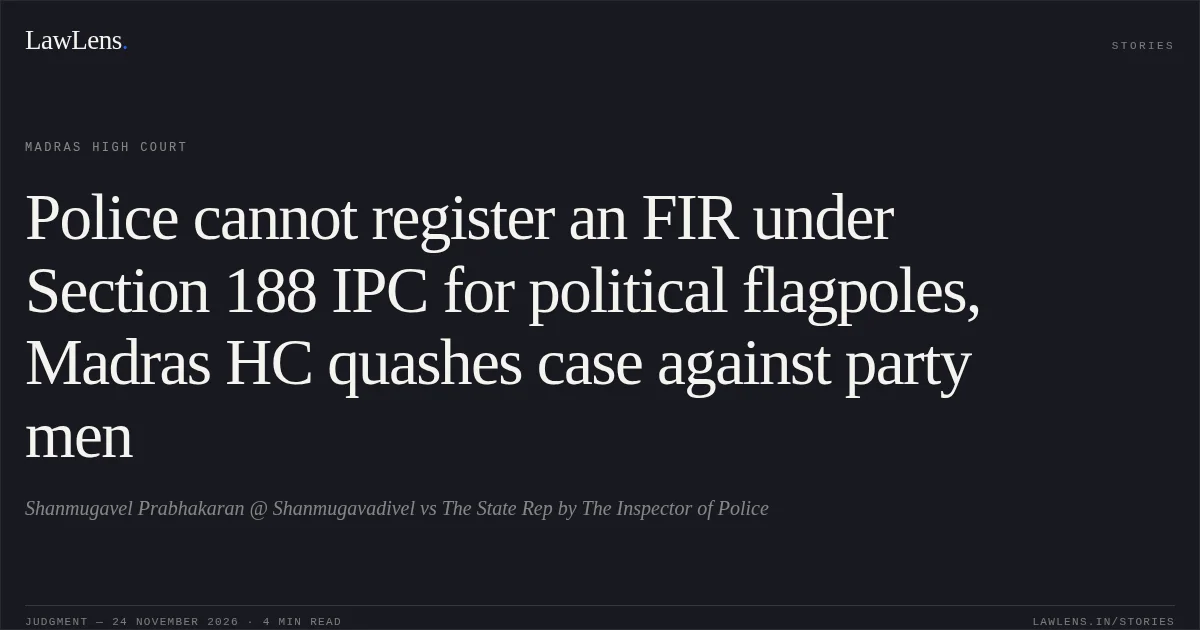
Applying Section 195(1)(a)(i) CrPC and the Jeevanandham guidelines, the Court held that the police were not competent to register an FIR for the Section 188 IPC offence. The FIR was founded on the Village Administrative Officer's complaint, so the Section 188 charge was legally unsustainable at its inception, and the proceedings on that count were liable to be quashed.
¶ 10The Court did not examine the merits of the Section 188 ingredients.
On Section 4(1), the Court held that the allegation that political flagpoles were erected in a public place, in violation of the Model Code of Conduct, does not by itself constitute an "advertisement" under the Act. The prosecution had to show that the display fell within the statutory definition, that it was exhibited without the written consent of the owner or occupier, and that there was specific material linking the petitioners to the act.
p. 10 · ¶ 9The record contained no such material, so the Section 4(1) prosecution could not be sustained. The Court therefore quashed the proceedings against the petitioners as a whole.
¶ 10Its reasoning on the Section 4(1) count rests on the absence of ingredients and specific evidence of involvement, not on the Section 195 bar.
05Holding
Registration of the Section 188 IPC case by the police was impermissible under Section 195(1)(a)(i) CrPC and the Jeevanandham guidelines.
¶ 7, 9–10The Section 4(1) Tamil Nadu Open Places Act charge lacked the necessary ingredients and specific material against the petitioners.
¶ 9–10The Criminal Original Petition is allowed, and S.T.C. No. 3477 of 2023 on the file of the Judicial Magistrate No. I, Pollachi, is quashed in its entirety. Connected miscellaneous petitions are closed.
¶ 11The order is to be communicated to the Judicial Magistrate No. I, Pollachi; the Inspector of Police, Anamalai Police Station; and the Public Prosecutor.
p. 11Original Court PDF
Shanmugavel Prabhakaran @ ShanmugavadivelvsThe State Rep by The Inspector of Police
Click to open original judgment
Original judgment, available to read, download and summarize on LawLens.in