01Facts
The petitioner, a public-health non-profit, sought a mandatory interpretive Front-of-Package Nutrition Labelling (FoPNL) regime, preferably a warning label, for packaged foods high in saturated fat, sugar and salt.
¶ 5–6The FSSAI (Respondent No. 4) had published a 2022 draft amendment to the Labelling and Display Regulations, 2020, proposing a star-rating (INR) format, which drew about 14,000 comments.
¶ 8–9On 09.04.2025 the Court disposed of the writ petition, directing the Expert Committee to report within three months.
¶ 11The Expert Committee's report of 08.10.2025 found no stakeholder consensus on the INR format and favoured interpretive labels, including warning labels.
¶ 13–15The Committee of Secretaries then recommended withdrawal of the 2022 draft.
¶ 16The FSSAI's substitute 2025 draft, which proposed only bolding nutrient values at the back of the pack, was found unrelated to FoPNL.
¶ 17–18The FSSAI then proposed displaying DGI 2024 daily limits on the front of the pack, which the petitioner contended was not an FoPNL.
¶ 21–22Following the Court's orders of 10.02.2026 and 13.08.2026, the FSSAI proposed a red-hexagon warning label.
¶ 23–24The Court's order of 10.09.2026 raised specific queries, and the FSSAI and petitioner filed responses.
¶ 123, 130–131The FSSAI proposed a single-phase approach with a four-month regulatory process and a 365-day voluntary transition period.
¶ 190, 193The petitioner sought a time-bound mandamus and specific directions on label design.
¶ 26(i)02Issues
i.1. Whether the right to health, the right to food, and the right to make an informed choice under Article 21 impose a positive obligation on the State to adopt regulatory measures such as an FoPNL.
¶ 27(i) · ¶ 111ii.2. Whether the FoPNL proposed by the FSSAI suffers from deficiencies in its broad aspects that would undermine the very objective of bringing an FoPNL into force.
¶ 27(ii) · ¶ 131–13203Law Applied
The Court relied on Article 21 of the Constitution, read with Article 47 (duty to raise nutrition and improve public health), as encompassing the right to health, safe and nutritious food, and informed choice.
¶ 73–77, 88–96, 111The Court drew on the ICESCR (Articles 2, 11 and 12) and General Comments 3, 12 and 14, which impose duties to respect, protect and fulfil, and minimum core obligations.
¶ 55–71Under Kesavananda Bharati and Vishaka, Article 21 is to be interpreted in conformity with international law.
¶ 72Precedents on the State's duty to protect health and regulate third parties include Vincent Panikurlangara, Paschim Banga Khet Mazdoor Samity, CPIL (2013), Swami Achyutanand Tirth, the Arjun Gopal series and M.C. Mehta (2019).
¶ 77, 80–83, 91, 101Under the Food Safety and Standards Act, 2006, Section 16 requires the FSSAI to ensure safe and wholesome food and to specify labelling standards.
¶ 105Section 18 mandates protection of consumer interests and informed choice, proportionality, and consideration of international standards under Section 18(2)(a)(ii).
¶ 104, 107, 133, 195Regulations 4(3), 4(7) and 6 of the 2020 Regulations require labels to be clear, prominent and legible under normal conditions of purchase.
¶ 163, 181The Court framed its role as a facilitator and balancer, not an adversary, relying on Bandhua Mukti Morcha and Ashwani Kumar.
¶ 122, 126–128Provisions in the judgment · 4 · Linked ones open on LawLens
Food Safety and Standards Act, 2006 Section 16Section 18Section 23Section 92
04Reasoning
The Court first located FoPNL within the "upstream" population strategy and the stewardship model of public health, reasoning that the food environment and informational asymmetry drive NCD incidence.
¶ 29–49The Court held that the FSSAI's own 2022 proposal and the Union's recognition of FoPNL as necessary established that an interpretive FoPNL is a reasonable means of realising Article 21 rights, which imposes a concomitant duty to ensure the framework is capable of effective implementation.
¶ 111–112The Court then assessed the FSSAI's proposal against its objective of prominent, at-a-glance, accessible information. It held that the nutrient set should be "total sugars" and "saturated fat" with salt, because the "added sugar" and "added fat" criteria were unverifiable, had no international counterpart and lacked justification beyond the DGI 2024.
¶ 137–141Thresholds calculated on added-nutrient bases could not be carried over and had to be recalibrated so that they were neither too low (label fatigue) nor too high (under-inclusion).
¶ 142–144On format, the Court found that text alone excluded low-literacy and non-English-speaking consumers, so pictograms combined with text were "absolutely necessary."
¶ 149–160The Court held that a single combined hexagon would reduce legibility and mislead consumers, so separate hexagons were required.
¶ 161–169Size had to be proportionate to the principal display panel, with reference to international practice of about 4–5% per warning.
¶ 170–179The Court rejected reliance on the Canadian model and found that using the same hexagon for beverage categories would dilute the warning.
¶ 171–173, 187–189The 365-day voluntary transition was accepted as consistent with Section 18(1)(d) proportionality, subject to strict monitoring against misuse and stockpiling.
¶ 195–200The Court also required monitoring of additive-driven reformulation under Section 18(2)(a)(ii)-type concerns and a robust exemption list.
¶ 202–209Finally, the Court required the authorities to implement nutritional literacy measures in practice, not only in theory.
¶ 210–221The Court stressed that its directions did not displace the statutory rule-making process under Section 92.
¶ 12905Holding
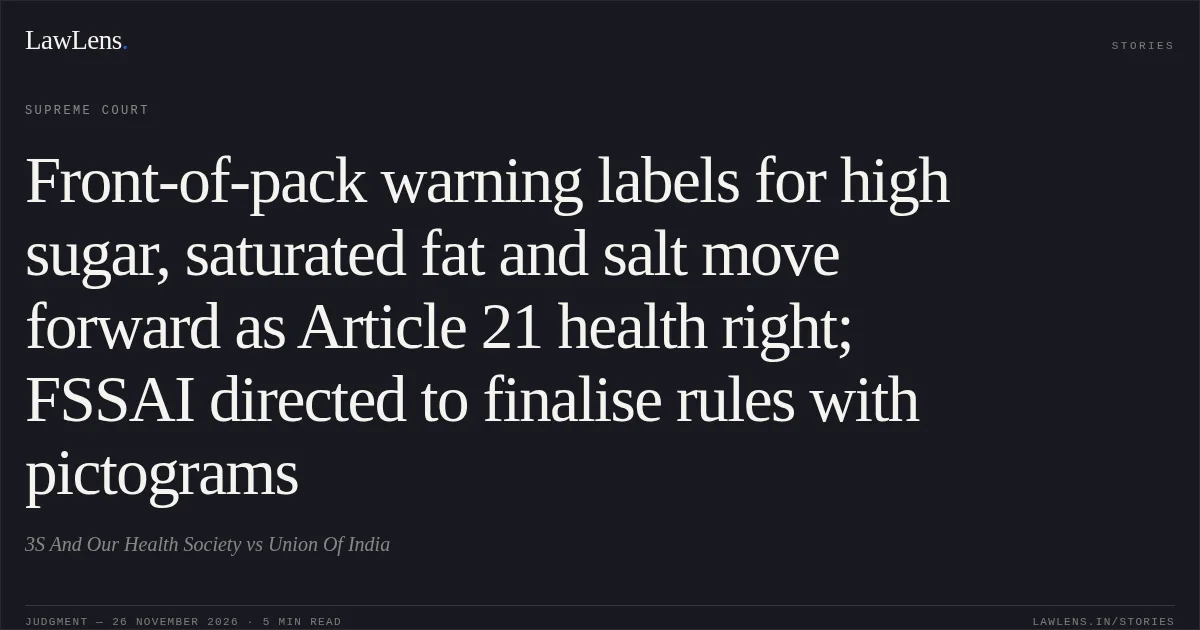
The Court answered Issue 1 in the affirmative: Article 21, read with Article 47 and the ICESCR framework, imposes positive obligations on the State to adopt regulatory measures such as an interpretive FoPNL, and such a measure is reasonable.
¶ 111–112, 222On Issue 2, the Court held that the proposal, in its present form, would undermine the FoPNL's objective. It directed the FSSAI to: (a) adopt "total sugars" and "saturated fat" alongside salt and recalibrate thresholds on evidence; (b) use a standardised pictogram with text in separate hexagons for each nutrient, sized in proportion to the display panel (about 4–5%) with legible font; (c) avoid look-alike labels for beverage categories; (d) finalise a robust exemption list; (e) monitor additive-driven reformulation; (f) bring the regulations into force within its proposed timeline; (g) prevent misuse of the 365-day transition period, with no ordinary extensions; and (h) ensure implementation of the school food regulations and nutritional literacy measures.
¶ 222The Registry was directed to list the matter after ten weeks for a progress affidavit, with the matter treated as part-heard, and a copy was to be forwarded to the Principal Secretary, Ministry of Health and Family Welfare.
¶ 223–224Original Court PDF
3S And Our Health SocietyvsUnion Of India
Click to open original judgment
Original judgment, available to read, download and summarize on LawLens.in