01Facts
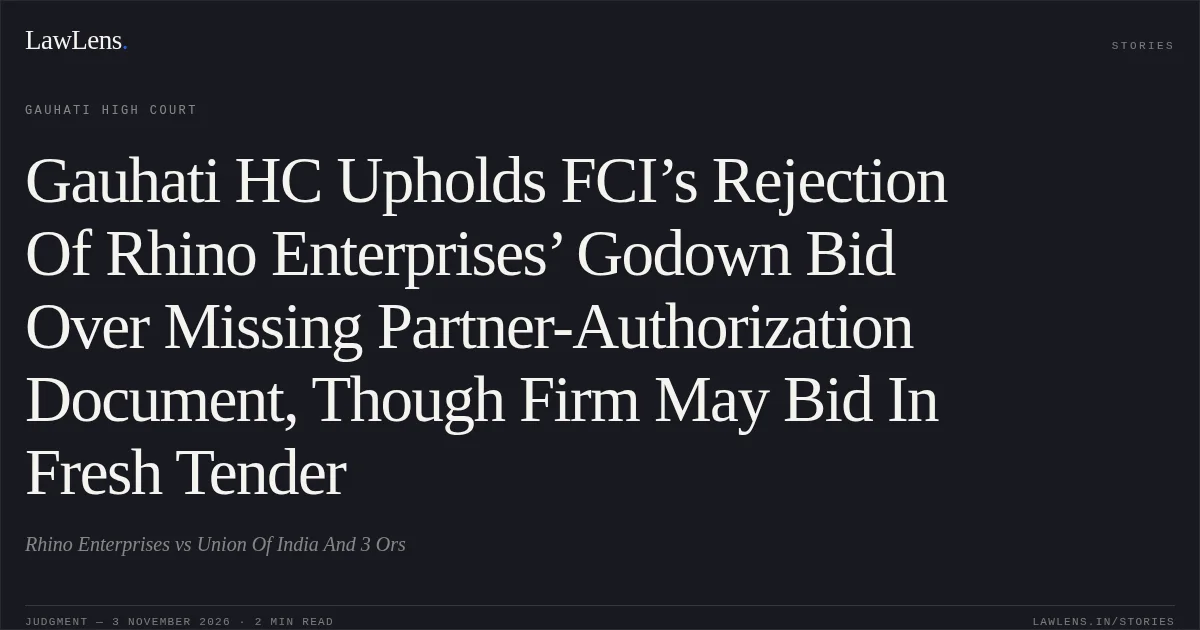
The Food Corporation of India’s tender notice required a partnership-firm signatory to state the capacity in which they signed and produce a document empowering them to do so.
pp. 2–5Rhino Enterprises’ bid was rejected as technically non-responsive because it had not submitted that document.
pp. 2–5The firm relied on a clause in its partnership deed permitting partners to submit bids jointly or severally, and later represented that either or all partners could bid on its behalf.
pp. 2–5The representation was rejected.
pp. 2–5While the writ petition challenging the rejection was pending, FCI cancelled the tender and issued a fresh notice.
pp. 2–502Issues
i.Whether FCI was justified in rejecting Rhino Enterprises’ bid as technically non-responsive for failure to comply with Clause 4(b)(2) of the tender instructions.
pp. 2–4, 6ii.Whether the partnership-deed clause relied on by Rhino Enterprises warranted interference with the rejection decision under Article 226.
pp. 5–603Law Applied
Clause 4(b)(2) of the Invitation to Tender and Instructions to Tenderers required a signatory for a registered partnership firm to identify whether they signed as a partner or constituted attorney and to produce a document empowering them to sign.
pp. 3–4, 6The Court considered the scope of its limited jurisdiction under Article 226 of the Constitution in reviewing the tender authority’s decision.
pp. 3–4, 6No statute or judicial precedent was cited as a separate basis for the decision.
pp. 3–4, 604Reasoning
The Court found that the tender authority had expressly required documentary proof empowering the particular partner to submit the bid.
pp. 4–6Rhino Enterprises admittedly had not supplied such a document with its bid.
pp. 4–6The Court considered the firm’s reliance on the partnership-deed clause but concluded that the record did not contain a document showing that all partners had authorised the partner who submitted the bid.
pp. 4–6In the Court’s view, the authority’s decision to enforce the stated tender requirement did not warrant interference under Article 226.
pp. 4–605Holding
The Court held that the rejection of Rhino Enterprises’ bid as technically non-responsive did not call for interference and dismissed the writ petition.
pp. 6–7It clarified that the dismissal did not preclude the firm from bidding in response to the fresh tender notice, if so advised.
pp. 6–7Original Court PDF
Rhino EnterprisesvsUnion Of India And 3 Ors
Click to open original judgment
Original judgment, available to read, download and summarize on LawLens.in