01Facts
The respondent land owners' agricultural lands were acquired for a link road connecting NH 205 with SH 58 (SCKAT Road).
The Land Acquisition Officer (LAO) fixed compensation by land type, ranging from Rs.247.10 to Rs.7,372.94 per sq. m.
pp. 2–3 · ¶ 2Six land categories were recognised: Punjai Maanavari Type-I (dry), Punjai Special Type-III, Punjai Type-I (well irrigation), Residential Area Special-5 Type-I, Nanjai Single Crop Type-I (lake irrigation), and Nanjai Special Type-I.
pp. 5–6 · ¶ 5On reference, the Principal District Judge, Tiruvallur (PDJ) enhanced compensation to Rs.10,760 per sq. m. (Rs.1,000 per sq. ft.), applied a multiplier of 1.25, and awarded additional compensation at 12% per annum on the cumulative amount, plus 100% solatium on that cumulative amount.
p. 2 · ¶ 2The PDJ relied on Ex.P1 (Guideline Value extract for Tiruttani village) and on this Court's earlier decision in CRP.No.2876 of 2022, which concerned Residential Type-I land under the same notification.
pp. 4–5 · ¶ 4 · p. 6 · ¶ 5The petitioners (LAO and requisitioning department) challenged the enhancement.
The respondents contended that the lands lie within 1.5 km of Tiruttani Railway Station and Temple and that the LAO's rates were low.
p. 4 · ¶ 4The 26 petitions cover different survey numbers and land classifications; in CRP.No.3422 of 2026, the Section 15(2) notification described the land as "dry land," but the award treated it as Residential Area Special-5 Type-I.
pp. 6–8 · ¶ 6–7The Section 15(2) notification is dated 22.06.2013.
p. 17 · ¶ 2202Issues
i.1. Whether the PDJ erred in relying on the Guideline Value for Residential Type-I/Special-5 land to determine the market value of agricultural (dry and irrigated) punjai/nanjai lands.
pp. 8–11 · ¶ 7, 9, 20ii.2. Whether the applicable multiplier under Schedule I of the Right to Fair Compensation Act, 2013 is 1 (urban) or 1.25 (non-urban).
pp. 11–12 · ¶ 11–12iii.3. Whether additional compensation under Section 30(3) at 12% per annum is computed on the market value under Section 26 or on the value after applying the Schedule I multiplier.
pp. 12–13 · ¶ 13–15iv.4. Whether 100% solatium under Section 30(1)–(2) and Schedule I, Entry 5 is computed on the multiplied value including additional compensation, or only on the Section 26/27 value.
pp. 13–16 · ¶ 16–1903Law Applied
Section 26(1)(a) of the Right to Fair Compensation Act, 2013 requires market value to be determined by reference to the Indian Stamp Act valuation for the area, and under Section 26(1)(b), the average sale price of similar land in the nearest village; the guideline value must relate to the same type of land and cannot be borrowed from a different category such as residential land.
pp. 9–11 · ¶ 8–9Section 26(2) and Schedule I provide that the market value is multiplied by a factor of 1 for urban areas and 1 to 2 for non-urban areas.
p. 11 · ¶ 10–11Section 30(3) mandates additional compensation at 12% per annum on the market value under Section 26, from the Section 4(2) SIA notification to the award or possession, whichever is earlier.
p. 12 · ¶ 13–14Section 30(1)–(2) and Schedule I, Entry 5 provide that solatium equals 100% of the market value multiplied by the applicable factor, plus the value of assets under Section 27.
pp. 13–15 · ¶ 16–18This Court's decision in CRP.No.2876 of 2022, which concerned Residential Type-I land, was held inapplicable to agricultural land.
p. 16 · ¶ 21Provisions in the judgment · 7 · Linked ones open on LawLens
Right to Fair Compensation and Transparency in Land Acquisition, Rehabilitation and Resettlement Act, 2013 Section 2Section 4Section 11Section 15Section 26Section 27Section 30
04Reasoning
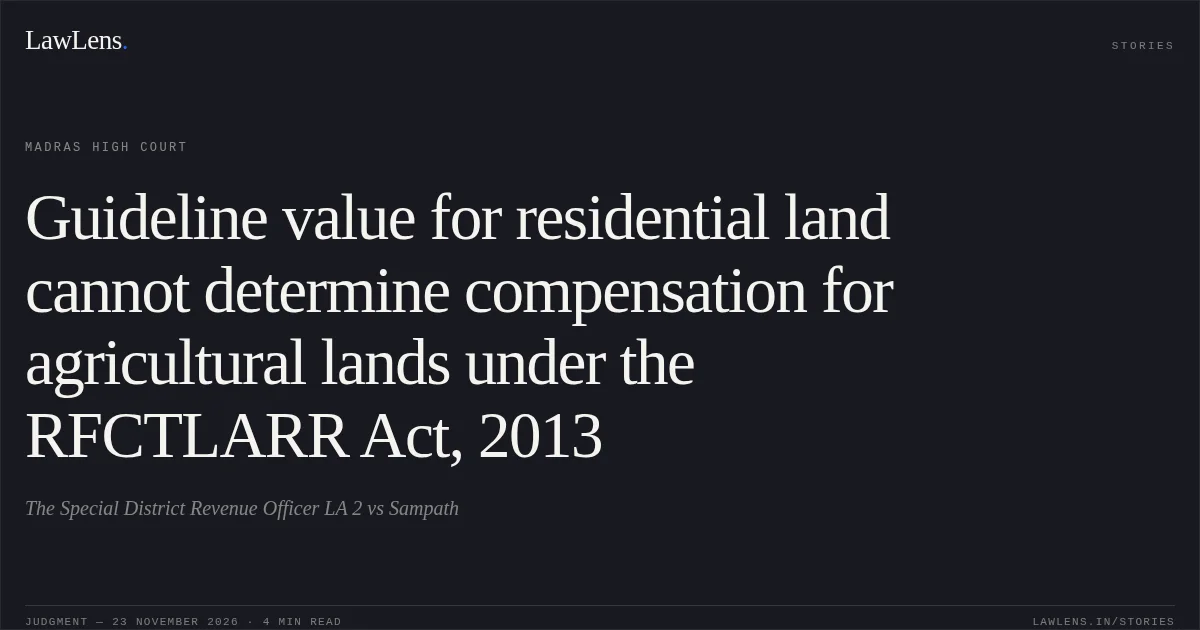
The LAO classified the lands as agricultural punjai/nanjai, but the PDJ adopted the guideline rate for Residential Type-I land from Ex.P1 without any guideline value for the survey numbers or for comparable agricultural land.
pp. 8–10 · ¶ 7, 9Because CRP.No.2876 of 2022 concerned a different land class, it did not support the PDJ's approach.
p. 16 · ¶ 21On the multiplier, the court accepted RW.1's evidence that the lands are within 1.5 km of the railway station and temple, placing them in an urban area; the factor is therefore 1, and the PDJ's 1.25 is set aside.
pp. 11–12 · ¶ 12On Section 30(3), the statutory text ties additional compensation to "market value," so the court held that the higher multiplied figure cannot be the base.
p. 13 · ¶ 15On solatium, the court read Schedule I, Entry 5 as applying only to the Section 26 market value plus Section 27 asset value, multiplied by the factor, and excluded the Section 30(3) additional compensation.
pp. 15–16 · ¶ 18–19The respondents' concession on the multiplier, Section 30(3) base and solatium base was recorded.
p. 4 · ¶ 4Since the record lacked evidence supporting the rate fixed, the court did not fix a new rate itself; it remanded the matters for fresh determination after the parties could lead evidence on land type.
pp. 16–17 · ¶ 21–2205Holding
The PDJ erred in applying the Residential Type-I guideline value to agricultural lands.
pp. 12–16 · ¶ 12, 15, 19–20The applicable multiplier is 1, as the lands are urban.
pp. 12–16 · ¶ 12, 15, 19–20The 12% per annum additional compensation under Section 30(3) is payable only on the Section 26 market value.
pp. 12–16 · ¶ 12, 15, 19–20100% solatium is payable only on the Section 26/27 value multiplied by factor 1, excluding Section 30(3) additional compensation.
pp. 12–16 · ¶ 12, 15, 19–20The impugned PDJ judgment and decree (including Clauses (ii)–(iv)) were set aside, and all LAOPs were remanded to the PDJ, Tiruvallur, to fix compensation according to the actual land type, allowing both parties to lead further evidence.
pp. 16–17 · ¶ 21–22The PDJ was directed to dispose of the LAOPs within six months of receipt of the order.
CRP.No.3422 of 2026 was specifically directed to address the discrepancy between "dry land" in the Section 15(2) notification and the Residential classification in the award.
pp. 16–17 · ¶ 21–22The CRPs were allowed, with no costs, and connected miscellaneous petitions were closed.
p. 17 · ¶ 22Original Court PDF
The Special District Revenue Officer LA 2vsSampath
Click to open original judgment
Original judgment, available to read, download and summarize on LawLens.in