01Facts
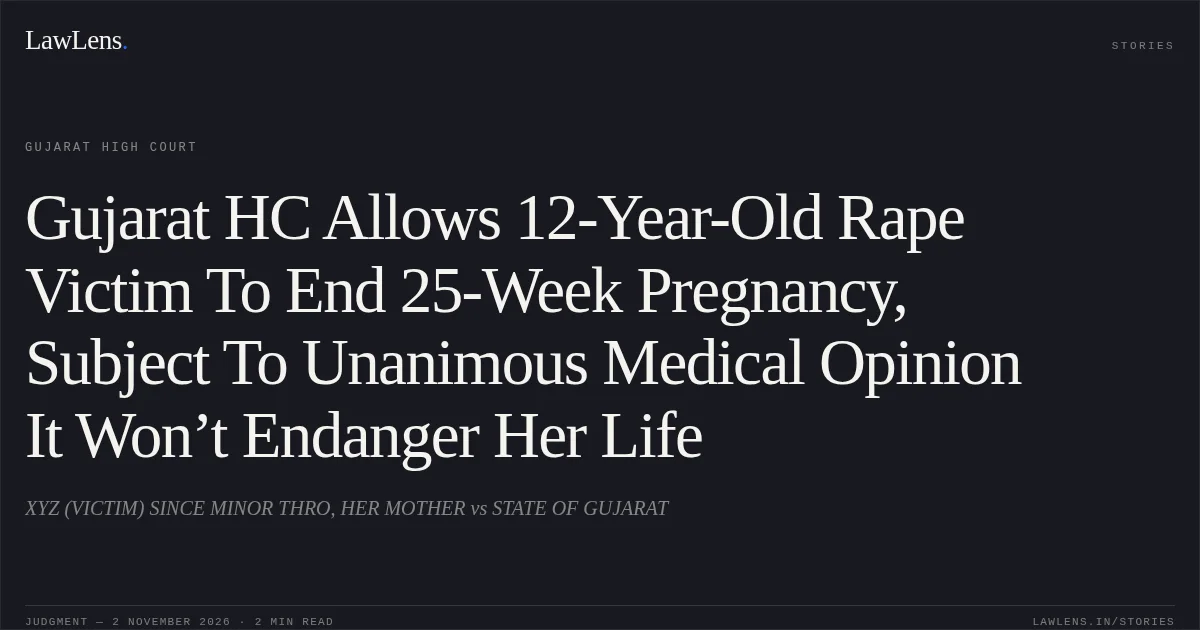
The petitioner, a 12-year-old rape victim, sought permission to terminate a pregnancy of approximately 25 weeks and 3 days.
pp. 3–5The High Court had directed a Medical Board to examine her and report on the feasibility of termination. The Board found her medically fit for the procedure, while identifying potential complications, including haemorrhage, infection, uterine injury and, rarely, life-threatening conditions. It advised that, if termination were considered, it should be performed without delay.
pp. 3–5The petitioner’s counsel stated that the victim and her parents did not wish to continue the pregnancy.
pp. 3–5The FIR had been registered under provisions of the Bharatiya Nyaya Sanhita, 2023 and the POCSO Act.
p. 502Issues
i.Whether the Court should permit termination of a minor rape victim’s pregnancy at approximately 25 weeks, having regard to her expressed wish, parental consent, medical opinion and the limits of the statutory framework.
pp. 3–4, 11–12ii.Whether safeguards and ancillary directions should be issued concerning the procedure, fetal tissue for forensic testing, and the victim’s and any live-born infant’s care.
pp. 12–1403Law Applied
The Court invoked Articles 14, 21, 226 and 227 of the Constitution and the Medical Termination of Pregnancy Act, 1971.
pp. 5–11It relied on S v. The Union of India & Ors., SLP (C) No. 14454 of 2026 (decided 24 April 2026), for the principles that reproductive autonomy and bodily integrity are protected by Article 21; that a pregnant woman’s decision whether to continue a pregnancy must be given due weight; and that constitutional relief may remain available where statutory remedies are unavailable.
pp. 5–11It also referred to X v. Health & Family Welfare Department, 2022 SCC OnLine SC 1321, on reproductive autonomy, and A (Mother of X) v. State of Maharashtra & Others, Civil Appeal No. 827 of 2026, concerning termination of a minor’s late-term pregnancy.
pp. 8–9Provisions in the judgment · 8 · Linked ones open on LawLens
Bharatiya Nyaya Sanhita, 2023 Section 137Section 87Section 64Section 65Section 351
Protection of Children from Sexual Offences Act, 2012 Section 4Section 6Section 12
04Reasoning
The Court considered the Medical Board’s assessment that the victim was medically fit for termination, notwithstanding the identified risks, and the victim’s and her parents’ wish not to continue the pregnancy.
pp. 3–4, 11–12Applying the cited principles of reproductive autonomy and the best interests of the minor, it concluded that the victim’s interests warranted allowing the petition. It conditioned the procedure on a written undertaking from the victim, a further Medical Board assessment and unanimous medical opinion that termination could be performed safely without endangering her life; it also prescribed medical, forensic, psychological and post-procedure safeguards.
pp. 12–1405Holding
The petition was allowed, and termination of the pregnancy was permitted subject to the specified safeguards, including urgent medical assessment and treatment, preservation and transfer of fetal tissue for DNA analysis, and post-operative care.
pp. 11–13The Court also directed that any infant born alive receive immediate intensive care; that child-welfare authorities assume responsibility if the victim declined custody; and that the relevant authorities arrange compensation, rehabilitation and medical and related expenses.
pp. 13–14Original Court PDF
XYZ (VICTIM) SINCE MINOR THRO, HER MOTHERvsSTATE OF GUJARAT
Click to open original judgment
Original judgment, available to read, download and summarize on LawLens.in