Facts
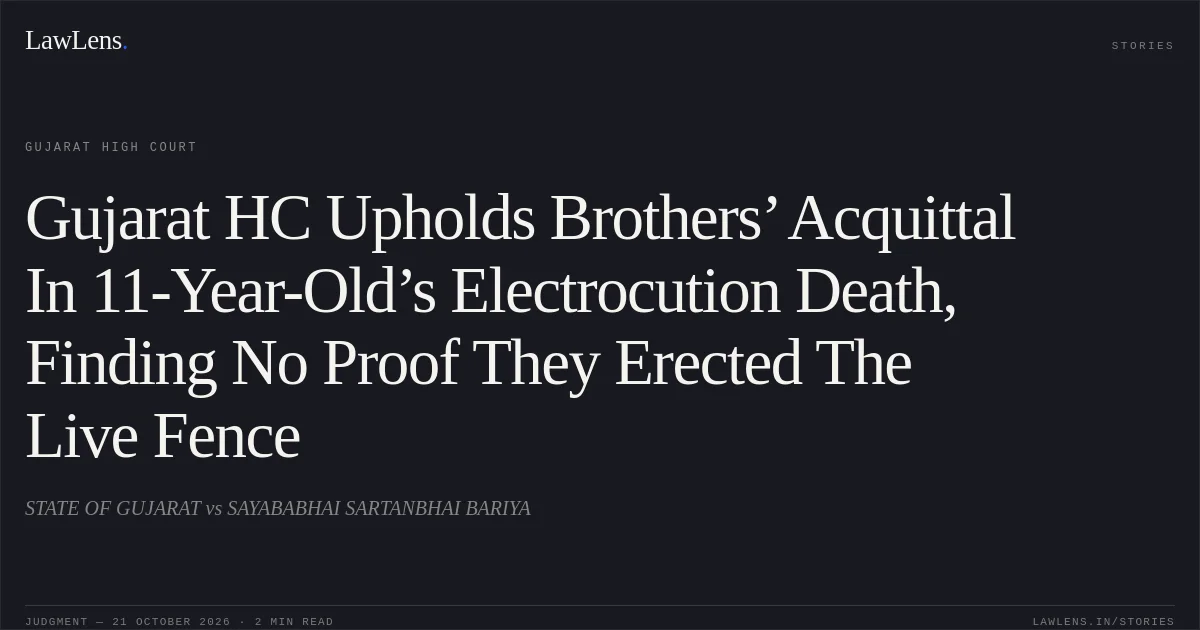
Eleven-year-old Ketan was found dead after becoming entangled in a wire fence at the boundary of a maize field; the post-mortem evidence attributed his death to electrocution.
Source reference: para. 3, 7The State alleged that the respondents had electrified the fence to protect their crops and charged them under Sections 304 and 114 of the Indian Penal Code (IPC).
Source reference: para. 3.1, 3.3The Sessions Court acquitted them under Section 235(1) of the Code of Criminal Procedure, 1973, giving them the benefit of doubt. The State appealed under Section 419 of the Bharatiya Nagarik Suraksha Sanhita, 2023.
Source reference: para. 1, 3.3–3.4Issues
1. Whether Ketan’s death was unnatural and caused by electrocution.
Source reference: para. 6(i)2. Whether the prosecution proved beyond reasonable doubt that the respondents erected and electrified the fence.
Source reference: para. 6(ii)Law Applied
To sustain liability under Section 304 IPC, the prosecution had to prove that the accused erected and charged the fence and acted with the knowledge required by that provision; proof that the death resulted from a live wire alone was insufficient.
Source reference: para. 8Section 114 IPC could not apply without proof of the relevant common intention or abetment.
Source reference: para. 13The Court accepted that ownership or possession of land may be proved by credible oral evidence and need not be established exclusively through revenue records.
Source reference: para. 9Under Syad Akbar v. State of Karnataka, res ipsa loquitur does not by itself establish criminal guilt: circumstantial evidence must be firmly established, point unerringly to guilt, and exclude reasonable alternative hypotheses.
Source reference: para. 14On an appeal against acquittal, the appellate court should respect the reinforced presumption of innocence and avoid interference where the trial court’s view is reasonable and plausible, unless the judgment is perverse or compelling circumstances justify intervention.
Source reference: para. 15; Tulasareddi @ Mudakappa & Anr. v. State of Karnataka & Ors., 2026 INSC 67Reasoning
The Court affirmed that the medical evidence established death by electrocution, but found that the prosecution had not reliably proved who owned or cultivated the field or who installed and energised the fence.
Source reference: para. 7, 10–11Witnesses gave differing accounts of the field’s ownership, and the investigation produced no survey or revenue records identifying the land, no evidence tracing the electricity supply, and no proof that the seized wire carried current.
Source reference: para. 10–11The inconsistencies about how Ketan came to be at the site further weakened the prosecution case, while the evidence that a charged fence existed did not establish that the respondents had made it so.
Source reference: para. 12–13Because the respondents’ authorship of the fence was not proved, the Court did not decide whether the alleged conduct would fall under Section 304 or Section 304A IPC.
Source reference: para. 13The acquittal was a reasonable and plausible view, not a perverse one warranting appellate interference.
Source reference: para. 15–16Holding
The Court answered the first issue affirmatively, holding that Ketan died by electrocution, but concluded that the prosecution had not proved beyond reasonable doubt that the respondents erected or electrified the fence.
It dismissed the State’s appeal as meritless, confirmed the Sessions Court’s acquittal, and directed that the record and proceedings be remitted to the concerned court.
Source reference: para. 17–19Acts & Sections Cited
6 provisions across 3 statutes referred to in this judgment. Each provision opens on LawLens.
Code of Criminal Procedure, 19733
Indian Penal Code, 18602
Bharatiya Nagarik Suraksha Sanhita, 20231
Original Court PDF
STATE OF GUJARATvsSAYABABHAI SARTANBHAI BARIYA
Click to open original judgment
Original judgment, available to read, download and summarize on LawLens.in