Facts
The victim alleged that she and the accused were in a relationship, lived together under an agreement dated 14 August 2019, and that he repeatedly had forcible sexual intercourse with her on a false promise of marriage and assaulted her.
Source reference: para. 2.1–2.4On 29 January 2020, they executed a further agreement cancelling the earlier one; she lodged an FIR the following day.
Source reference: para. 2.1–2.4The accused was charged under Sections 376, 376(2)(n) and 323 IPC.
Source reference: para. 2.1–2.4The Sessions Court acquitted him, finding the prosecution had not proved the charges beyond reasonable doubt.
Source reference: para. 2.1–2.4The victim appealed against the acquittal.
Source reference: para. 2.1–2.4Issues
Whether the Sessions Court’s acquittal was a plausible view of the evidence or was perverse or legally infirm so as to warrant appellate interference
Source reference: para. 22, 29Whether the evidence established that the sexual relationship was non-consensual or resulted from a false promise of marriage, and whether the accused’s liability for assault under Section 323 IPC was proved
Source reference: para. 6–19, 23–29Law Applied
The Court applied Sections 376, 376(2)(n) and 323 of the Indian Penal Code and considered the appeal’s stated statutory basis under Section 413 of the Bharatiya Nagarik Suraksha Sanhita, 2023; the submissions also invoked the victim’s right of appeal under the proviso to Section 372 CrPC.
Source reference: para. 1, 3.2On an appeal against acquittal, the appellate court may reappraise the evidence but should not interfere where the trial court’s view is plausible; an acquittal reinforces the presumption of innocence, and interference is warranted in exceptional cases involving perversity or compelling circumstances.
Source reference: para. 22Relying on Pramod Suryabhan Pawar, Deepak Gulati and Sonu @ Subash Kumar, the Court stated that a false promise of marriage vitiates consent only where the maker had no intention to honour it when made; mere breach of a promise is insufficient.
Source reference: para. 22It also relied on Tulasareddi @ Mudakappa & Anr. v. State of Karnataka & Ors. and Ravish Singh Rana v. State of Uttarakhand for the principles governing acquittal appeals and false-promise allegations.
Source reference: para. 22Reasoning
The Court considered the victim’s contemporaneous medical history describing a continuing relationship, the father’s and uncle’s evidence that she had gone with the accused voluntarily, and the house owner’s evidence that they lived together as a couple.
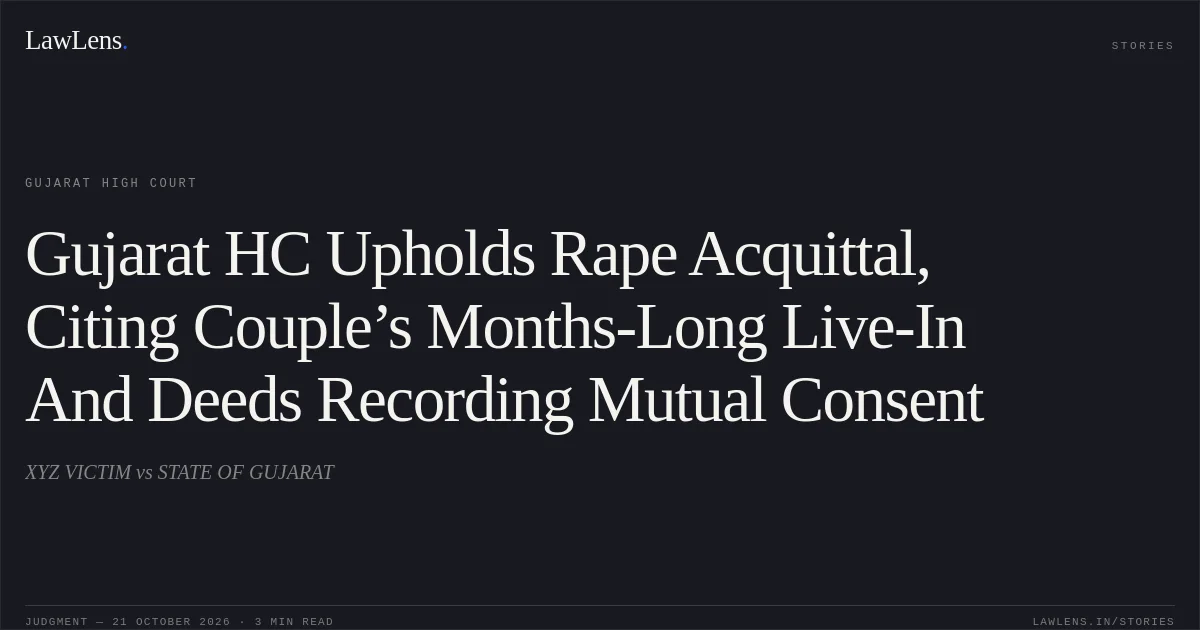
Source reference: para. 6–9It also relied on the two deeds, particularly the later deed recording that the parties had lived together by mutual consent and were separating voluntarily, while noting that the victim did not dispute their execution.
Source reference: para. 10–15, 27–28The Court concluded that the evidence did not establish an initially dishonest promise of marriage or force, and that the relationship and subsequent separation supported the trial court’s view of consent.
Source reference: para. 16, 23–28It further found contradictions and omissions in the victim’s evidence, the failure to seize the original agreements, and the lack of supporting evidence from panch witnesses weakened the prosecution case; medical and investigative material did not independently establish the accused’s involvement beyond reasonable doubt.
Source reference: para. 17–19Applying the deferential standard for appeals against acquittal, it found the trial court’s assessment plausible and not perverse.
Source reference: para. 29Holding
The Court held that the prosecution had not proved the charged offences beyond reasonable doubt and that the Sessions Court’s acquittal was a plausible view warranting no appellate interference.
The appeal was dismissed, and the record and proceedings were ordered to be remitted to the concerned court.
Source reference: para. 30Acts & Sections Cited
9 provisions across 3 statutes referred to in this judgment. Each provision opens on LawLens.
Indian Penal Code, 18603
Code of Criminal Procedure, 19735
Bharatiya Nagarik Suraksha Sanhita, 20231
Original Court PDF
XYZ VICTIMvsSTATE OF GUJARAT
Click to open original judgment
Original judgment, available to read, download and summarize on LawLens.in