Facts
Neetaben married respondent No. 1 in 2006 and later lived in a joint family with the respondents and her sister, Jetalben.
Source reference: para. 10About two years before Neetaben’s death, she left the matrimonial home and lodged a complaint against the respondents; the resulting criminal case ended in acquittal.
Source reference: paras. 18(a)–(e)She subsequently returned to the matrimonial home, where no complaint of harassment or cruelty was made for approximately one and a half years.
Source reference: paras. 18(a)–(e)Neetaben died by suicide on 3 June 2012.
Source reference: para. 11Jetalben alleged that the respondents had subjected her to cruelty, demanded money, and abetted her suicide.
Source reference: para. 11The Sessions Court acquitted the respondents of offences under Sections 498A, 306 and 114 IPC.
Source reference: para. 1The State appealed against that acquittal.
Source reference: para. 2Issues
Whether the trial court was justified in acquitting the respondents of the charged offences.
Source reference: para. 9(1)Whether the trial court properly appreciated the prosecution evidence, and whether its judgment disclosed any illegality, irregularity or perversity warranting appellate interference.
Source reference: paras. 9(2)–(3)Law Applied
Sections 498A, 306 and 114 of the Indian Penal Code were the offences charged; abetment under Section 306 required proof of the relevant ingredients of Section 107 IPC, including conduct amounting to instigation or abetment of suicide.
Source reference: paras. 1, 17Section 113A of the Indian Evidence Act, 1872 permits a court, in the circumstances specified there, to presume abetment of suicide by a husband or his relative; it does not dispense with consideration of the evidence and circumstances.
Source reference: para. 17On an appeal against acquittal, the appellate court may review and reappreciate the evidence, but must account for the reinforced presumption of innocence; where two reasonable views are possible, the acquittal should not be disturbed.
Source reference: paras. 20–23Chandrappa v. State of Karnataka, (2007) 4 SCC 415.
Source reference: paras. 20–23Reasoning
The High Court found no specific, reliable evidence identifying when, where or by whom cruelty or a demand for money had been made.
Source reference: paras. 13–16The complainant did not describe particular incidents; the deceased’s brother and father did not support the allegations of dowry demand or cruelty; and the alleged taunt that Neetaben was barren was inconsistent with her earlier complaint stating that she was pregnant.
Source reference: paras. 13–16The post-mortem evidence disclosed no external injuries, and the prosecution did not establish conduct by the respondents amounting to abetment of suicide.
Source reference: paras. 12, 17Given these evidentiary deficiencies and the circumstances recorded by the trial court, the High Court found its assessment reasonable and saw no perversity or other basis to interfere with the acquittal.
Source reference: paras. 18–19, 24–25Holding
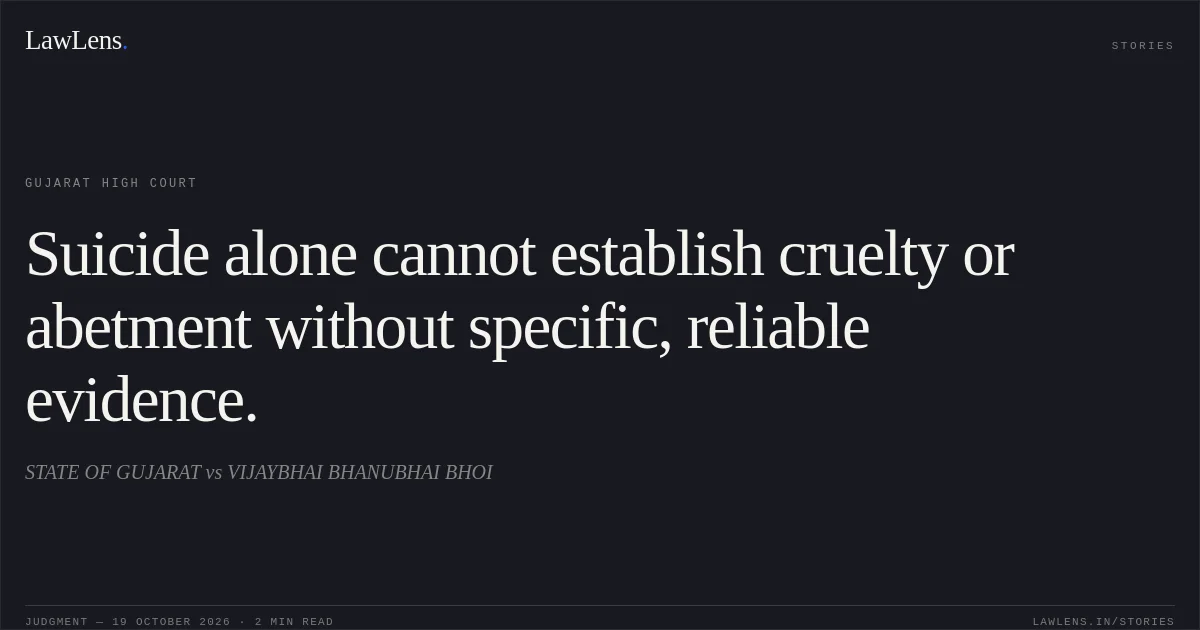
The High Court held that the prosecution had not proved the charges beyond reasonable doubt and that the trial court’s acquittal disclosed no error warranting appellate interference.
The State’s appeal was dismissed, the acquittal was confirmed, the bail bonds were cancelled, and the record and proceedings were directed to be returned to the trial court.
Source reference: para. 26Acts & Sections Cited
7 provisions across 2 statutes referred to in this judgment. Each provision opens on LawLens.
Code of Criminal Procedure, 19732
Indian Penal Code, 18605
Original Court PDF
STATE OF GUJARATvsVIJAYBHAI BHANUBHAI BHOI
Click to open original judgment
Original judgment, available to read, download and summarize on LawLens.in