Facts
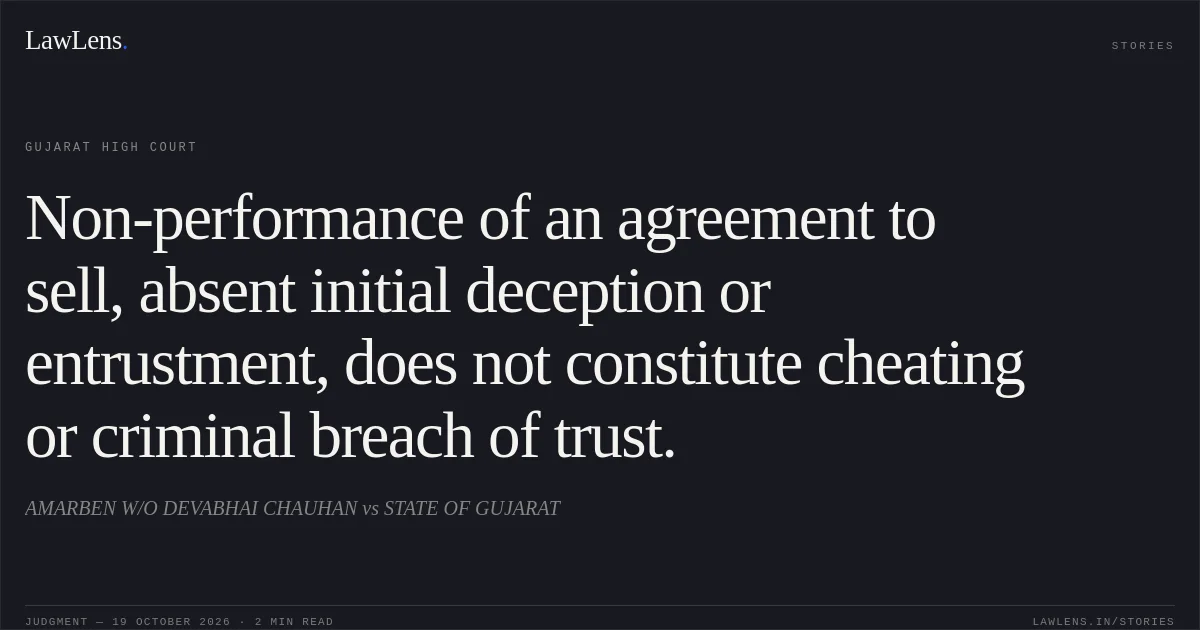
The complainant alleged that, in connection with an agreement to sell agricultural land, he paid ₹4.5 lakh by cheque to the legal heirs and a further ₹18 lakh to intermediaries, but the applicants later refused to execute a sale deed after the land was restored to its original owners.
Source reference: p. 2–6He alleged offences under Sections 406, 420 and 114 IPC. The complainant had also filed a civil suit for specific performance.
Source reference: p. 2–6The applicants sought quashing under Section 482 CrPC, contending that the dispute was civil and the FIR disclosed no criminal offence.
Source reference: p. 2–6, 10, 13Issues
1. Whether the FIR’s allegations, taken at face value, disclosed the ingredients of cheating under Section 420 IPC against the applicants.
Source reference: p. 10–152. Whether the payments made under the agreement to sell constituted entrustment capable of supporting a charge of criminal breach of trust under Section 406 IPC.
Source reference: p. 11–133. Whether the FIR and consequential proceedings should be quashed under Section 482 CrPC.
Source reference: p. 8–10, 17–20Law Applied
Section 482 CrPC empowers the High Court to prevent abuse of process and secure the ends of justice, subject to the illustrative categories in State of Haryana v. Bhajan Lal.
Source reference: p. 8–10Cheating under Section 420 IPC requires deception and dishonest or fraudulent intention when the inducement is made; a subsequent breach of contract alone is insufficient (Vesa Holdings Pvt. Ltd. v. State of Kerala).
Source reference: p. 15Criminal breach of trust under Sections 405–406 IPC requires entrustment of property or dominion over it, followed by dishonest misappropriation, conversion, use or disposal in violation of law or contract.
Source reference: p. 11–12The Court also relied on Radheyshyam v. State of Rajasthan for the principles that advance payment under an agreement to sell is not, without more, entrustment and that refusal to complete a sale may give rise to a civil remedy.
Source reference: p. 10–13The Court also relied on Kishan Singh v. Gurpal Singh on scrutiny of an unexplained belated FIR.
Source reference: p. 15–16The Court also relied on Pradeep Kumar Kesarwani v. State of Uttar Pradesh on the framework for assessing quashing petitions.
Source reference: p. 17–18Reasoning
The Court found that the FIR did not explain how the applicants had fraudulently or dishonestly induced the complainant to make the payments, or allege facts showing dishonest intent at the inception of the transaction.
Source reference: p. 10–16The payments were made as consideration under an agreement to sell, not entrusted to the applicants; their alleged refusal to execute a sale deed therefore did not establish misappropriation.
Source reference: p. 10–16The Court treated the dispute as predominantly civil, noting that a suit for specific performance was pending, and also considered the unexplained delay in lodging the FIR.
Source reference: p. 10–16It concluded that the allegations did not disclose the essential ingredients of Sections 406 or 420 IPC and that Section 114 IPC consequently had no application.
Source reference: p. 18–19Holding
The High Court allowed the application and quashed the FIR, C.R. No. I-30 of 2016, and all consequential criminal proceedings under Sections 406, 420 and 114 IPC qua the applicants only.
It clarified that its observations were confined to the quashing application and would not affect the merits of other litigation between the parties.
Source reference: p. 19–20Acts & Sections Cited
7 provisions across 2 statutes referred to in this judgment. Each provision opens on LawLens.
Code of Criminal Procedure, 19733
Indian Penal Code, 18604
Original Court PDF
AMARBEN W/O DEVABHAI CHAUHANvsSTATE OF GUJARAT
Click to open original judgment
Original judgment, available to read, download and summarize on LawLens.in