01Facts
The Complainant/Respondent No.1 in the writ appeal, Jagannath, owns House Nos. 353, 354, 355 and 395 at Harkud Village, Basavakalyan Taluk, Bidar District.
The PWD proposed to widen State Highway No. 126 across these properties.
¶ 1 · p. 4He submitted representations dated 25.04.2022 and 14.10.2022 seeking initiation of acquisition proceedings and payment of compensation before the road work commenced.
¶ 1–2 · p. 4The authorities did not decide the representations, so he filed W.P. No. 202692 of 2022 for a writ of mandamus.
¶ 1–2 · p. 4During the pendency of the writ petition, the authorities considered the representations and issued an endorsement dated 18.01.2023.
¶ 5 · pp. 5–6 · ¶ 8 · pp. 7–8The petitioner did not challenge this endorsement.
¶ 8 · pp. 7–8By order dated 18.06.2024, the learned Single Judge allowed the writ petition and directed the respondents to initiate acquisition proceedings within six months, if the land was needed for widening, and to pass an award in accordance with law.
¶ 3 · p. 5The State appealed under Section 4 of the Karnataka High Court Act, 1961, contending that the endorsement had been brought to the Single Judge's notice and that a positive direction to acquire was impermissible.
¶ 5 · pp. 5–6The petitioner argued that the properties could not be taken without acquisition, in violation of Article 300-A of the Constitution.
¶ 6 · pp. 6–7Separately, a contempt petition under Sections 11 and 12 of the Contempt of Courts Act, 1971, read with Article 215, was filed alleging non-compliance with the 18.06.2024 order.
pp. 1–202Issues
i.1. Whether a High Court can, in mandamus proceedings, direct the State to initiate acquisition proceedings and pay compensation, given that the initiation of acquisition is an exercise of plenary eminent domain power.
¶ 9 · pp. 8–9 · ¶ 10 · p. 9ii.2. Whether the learned Single Judge's positive direction to acquire was sustainable when the representations had already been considered and an endorsement dated 18.01.2023 had been issued and not challenged.
¶ 8 · pp. 7–8 · ¶ 10 · p. 9iii.3. Whether the contempt petition arising from the 18.06.2024 order survives once that order is set aside.
CCC para. 1 · pp. 10–1103Law Applied
The power of eminent domain vested in the State is plenary, and a writ of mandamus ordinarily cannot compel its exercise, as laid down in Kolhapur Municipal Corporation v. Vasant Madhav Patil, 2022 SCC OnLine SC 179.
¶ 9 · pp. 8–9A High Court cannot direct acquisition of land, as held in Union of India v. Kesang Dorjee, Civil Appeal Nos. 7042–7044 of 2025 (decided 20.05.2025), para. 17.
¶ 9 · p. 9A writ court may compel consideration of a representation but not the substantive outcome, reflected in the Court's treatment of the 18.01.2023 endorsement as a response that disposed of the mandamus claim.
¶ 8 · pp. 7–8Article 300-A of the Constitution, which bars deprivation of property save by authority of law, was noted as a party submission and was not independently adjudicated.
¶ 6 · pp. 6–7Contempt jurisdiction under Sections 11–12 of the Contempt of Courts Act, 1971 and Article 215 of the Constitution depends on the existence of a subsisting order capable of being disobeyed.
pp. 1–2 · CCC para. 1 · pp. 10–11Provisions in the judgment · 3 · Linked ones open on LawLens
Contempt of Courts Act, 1971 Section 11Section 12
KARNATAKA HIGH COURT ACT, 1961 Section 4
04Reasoning
The Court found that the endorsement dated 18.01.2023 was issued during the pendency of the writ petition, that the petitioner did not challenge it, and that the representations had therefore been considered.
¶ 8 · pp. 7–8Despite this, the learned Single Judge had directed the State to initiate acquisition, a positive direction the Court held to be contrary to Kolhapur Municipal Corporation and Kesang Dorjee.
¶ 9 · pp. 8–9 · ¶ 10 · p. 9Because whether to acquire is a matter for the State's discretion, the mandamus relief went beyond what a writ court may grant, and the impugned order was held arbitrary and erroneous, warranting interference.
¶ 10 · p. 9Since the order underlying the contempt proceedings no longer existed, the contempt petition did not survive for consideration.
CCC para. 1 · pp. 10–11The Court left the petitioner free to challenge the endorsement and kept all his contentions open, so the matter was not finally decided on the merits of the land dispute.
order iii–iv · p. 1005Holding
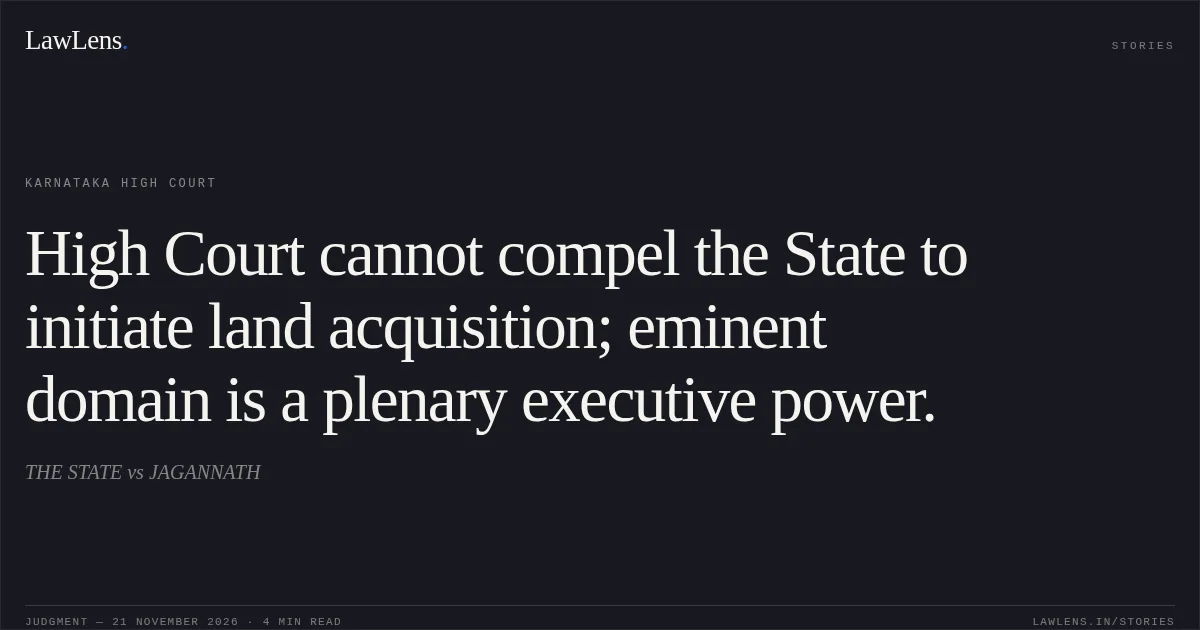
A High Court cannot issue a positive mandamus directing the State to initiate acquisition proceedings, as the power of eminent domain is plenary.
¶ 9–10 · pp. 8–9The Single Judge's direction was unsustainable, particularly since the representations had been considered by the endorsement dated 18.01.2023, which remained unchallenged.
¶ 8, 10 · pp. 7–9Without a subsisting order, the contempt petition could not proceed.
CCC para. 1 · pp. 10–11The Writ Appeal No. 200074 of 2025 is allowed. The order dated 18.06.2024 in W.P. No. 202692 of 2022 is set aside, and the writ petition is dismissed as infructuous. Liberty is reserved to the respondent to challenge the endorsement dated 18.01.2023, and all his contentions are kept open. CCC No. 200121 of 2025 is dismissed.
order i–iv · p. 10 · CCC para. 1–2 · pp. 10–11Original Court PDF
THE STATEvsJAGANNATH
Click to open original judgment
Original judgment, available to read, download and summarize on LawLens.in