01Facts
The petitioner in WP 18882/2022 (Jayanth S.) is the husband of respondent No. 2 (Smt. G.R. Pushpalatha). The petitioners in WP 18897/2022 (Rukmini and Prasanna S.) are his mother and brother, i.e., the parents-in-law and a co-resident family member.
¶ 3The marriage is undisputed, but the marital relationship soured shortly after, and respondent No. 2 alleged harassment, leading to a criminal complaint under s. 498A IPC and ss. 3 and 4 of the Dowry Prohibition Act, 1961 (DPA).
¶ 4Police investigated, collected oral and documentary evidence, and filed a charge sheet.
¶ 9The Trial Magistrate (II ACMM, Bengaluru) took cognizance, and trial is pending.
¶ 5The petitioners sought quashing of the entire proceedings under Arts. 226–227 of the Constitution read with s. 482 CrPC, contending that the allegations are omnibus.
¶ 2 · ¶ 6The petitions cite inconsistent case numbers (CC No. 593/2020 in WP 18882; CC No. 5093/2020 in WP 18897) for the same crime (Crime No. 119/2019).
¶ 2Respondent No. 2 and the State opposed quashing.
¶ 7At the hearing, the petitioners in WP 18897 (senior citizens) sought a direction for permanent exemption and a time-bound trial.
¶ 1202Issues
i.1. Whether the criminal proceedings under s. 498A IPC and ss. 3–4 DPA can be quashed in writ jurisdiction on the ground that the complaint allegations are omnibus and continuation amounts to abuse of process.
¶ 6 · ¶ 11ii.2. Whether the plea that articles given at marriage were "customary" can be adjudicated at the quashing stage or must be decided at trial.
¶ 10iii.3. Whether senior-citizen parents-in-law are entitled to a direction for permanent exemption from personal appearance and a time-bound conclusion of trial.
¶ 12–1303Law Applied
Section 498A IPC, which penalises cruelty by a husband or relative of the husband toward a married woman.
¶ 9Sections 3 and 4 of the Dowry Prohibition Act, 1961, which prohibit giving, taking, or demanding dowry and penalise such demands.
¶ 9The inherent power under s. 482 CrPC, read with Arts. 226–227 of the Constitution, to quash proceedings, which is exercised sparingly and only where the material does not disclose a prima facie offence or continuation amounts to abuse of process.
¶ 6 · ¶ 11In writ jurisdiction at the pre-trial stage, a charge sheet supported by investigated material cannot be quashed.
¶ 11Whether the articles given at marriage are customary is a factual question for trial on evidence.
¶ 10No precedent is cited in the order.
Provisions in the judgment · 3 · Linked ones open on LawLens
Code of Criminal Procedure, 1973 Section 482
04Reasoning
The petitioners and respondent No. 2 lived under the same roof, and the complaint contained serious allegations investigated through oral and documentary evidence, resulting in a charge sheet under s. 498A IPC and ss. 3–4 DPA.
¶ 8 · ¶ 9Because prima facie material existed, the petitioners' "omnibus allegations" plea could not be accepted at this stage; the court refused to examine the merits of the defence on the dowry-related articles, reserving them for trial.
¶ 10–11The court therefore declined to exercise its limited writ/inherent jurisdiction to quash the charge sheet.
¶ 11On the senior-citizen plea, the court accepted that the petitioners in WP 18897 could seek permanent exemption, provided they file an application without disputing their identity, which the Trial Magistrate may consider in accordance with law.
¶ 12–13Separately, the court directed expeditious trial to address prolonged pendency.
¶ 14(ii)05Holding
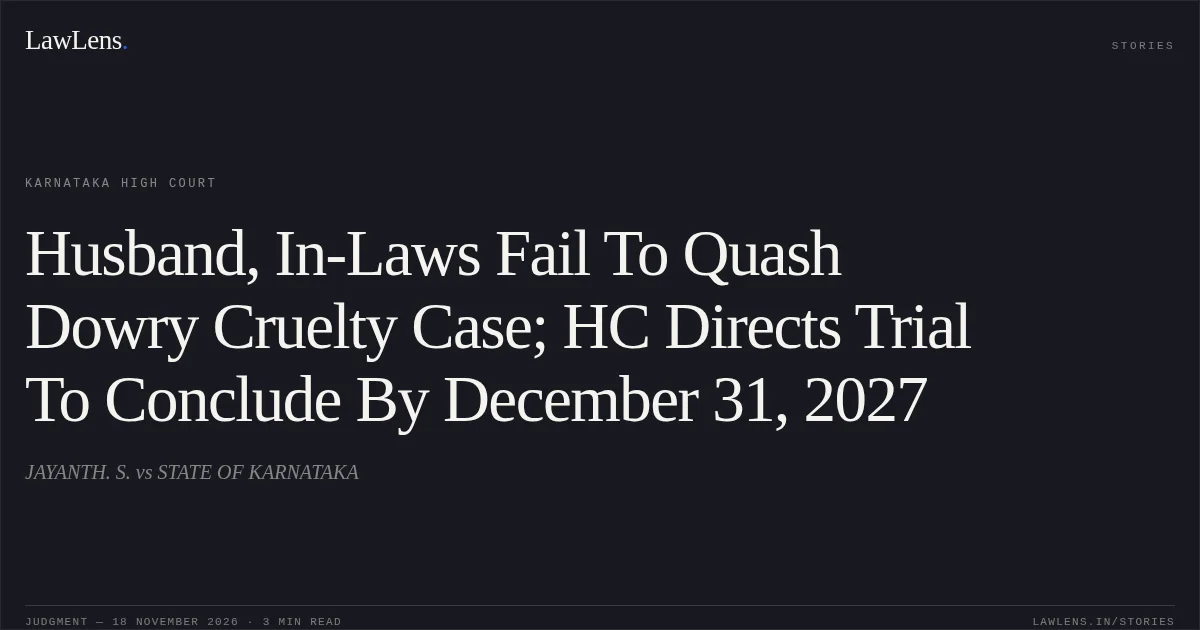
The petitions are dismissed; the court held that the charge sheet under s. 498A IPC and ss. 3–4 DPA cannot be quashed at this stage, and the customary-articles defence must be established at trial.
¶ 10, 11, 14(i)The Trial Magistrate is directed to expedite trial and conclude it in a time-bound manner, not later than 31.12.2027. Parties are directed to cooperate for early disposal. The petitioners in WP 18897 may apply for permanent exemption without disputing identity, and the Trial Magistrate may consider and pass appropriate orders in accordance with law.
¶ 13 · ¶ 14(ii) · ¶ 14(iii)Original Court PDF
JAYANTH. S.vsSTATE OF KARNATAKA
Click to open original judgment
Original judgment, available to read, download and summarize on LawLens.in