01Facts
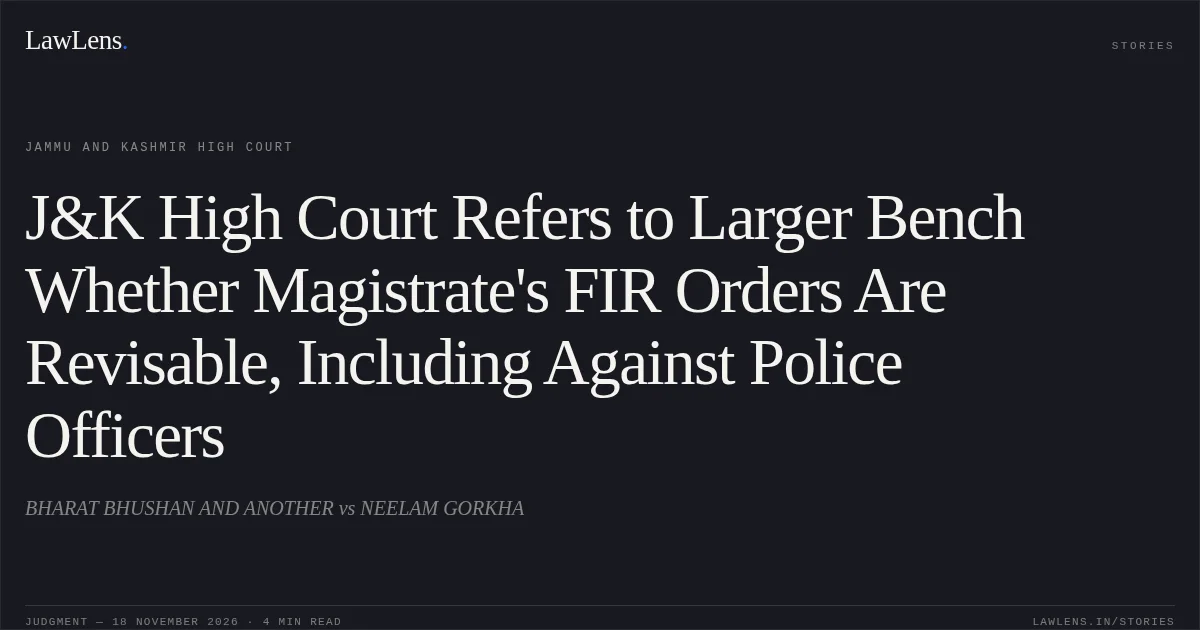
Two petitions raise whether an order under Section 156(3) Cr.P.C. (Section 175(3) BNSS) directing registration of an FIR and investigation is an interlocutory order barring revision under Section 397(2) Cr.P.C. (Section 438(2) BNSS), or an intermediate order that is revisable
¶ 1The petitioners run M/s National Medical Hall at Bishnah, Jammu, as tenants of the respondent's family, and allege threats of forcible dispossession from 15.11.2023
¶ 19–20The petitioners obtained a civil injunction restraining dispossession
¶ 21On 09.03.2024 and 10.03.2024, the respondent and her sons allegedly forcibly entered the shop and assaulted petitioner No. 2, and FIR No. 0027/2024 was registered under IPC Sections 447, 441, 323 and 34
¶ 22The respondent then moved the Munsiff/JMIC, Bishnah under Section 156(3) Cr.P.C.
¶ 22On 03.06.2024 the Magistrate allowed the application and directed the SHO to register an FIR
¶ 18, 22The Additional Sessions Judge, Jammu dismissed the revision on 28.02.2025 as non-maintainable, holding the order interlocutory
¶ 18, 22In CRM(M) No. 678/2021, the petitioners are the then SSP Jammu, the Cyber Crime PS DySP, and the SHO Janipur PS, and the order directed FIR registration against senior police officials
¶ 16, 23–24The petitioners contend that no statutory sanction was obtained and that the order was passed without jurisdiction, judicial application of mind, or compliance with statutory safeguards
¶ 16, 23–24The revisional court dismissed the revision as non-maintainable
¶ 4(iv), 1702Issues
i.1. Whether an order under Section 156(3) Cr.P.C. directing registration of an FIR and investigation is invariably interlocutory within Section 397(2) Cr.P.C.
¶ 4(i) · ¶ 1ii.2. Whether final disposal of a Section 156(3) application, with its consequences, renders the order revisable
¶ 4(ii) · ¶ 47–49iii.3. Whether the revisional court may examine lack of jurisdiction, non-application of mind, or non-compliance with statutory safeguards in such an order
¶ 4(iii) · ¶ 57iv.4. Whether the Additional Sessions Judge was justified in dismissing the revisions solely as non-maintainable
¶ 4(iv) · ¶ 18v.5. Whether Satpal Sharma (coordinate Bench) requires reconsideration and reference to a larger Bench
¶ 60–6203Law Applied
Section 156(3) Cr.P.C., which permits a Magistrate to direct investigation at the pre-cognizance stage, together with the judicial-discretion requirement that accompanies it
¶ 26–27Section 397(1) and (2) Cr.P.C. (Section 438 BNSS) confer revisional power but bar revision of interlocutory orders, and Section 175(3) BNSS adds affidavit and police-submission safeguards
¶ 27–28Under Amar Nath v. State of Haryana and Madhu Limaye v. State of Maharashtra, the classification of orders is not binary; intermediate orders with finality on a distinct issue fall outside the bar
¶ 30–31Girish Kumar Suneja v. CBI adds that the test is whether acceptance of the objection would end the proceedings or a part of them
¶ 32Father Thomas v. State of U.P. (Allahabad FB) holds such orders interlocutory and non-revisable at the instance of a prospective accused
¶ 34–35Arun P. Gidh v. Chandraprakash Singh (Bombay FB) recognises revisional jurisdiction within its precedents without deciding the general question
¶ 37–39Manohar Nath Sher v. State of J&K (1980 KLJ 1) lays down the test for interlocutory orders
¶ 40Satpal Sharma v. Pawan Singh Rathore (J&K HC) holds such orders interlocutory and non-revisable, and binds a coordinate Bench absent distinction or a larger-Bench reference
¶ 41–42Anurag Bhatnagar v. State (NCT of Delhi) (SC) requires independent judicial application of mind
¶ 43–45HDFC Securities v. State of Maharashtra (SC) limits interference with investigation
¶ 46Priyanka Srivastava v. State of U.P. and Anil Kumar v. M.K. Aiyappa (SC) require the Magistrate to apply judicial mind and not act as a forwarding authority
¶ 53–54Where a statutory prohibition or sanction applies to public servants, the Magistrate must examine it
¶ 56–57Provisions in the judgment · 10 · Linked ones open on LawLens
Code of Criminal Procedure, 1973 Section 156Section 190Section 397Section 482
Bharatiya Nagarik Suraksha Sanhita, 2023 Section 175Section 438
Indian Penal Code, 1860 Section 447Section 441Section 323Section 34
04Reasoning
The Court held that neither the finality of the Section 156(3) disposal nor the serious consequences of investigation is determinative. Disposal of the application terminates only the request for a procedural direction, not the criminal proceeding, and the test of finality cannot be applied mechanically
¶ 47–48Consequences such as examination, search or arrest are relevant but do not by themselves decide the order's character, since an investigation order is not a finding of guilt
¶ 50–51The Court accepted that jurisdictional defects and non-application of mind must be checked, but held that the existence of a defect and the availability of revision are distinct questions; the revisional court must first have jurisdiction
¶ 52, 57On Satpal Sharma, the Court noted that a coordinate Bench may not overrule an earlier decision merely because a different view appears preferable
¶ 42, 60Where a substantial question of law exists and divergent High Court views persist, the proper course is a larger-Bench reference, given the frequency of such orders and their continuing relevance under Section 175(3) BNSS
¶ 61The Court therefore did not decide the merits of either petition
05Holding
The Court did not finally answer whether a Section 156(3) order is interlocutory or revisable. It held that the question requires authoritative determination by a larger Bench, given the existing contrary decision in Satpal Sharma and divergent High Court views. It formulated six questions for reference, covering: interlocutory versus intermediate character; relevance of final disposal; the effect of Amar Nath, Madhu Limaye and Girish Kumar Suneja on Satpal Sharma; whether jurisdictional or safeguard defects are revisable; the permissible scope of revisional interference at each stage; and the effect of Section 175(3) BNSS read with Section 438(2) BNSS
¶ 58, 62–63The Registry was directed to place the records of both petitions before the Chief Justice for constitution of a larger Bench. The judgment does not set aside the impugned revisional orders or the Magistrate's directions, and it does not remit the matters for merits consideration. The petitioners' prayer for setting aside and remand is therefore left to the larger Bench's determination
¶ 17, 64Original Court PDF
BHARAT BHUSHAN AND ANOTHERvsNEELAM GORKHA
Click to open original judgment
Original judgment, available to read, download and summarize on LawLens.in