01Facts
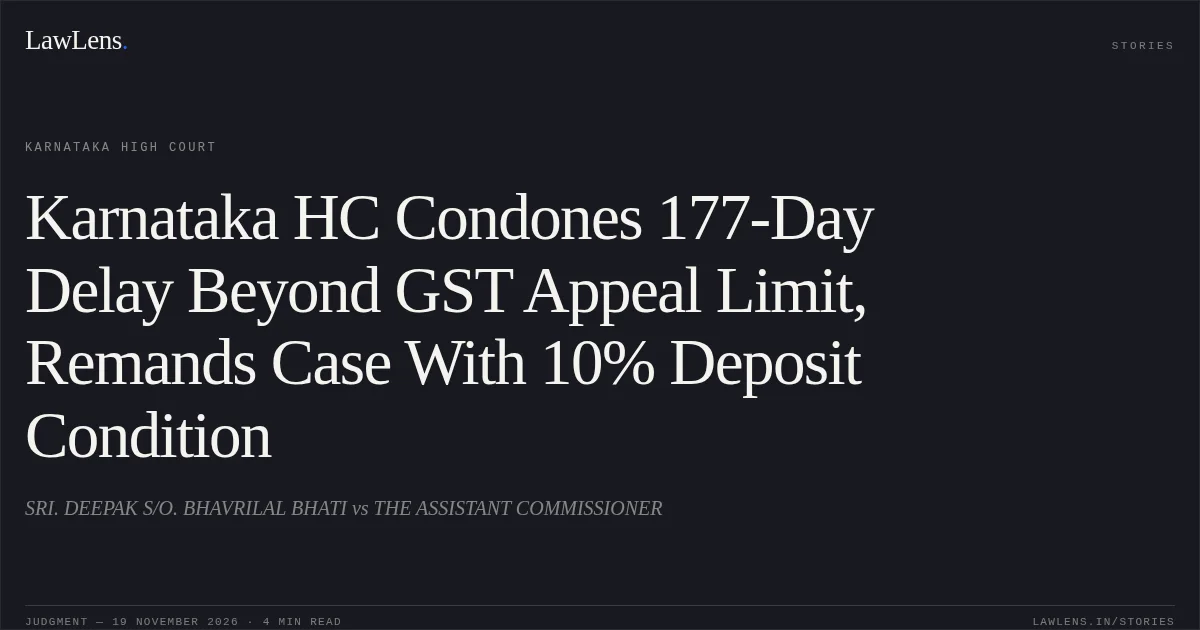
The petitioner, a proprietor trading as M/s. Chethan Steel Traders, Belagavi, challenged an order-in-appeal dated 26.11.2024 (Appeal No. GST-668/2024-25/B-766) passed by the Joint Commissioner of Commercial Taxes (Appeals), Belagavi, for tax period 2017-18.
¶ 1The original authority's adjudication order dated 22.12.2023 raised a demand of ₹25,13,303 with interest and penalty. The petitioner filed the first appeal 177 days late.
¶ 2The Appellate Authority rejected the appeal solely on limitation, holding that under Section 107 of the CGST/KGST Act, 2017, it may condone delay only within the statutory one-month period following the three-month preliminary period, and cannot go beyond that. The Appellate Authority did not examine the merits.
¶ 3 · ¶ 13Revenue contended that the appeal was filed beyond the 30-day maximum condonable period under Section 107(4), and that such belated appeals are being used to seek remand under Article 226.
¶ 9–12The petitioner relied on W.P. No. 107961/2026 (disposed 25.09.2026) and W.P. No. 26900/2024, Bondada Engineering Ltd. (disposed 20.03.2025).
¶ 7–8, 15The petition sought certiorari quashing the 26.11.2024 order and mandamus directing a decision on merits.
p. 202Issues
i.1. Whether the Appellate Authority, having rejected the appeal on limitation alone, was correct in declining to examine the merits of the tax demand, and whether such rejection amounts to denial of a statutory remedy and of natural justice.
¶ 5–6, 13, 16ii.2. Whether the High Court, in exercise of its writ jurisdiction under Articles 226/227, may condone a delay that exceeds the period prescribed under Section 107(4) and remand the matter for adjudication on merits.
¶ 8–10, 14, 17iii.3. Whether, and on what conditions, relief should be granted in view of the petitioner's inordinate delay.
¶ 12, 14, 17(iv)–(vi)03Law Applied
Section 107 of the CGST/KGST Act, 2017, particularly sub-sections (4), (11) and (12). Section 107(4) caps condonable delay in filing first appeals; Section 107(11) requires the appellate authority to afford a reasonable opportunity of being heard; and Section 107(12) requires a reasoned written order stating points for determination, decision, and reasons.
¶ 9, 15 (quoting Bondada · ¶ 6), 16Bondada Engineering Ltd. v. Office of the Assistant Commissioner of Central Tax (W.P. No. 26900/2024, dated 20.03.2025), which held that dismissal of an appeal without a reasoned merits decision is inconsistent with Section 107(12) and that denial of a statutory appellate remedy amounts to denial of substantial rights, warranting remand.
¶ 15W.P. No. 107961/2026 (dated 25.09.2026), which followed the same approach.
¶ 7, 15The appellate authority's reliance on Singh Enterprises (2008) 3 SCC 70 and Hongo India (2009) 5 SCC 791, which hold that statutory appellate authorities cannot condone delay beyond the statutory period, is recorded but not separately examined. The Court's power to grant relief rests on Articles 226 and 227 of the Constitution.
¶ 3 · p. 2Provisions in the judgment · 2 · Linked ones open on LawLens
Central Goods and Services Tax Act, 2017 Section 107
KARNATAKA GOODS AND SERVICES TAX ACT, 2017 Section 107
04Reasoning
The Court accepted that the Appellate Authority, as a creature of statute, is bound by Section 107(4), and that the appeal was filed beyond the permissible condonation period. However, it treated the lack of any merits determination as the decisive defect. Because the impugned order rejected the appeal only on limitation, the petitioner's statutory right of first appeal against a tax demand was never examined. Applying Bondada and W.P. No. 107961/2026, the Court held that denying a statutory remedy in a tax matter, without a reasoned merits decision, is contrary to natural justice and Section 107(12).
¶ 9–10, 13–16To balance this, the Court held that the petitioner's delay of nearly a year was inexcusable and must be deprecated. It therefore conditioned relief on payment of costs and on a statutory pre-deposit to protect revenue and discourage belated appeals. The Court did not expressly rule on whether Section 107(4) permits condonation beyond 30 days; it instead exercised writ jurisdiction to set aside the order.
¶ 14 · ¶ 17(ii)–(iii), (iv)–(vi)05Holding
The rejection of the appeal solely on limitation, without examining the merits, could not be sustained under Section 107(11)–(12).
¶ 14–16The writ petition is allowed. The Court condones the 177-day delay in filing the first appeal; sets aside the order-in-appeal dated 26.11.2024 in Appeal No. GST-668/2024-25/B-766; and remands the matter to the Appellate Authority to decide the appeal on merits in accordance with Section 107(11)–(12). The grant of relief is subject to deposit of an additional 10% of the disputed tax liability before the Appellate Authority, and payment of costs of ₹30,000 to the Pradhan Mantri Emergency Relief Fund within two weeks, with proof filed before the Court and the Appellate Authority, which is a condition precedent to a merits hearing. The petitioner must appear on 10.12.2026, and the Appellate Authority must dispose of the appeal within two months of first appearance. All rival contentions are left open.
¶ 17(i)–(ix)Original Court PDF
SRI. DEEPAK S/O. BHAVRILAL BHATIvsTHE ASSISTANT COMMISSIONER
Click to open original judgment
Original judgment, available to read, download and summarize on LawLens.in