01Facts
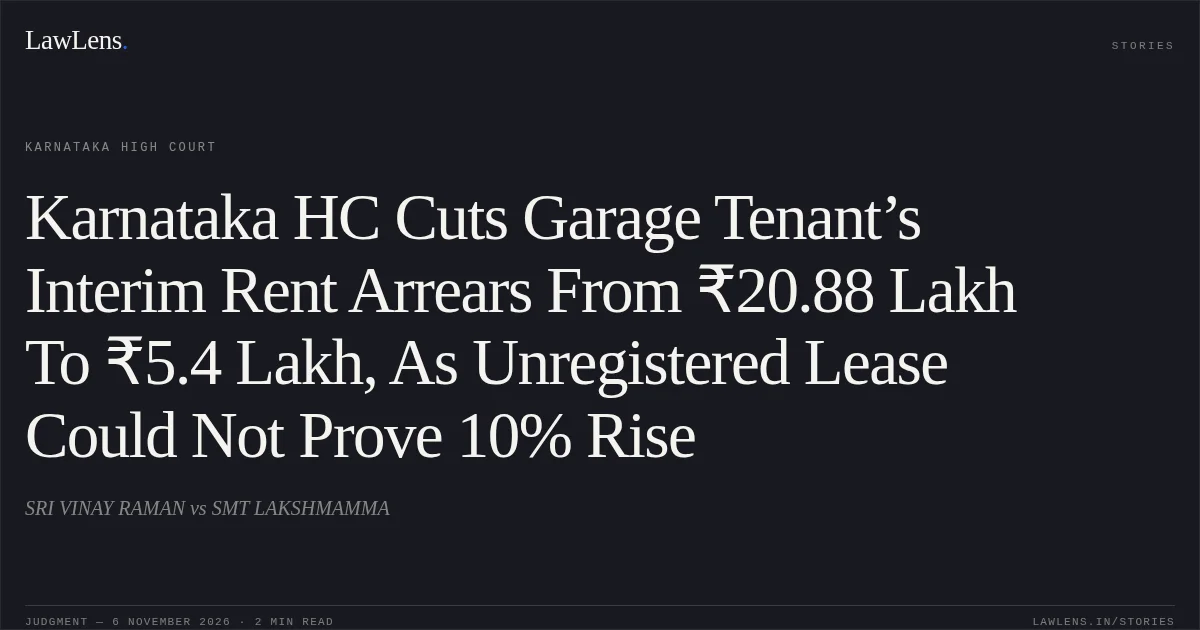
The petitioner, a tenant in occupation of the suit property, challenged an order directing him to deposit ₹20,88,097 as arrears of rent, failing which his defence would be struck off.
pp. 3–4, 12–14 · ¶ 1–4, 10The plaintiffs had sought ejectment and arrears of rent, and relied on a 10% annual rent-escalation clause in an unregistered lease agreement.
pp. 3–4, 12–14 · ¶ 1–4, 10The petitioner disputed the calculation, relying on an asserted security deposit of ₹11,00,000 and the admitted monthly rent of ₹15,000.
pp. 3–4, 12–14 · ¶ 1–4, 10The Trial Court calculated arrears using the escalation clause; the petitioner challenged that order under Articles 226 and 227 of the Constitution.
pp. 3–4, 12–14 · ¶ 1–4, 1002Issues
i.1. Whether the Trial Court could, on an application under Section 151 CPC, direct payment of arrears calculated by applying the escalation clause in an unregistered lease agreement, absent a clear admission of that increased rent.
pp. 12–16 · ¶ 10–16ii.2. Whether the petitioner could be directed to pay the admitted rent of ₹15,000 per month for the three-year period considered by the Court.
p. 19 · ¶ 1603Law Applied
Order XXXIX Rule 10 CPC permits a court to order deposit or delivery where a party admits holding money for, or owing money to, another party; Order XII Rule 6 CPC permits judgment on admissions, which must be clear, unequivocal and categorical (Karan Kapoor v. Madhuri Kumar).
pp. 14–16 · ¶ 12–13.1Section 49 of the Registration Act, 1908 bars an unregistered document requiring registration from being admitted to prove its terms, though it may be used for a genuinely collateral purpose; an essential lease term cannot be proved on that basis (K.B. Saha and Sons Pvt. Ltd. v. Development Consultant Ltd.).
pp. 16–18 · ¶ 15The Court also referred to Paul Rubber Industries Pvt. Ltd. v. Amit Chand Mitra on the inadmissibility of an unregistered lease document to establish an essential term.
pp. 18–19 · ¶ 15.1Provisions in the judgment · 4 · Linked ones open on LawLens
Code of Civil Procedure, 1908 Section 151
Registration Act, 1908 Section 17Section 49
Transfer of Property Act, 1882 Section 107
04Reasoning
The Court found no clear admission in the pleadings that rent had increased by 10% annually.
pp. 14–19 · ¶ 11–16The Trial Court nevertheless used the escalation clause in the unregistered lease to calculate the amount due, although the dispute over the applicable rent and arrears required trial.
pp. 14–19 · ¶ 11–16Since the lease terms could not be relied on to establish the escalation clause and the pleadings reflected an admitted monthly rent of ₹15,000, the Court held that only arrears calculated at that rate could be directed at this stage.
pp. 14–19 · ¶ 11–1605Holding
The Court set aside the impugned order and directed the petitioner to pay ₹5,40,000, representing rent of ₹15,000 per month for 36 months, within six weeks.
p. 20 · ¶ 17–20The plaintiffs remained at liberty to apply in accordance with law for any further arrears or amounts due, and both parties’ rights and contentions were reserved for trial.
p. 20 · ¶ 17–20Original Court PDF
SRI VINAY RAMANvsSMT LAKSHMAMMA
Click to open original judgment
Original judgment, available to read, download and summarize on LawLens.in