01Facts
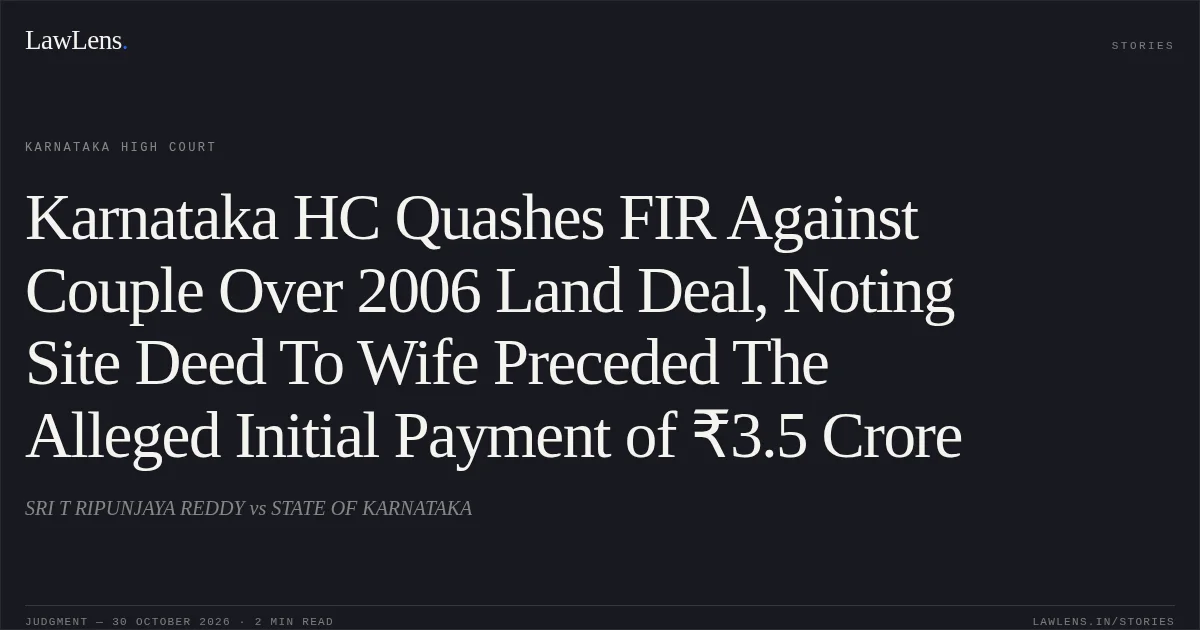
Respondent No. 2 complained that he and several firms had agreed to purchase land at Kengeri from Prasannaiah and Laxmin Pramod Kumar, and had paid ₹3.5 crore towards the transaction.
pp. 2–6, 8He alleged that the vendors failed to convey the land and that Site No. 4, which was said to have been promised to the firms, was instead conveyed to petitioner No. 2, the wife of petitioner No. 1.
pp. 2–6, 8Kengeri Police registered Crime No. 460/2024 under Sections 34, 406, 420 and 417 IPC.
pp. 2–6, 8The petitioners sought to quash the FIR and complaint under Section 482 CrPC/Section 528 BNSS.
pp. 2–6, 8They produced a sale deed for Site No. 4 dated 19 May 2006.
pp. 2–6, 8Respondent No. 2, though served, did not appear.
pp. 2–6, 802Issues
i.Whether the complaint and material on record prima facie disclosed the ingredients of offences under Sections 406, 417 or 420 IPC against the petitioners.
pp. 7–8ii.Whether the FIR and complaint should be quashed in the exercise of the Court’s inherent jurisdiction.
pp. 2, 8–903Law Applied
The petition invoked the High Court’s inherent jurisdiction under Section 482 CrPC, corresponding to Section 528 BNSS, to seek quashing of criminal proceedings.
p. 2The Court considered Sections 406, 417 and 420 IPC, observing that non-performance of an agreement concerning immovable property, or a subsequent dispute over transfer, does not by itself establish criminal breach of trust or cheating.
pp. 7–8The complaint must disclose dishonest intention and the other essential ingredients of the alleged offences.
pp. 7–8The Court also clarified that the existence of a civil remedy does not, by itself, exclude criminal liability where the ingredients of an offence are otherwise made out.
pp. 7–8Provisions in the judgment · 6 · Linked ones open on LawLens
Code of Criminal Procedure, 1973 Section 482
Bharatiya Nagarik Suraksha Sanhita, 2023 Section 528
Indian Penal Code, 1860 Section 34Section 406Section 417Section 420
04Reasoning
The alleged transaction related to 2006, but the complaint was lodged in 2024.
pp. 6–8The complaint stated that ₹3.5 crore was paid on 6 July 2006, while the sale deed conveying Site No. 4 to petitioner No. 2 was dated 19 May 2006.
pp. 6–8It did not explain how that earlier conveyance amounted to dishonest inducement at the inception of the alleged arrangement, nor clearly state the dates or circumstances of the later arrangements concerning Site No. 4.
pp. 6–8In these circumstances, the allegations did not prima facie establish the required dishonest intention or other ingredients of the charged offences; the dispute appeared essentially civil in nature, without foreclosing any civil remedies subject to applicable objections, including limitation.
pp. 6–805Holding
The Court held that the allegations did not make out offences under Sections 406, 417 or 420 IPC and allowed the petition.
pp. 8–9It quashed the FIR and complaint in Crime No. 460/2024, while leaving the complainant and firms at liberty to pursue any civil remedies available in law, subject to applicable objections.
pp. 8–9Original Court PDF
SRI T RIPUNJAYA REDDYvsSTATE OF KARNATAKA
Click to open original judgment
Original judgment, available to read, download and summarize on LawLens.in