01Facts
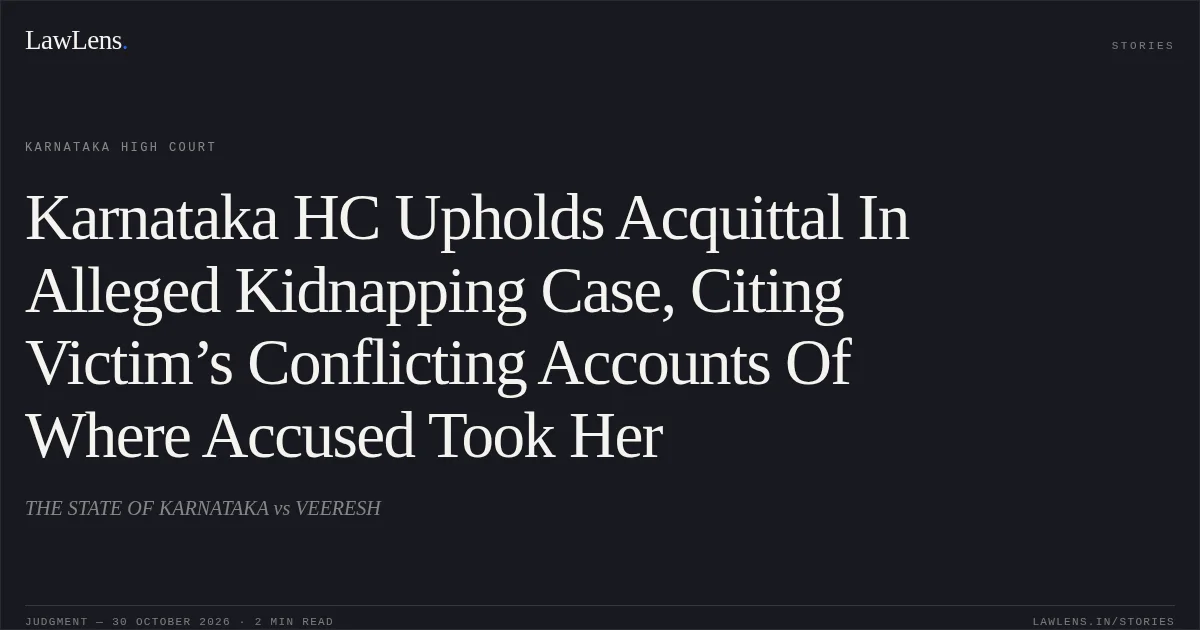
The prosecution alleged that the accused kidnapped the complainant’s minor daughter from her home on 16 April 2012 with the intention of marrying her.
pp. 2–4, paras 1, 3–4The charge-sheet was filed under Section 366-A IPC; after trial, the L Additional City Civil and Sessions Judge, Bengaluru, acquitted the accused on 24 February 2016.
pp. 2–4, paras 1, 3–4The State appealed against the acquittal under Section 378 CrPC.
pp. 2–4, paras 1, 3–4At trial, nine witnesses were examined and six exhibits marked.
p. 3, para 4The accused denied the prosecution case in his Section 313 CrPC statement and did not adduce defence evidence.
p. 3, para 402Issues
i.Whether the State had established grounds for appellate interference with the judgment of acquittal
p. 6, para 7ii.Whether the trial court’s acquittal could be reversed on the evidence and material on record
pp. 7–8, para 903Law Applied
Under Section 378 CrPC, an appellate court may reappreciate the evidence in an appeal against acquittal, but the acquittal reinforces the presumption of innocence.
pp. 7–8, para 9If the trial court’s view is a plausible one, the appellate court cannot reverse the acquittal merely because another view is possible; interference is justified where the judgment is perverse, materially misreads or omits evidence, or the evidence permits only a conclusion of guilt beyond reasonable doubt.
pp. 7–8, para 9The Court relied on Constable 907 Surendra Singh v. State of Uttarakhand (2025) 5 SCC 433, Babu Sahebgouda Rudragoudar v. State of Karnataka (2024) 8 SCC 149, Chandrappa v. State of Karnataka (2007) 4 SCC 415, and H.D. Sundara v. State of Karnataka (2023) 9 SCC 581.
pp. 7–8, para 9Provisions in the judgment · 3 · Linked ones open on LawLens
Code of Criminal Procedure, 1973 Section 378Section 313
Indian Penal Code, 1860 Section 366
04Reasoning
On reappreciating the evidence, the Court noted that PW1 and PW3, the mahazar witnesses, did not support the prosecution; PW2, the victim’s mother, stated that she did not know the accused; and PW5, the victim, likewise stated that she did not know him.
pp. 9–10, paras 11–12PW4 and PW7 did not support the prosecution, while PW8 gave no evidence connecting the accused to the alleged offence.
pp. 9–10, paras 11–12The Court found no legal or factual error in the trial court’s assessment and held that the State had not shown that the acquittal was perverse or that only a finding of guilt was possible.
pp. 9–10, paras 11–1205Holding
The Court answered the question of appellate interference in the negative and dismissed the State’s appeal.
pp. 10, paras 12–13The acquittal of the accused was left undisturbed.
pp. 10, paras 12–13Original Court PDF
STATE OF KARNATAKAvsKARTHIK
Click to open original judgment
Original judgment, available to read, download and summarize on LawLens.in