01Facts
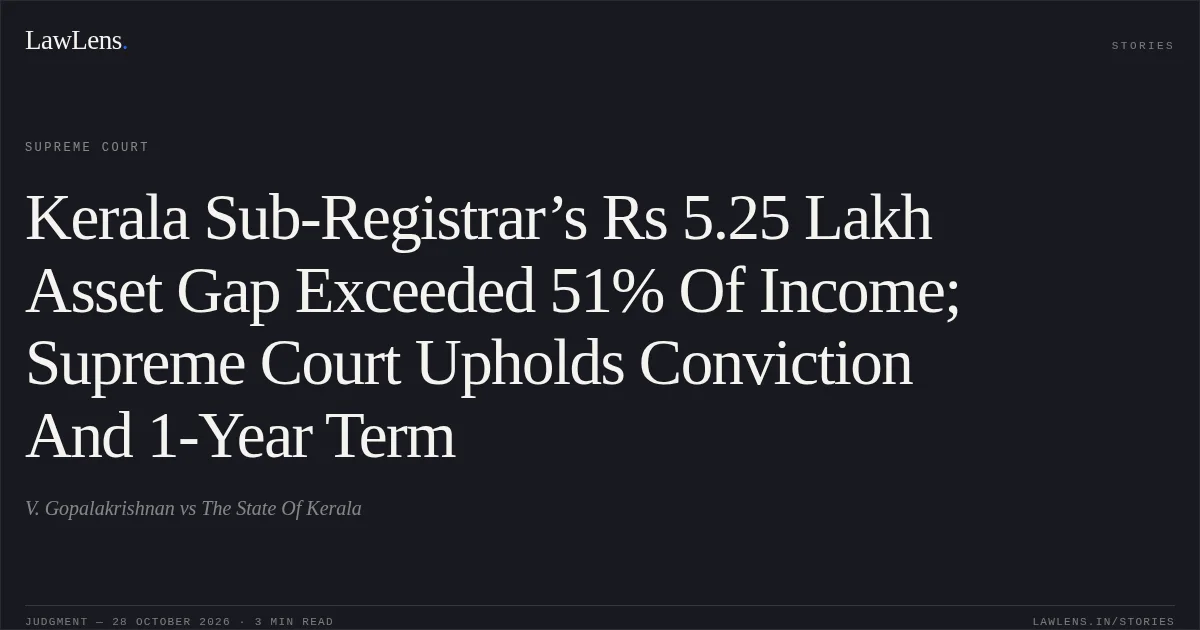
The appellant, a public servant, was convicted under Sections 13(2) read with 13(1)(e) of the Prevention of Corruption Act, 1988, for possessing assets disproportionate to his known sources of income during the check period from 1 January 1993 to 16 January 2001.
¶ 2–6The prosecution calculated disproportionate assets of ₹5,25,129—approximately 51.88% of the appellant’s and his family’s income during that period.
¶ 2–6The Trial Court convicted him and imposed two years’ rigorous imprisonment and a fine; the High Court affirmed the conviction but reduced the sentence to one year’s rigorous imprisonment and a fine of ₹2,00,000.
¶ 1The appellant challenged the conviction, disputing, among other things, the valuation of a building and estimates of household and other expenses.
¶ 9–1802Issues
i.1. Whether the prosecution established the foundational facts of disproportionate assets and thereby shifted to the appellant the burden of satisfactorily accounting for the excess.
¶ 19–25ii.2. Whether the appellant’s challenges to the valuation of the building, household expenditure, and other income and expense entries materially undermined the finding of disproportionate assets.
¶ 9–18, 2903Law Applied
Section 13(1)(e) of the Prevention of Corruption Act, 1988, as applicable to the case, requires proof that a public servant possessed pecuniary resources or property disproportionate to known sources of income and could not satisfactorily account for them; Section 13(2) prescribes the punishment for criminal misconduct.
¶ 16Under P. Nallamal v. State, the prosecution bears the burden of proving possession of disproportionate assets, while the public servant bears the onus of accounting for them.
¶ 19State of Tamil Nadu v. R. Soundirarasu explains that “known sources of income” are those known to the prosecution after lawful investigation, and that the prosecution need not conduct an open-ended inquiry into undisclosed sources; the accused must account for matters within their special knowledge.
¶ 20, 26–28Section 109 of the Bharatiya Sakshya Adhiniyam, 2023 (corresponding to Section 106 of the Indian Evidence Act, 1872), places the burden of proving a fact especially within a person’s knowledge on that person.
¶ 24The explanation must be satisfactory, not merely plausible, as stated in State of Madhya Pradesh v. Awadh Kishore Gupta.
¶ 21The 10% benefit discussed in Krishnanand Agnihotri v. State of Madhya Pradesh is not a general rule allowing deduction beyond that limit; B.C. Chaturvedi v. Union of India declined to extend it.
¶ 6–7Provisions in the judgment · 3 · Linked ones open on LawLens
Prevention of Corruption Act, 1988 Section 13Section 5
Bharatiya Sakshya Adhiniyam, 2023 Section 109
04Reasoning
The prosecution’s calculations showed disproportionate assets of ₹5,25,129, exceeding 50% of the family’s income during the check period.
¶ 4–6The Court found no adequate evidentiary basis to displace the prosecution’s building valuation: the appellant’s notebook contained sporadic entries, was not shown to have been maintained in the ordinary course of business, and was not substantiated in his testimony.
¶ 13Even allowing the appellant’s claimed ₹1,90,153 reduction for construction costs would leave disproportionate assets of ₹3,34,976; allowing a further ₹67,200 reduction for household expenses would still leave ₹2,67,776, or over 26% of income.
¶ 14–15The prosecution’s household-expense calculation was based on the prevailing price index, whereas the appellant’s alternative was an estimate.
¶ 15The Court also noted that the other asset values were supported by documents, and that the appellant did not substantiate his claims concerning salary, GPF loans, rental income, or other disputed entries with adequate material.
¶ 12, 17–18The prosecution had therefore established the foundational disproportion, and the appellant had not satisfactorily accounted for it.
¶ 2905Holding
The Supreme Court held that the prosecution proved disproportionate assets and that the appellant failed to provide a satisfactory explanation.
¶ 29–30It found no infirmity in the Trial Court’s conviction, as affirmed by the High Court, and dismissed the appeal.
¶ 29–30The interim bail was vacated, and the appellant was granted two weeks to surrender before the Trial Court to serve the remaining sentence.
¶ 30Original Court PDF
V. GopalakrishnanvsThe State Of Kerala
Click to open original judgment
Original judgment, available to read, download and summarize on LawLens.in