01Facts
The appellant, a 37-year-old married man, was the uncle by marriage of the survivor (PW1), who was 17 years and 7 months old at the time of the occurrence.
p. 2 · pp. 6–7The prosecution alleged that on 16.09.2014 he took her to Chennai and Thiruppur on the pretext of a job, confined her in hotel rooms, repeatedly committed penetrative sexual assault, and returned her to her village on 25.09.2014.
p. 2 · p. 7The FIR was lodged the same day and Crime No.370 of 2014 was registered.
p. 2 · p. 10The Trial Court (Fast Track Mahila Court, Thanjavur) convicted him under Sections 365 and 366 IPC and Section 6 POCSO Act, 2012, imposing 7, 10 and 10 years' rigorous imprisonment respectively, with concurrent running.
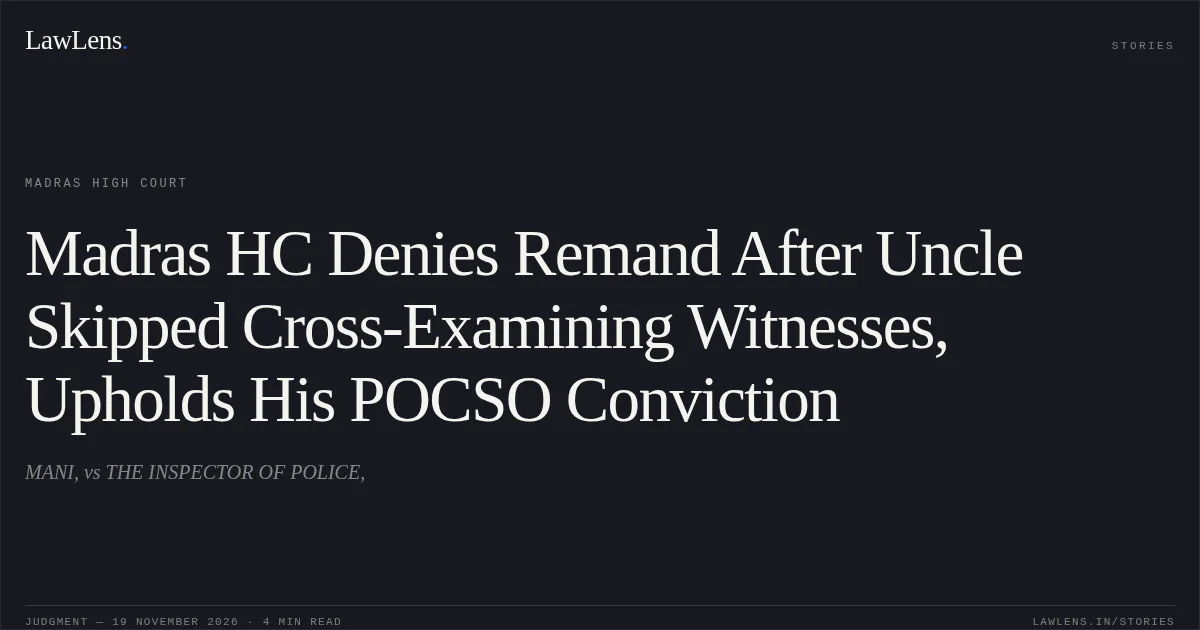
pp. 3–4The defence cross-examined only the doctor (PW9) and did not cross-examine PW1–PW8, PW10–PW15.
pp. 9–11Prosecution witnesses were examined between 07.05.2015 and 12.08.2016.
pp. 10–11The defence sought recall of PW1–PW6, PW14 and PW15 only on 23.08.2016, which the Trial Court dismissed on 14.09.2016; this Court dismissed the revision in Crl.O.P(MD) No.19655 of 2016 on 20.10.2016.
pp. 5–6 · pp. 12–13The appellant's defence (DW1) was that the child went with him willingly to obtain employment.
pp. 16–1702Issues
i.1. Whether the appellant is entitled to remand the matter to recall and cross-examine PW1–PW6, PW14 and PW15, after an unexplained delay and a prior final order refusing recall.
pp. 4–6 · pp. 11–14ii.2. Whether the prosecution proved the offences under Section 366 IPC and Section 6 POCSO Act beyond reasonable doubt on the unchallenged evidence of PW1 and corroborating witnesses.
pp. 6–9 · pp. 15–18iii.3. Whether conviction under Section 365 IPC can stand alongside Section 366 IPC for the same act of abduction.
p. 19iv.4. Whether the sentence under Section 366 IPC, being the maximum term without consideration of mitigating circumstances, should be modified.
p. 2003Law Applied
The court applied Section 2(1)(d) of the POCSO Act (definition of "child").
p. 6The court applied Section 5(l) read with Section 6 POCSO Act (aggravated penetrative sexual assault, minimum ten years before the 2019 amendment).
p. 15 · p. 20Section 366 IPC (abduction/kidnapping of a woman to compel illicit intercourse) and Sections 359, 362 and 365 IPC (kidnapping, abduction and aggravated wrongful confinement) were construed to hold that a conviction cannot rest on two provisions for the same act of abduction.
p. 19Section 33(5) POCSO Act, requiring that a child not be called repeatedly to testify, was applied against remand.
p. 13The court relied on Swaran Singh v. State of Punjab (2000) 5 SCC 668 and State of U.P. v. Shambu Nath Singh (2001) 5 SCC 667, which deprecate adjournments and belated recall aimed at winning over witnesses.
p. 5 · p. 12The court relied on K. Ramajayam v. Inspector of Police (2016 (1) L.W.(Crl.) 145).
p. 5 · p. 12The court relied on Vinod Kumar v. State of Punjab (2015) 3 SCC 220, holding that recalling witnesses after a long lapse is anathema to a fair trial.
p. 6M. Kannan v. State (2018 Crl.L.J 116) was treated as distinguishable on its procedural timeline.
p. 14The principle that a child's consent does not justify taking her away for illicit sex was applied.
p. 17Section 428 CrPC (set-off) was applied.
p. 21Provisions in the judgment · 14 · Linked ones open on LawLens
Code of Criminal Procedure, 1973 Section 374Section 428Section 311Section 313
Indian Penal Code, 1860 Section 365Section 366Section 359Section 362
Protection of Children from Sexual Offences Act, 2012 Section 6Section 2Section 4Section 8Section 33Section 5
04Reasoning
On remand, the court held that the appellant made a deliberate choice not to cross-examine PW1–PW8 and the formal witnesses, and filed the recall application only after his own Section 313 examination, which indicated an intent to win over witnesses.
pp. 11–12The recall plea had already been rejected by the Trial Court and that order was upheld in revision, so it had attained finality and could not be reopened on appeal.
p. 13The delay of over eleven years, the survivor's present age, and Section 33(5) POCSO further weighed against remand.
p. 13On the merits, PW1's testimony was the only direct evidence of penetrative assault; it was unchallenged and was corroborated by PW2–PW4 (consistent account of the 16–25.09.2014 period) and by PW9's finding that the hymen was not intact.
pp. 8–9 · p. 15DW1's account of employment was unsupported by any documentary or witness evidence, and the defence was never put to PW1 in cross-examination.
pp. 17–18The court noted an investigative lapse (failure to identify the hotels) but found it immaterial, since the appellant admitted taking the child to Chennai and Thiruppur.
pp. 18–19On Section 365 IPC, the court held that the same act of abduction underlay Section 366 IPC, so the conviction under Section 365 could not be sustained.
p. 19On sentence, because the child was induced rather than forced, and no injury beyond the sexual assault was caused, the court reduced the Section 366 term from ten to three years, noting that concurrent running of the ten-year POCSO sentence left the overall punishment unaffected.
p. 2005Holding
The Court refused remand, holding that the prior order refusing recall had attained finality and that the belated plea was an attempt to win over witnesses.
pp. 13–14The appeal is partly allowed. The conviction under Section 365 IPC is set aside, with any fine refunded. The conviction under Section 6 POCSO Act (ten years' rigorous imprisonment and Rs.1,000 fine) is upheld. The conviction under Section 366 IPC is upheld, but the sentence is reduced from ten to three years' rigorous imprisonment, with the Rs.1,000 fine maintained. The sentences run concurrently, with set-off under Section 428 CrPC.
pp. 20–21Original Court PDF
MANI,vsTHE INSPECTOR OF POLICE,
Click to open original judgment
Original judgment, available to read, download and summarize on LawLens.in