01Facts
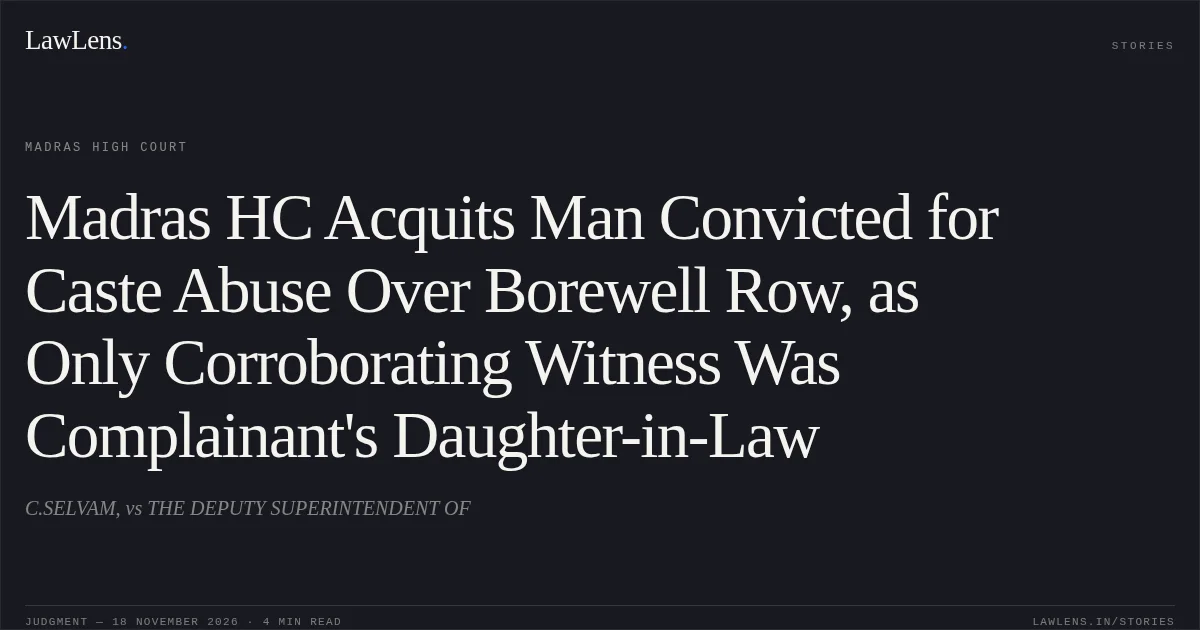
The de-facto complainant (P.W.1), a member of a Scheduled Caste, objected when Panchayat workers began digging a borewell near her house on 21.02.2013.
¶ 3 · p. 2The appellant, a member of a dominant community, allegedly restrained her, abused her by caste name, and threatened her with an iron spade.
¶ 3 · p. 2The complaint was lodged the same day, but the FIR (Crime No. 26/2013) was registered only three days later.
¶ 4 · p. 3The Deputy Superintendent of Police filed the final report, and the case was committed to the Special Court as S.C. No. 73 of 2013.
¶ 5 · p. 3The appellant was charged under Sections 341 and 506(ii) IPC and Section 3(1)(x) SC/ST (PoA) Act, pleaded not guilty, and the prosecution examined 21 witnesses.
¶ 6–7 · pp. 3–4The Trial Court convicted him on all three counts on 03.04.2019 and imposed rigorous imprisonment of one year under Sections 506(ii) IPC and 3(1)(x), with fines and default sentences.
¶ 7 · pp. 3–4The appellant challenged the conviction.
The case rests only on P.W.1 and P.W.7 (P.W.7 being P.W.1's daughter-in-law), because P.W.2 admitted in cross-examination that he was not at the scene.
¶ 9, 14 · p. 4, 6Both sides had long-standing political enmity.
¶ 16 · p. 702Issues
i.1. Whether the prosecution proved beyond reasonable doubt the offences under Sections 341 and 506(ii) IPC and Section 3(1)(x) SC/ST (PoA) Act.
¶ 12 · p. 6ii.2. Whether the testimony of P.W.1 and P.W.7, who are interested and related witnesses, is reliable and sufficient without independent corroboration.
¶ 17–19 · pp. 7–8iii.3. Whether the abuse was uttered "within public view," as required under Section 3(1)(x).
¶ 20–23 · pp. 8–1003Law Applied
Section 341 IPC requires proof that the accused obstructed the complainant so as to confine her within circumscribing limits against her will.
¶ 24 · p. 10Section 506(ii) IPC requires a threat to cause death or grievous hurt that creates genuine fear in the threatened person.
¶ 26 · p. 11Section 3(1)(x) SC/ST (PoA) Act requires intentional insult or intimidation with intent to humiliate a member of a Scheduled Caste "in any place within public view."
¶ 20 · pp. 8–9On "public view," the Court relied on Priti Agarwalla v. State of GNCT of Delhi (2024 SCC OnLine SC 973), which holds that witnesses must be independent and impartial, so persons closely related to or associated with the complainant are excluded.
¶ 10, 21 · pp. 4–5, 9The Court also relied on Swaran Singh, Ramawatar, Nepoleon, K. Karnan, and Thanushkodi for the same principle.
¶ 10 · pp. 4–5Where the prosecution rests wholly on interested witnesses with motive, their testimony must be scrutinised with care and accepted only if consistent, credible and, where necessary, independently corroborated.
¶ 17 · p. 7Delay in lodging the FIR, if unexplained, leaves room for embellishment and false implication, and the benefit of reasonable doubt goes to the accused.
¶ 28–29 · pp. 11–12Provisions in the judgment · 4 · Linked ones open on LawLens
Scheduled Castes and the Scheduled Tribes (Prevention of Atrocities) Act, 1989 Section 3
Code of Criminal Procedure, 1973 Section 374
Indian Penal Code, 1860 Section 341Section 506
04Reasoning
The Court found the testimony of P.W.1 and P.W.7 unreliable on two grounds. First, P.W.1's complaint and both witnesses' depositions placed P.W.2 at the scene, but P.W.2 denied being present.
¶ 18(i) · pp. 7–8Second, the witnesses contradicted each other on the weapon and the appellant's conduct: P.W.1 said the appellant pushed her and threw stones, while P.W.7 said nothing of a push and mentioned both a spade and a brick.
¶ 18(ii) · p. 8The Court held these were core contradictions, not peripheral details.
¶ 19 · p. 8On Section 3(1)(x), P.W.7, as P.W.1's daughter-in-law and a person with an election grudge against the appellant, could not be treated as an independent public witness under Priti Agarwalla. With P.W.7 excluded, no independent evidence corroborated the caste-based abuse.
¶ 22 · p. 9The Court also noted that the dispute over the borewell site between rival political groups made intent to humiliate on caste grounds less probable.
¶ 23 · pp. 9–10On Section 341 IPC, the evidence showed that P.W.1, not the appellant, obstructed the digging workers, and there was no proof of confinement within circumscribing limits.
¶ 24–25 · p. 10On Section 506(ii) IPC, the only proof of threat came from the same contradictory witnesses, and the recovery of the iron spade (M.O.1) showed only that a spade was recovered, not that it was brandished to threaten.
¶ 26–27 · p. 11Finally, the unexplained three-day delay in registering the FIR, together with the doubtful testimony, left a reasonable doubt about false implication of a political opponent.
¶ 28–29 · pp. 11–1205Holding
The prosecution failed to prove any of the charges beyond reasonable doubt. Convictions under Section 341 IPC, Section 506(ii) IPC, and Section 3(1)(x) SC/ST (PoA) Act could not be sustained, because the witnesses were interested and inconsistent, the "public view" requirement lacked independent corroboration, and the FIR delay was unexplained.
¶ 19, 23, 25, 27, 29 · pp. 8–12The Criminal Appeal was allowed. The judgment dated 03.04.2019 in S.C. No. 73 of 2013 was set aside, and the appellant was acquitted of all charges. His bail bond was discharged, and the fine already paid is to be refunded.
¶ 30–31 · p. 12Original Court PDF
C.SELVAM,vsTHE DEPUTY SUPERINTENDENT OF
Click to open original judgment
Original judgment, available to read, download and summarize on LawLens.in