01Facts
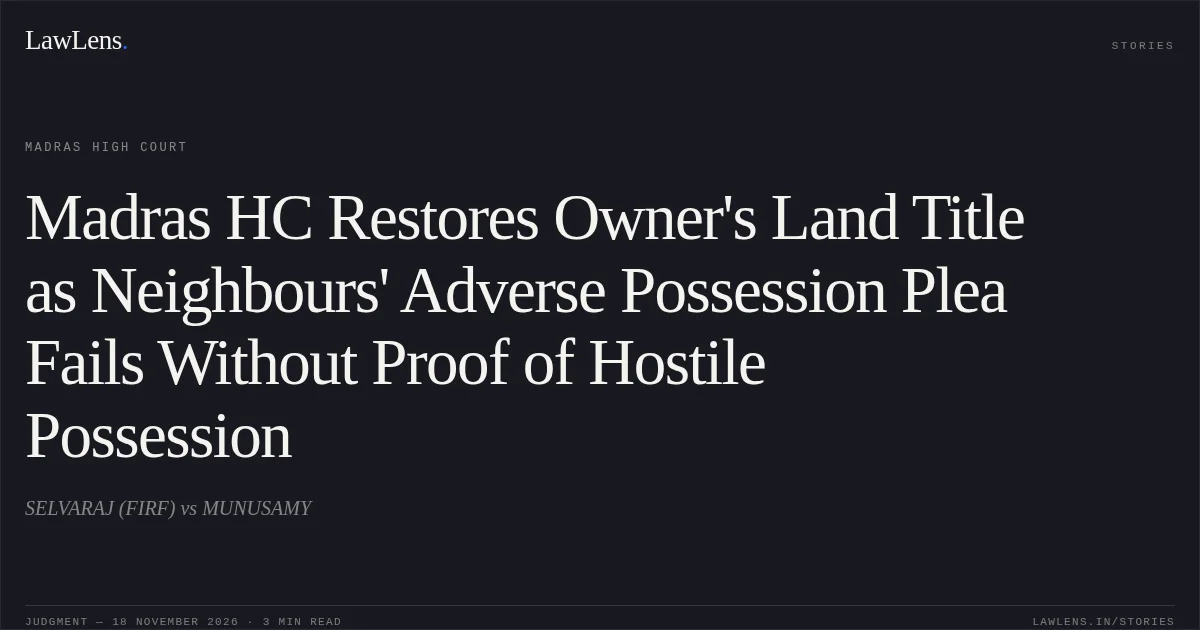
The plaintiff, Selvaraj, sued for a declaration of title to the suit property and a consequential permanent injunction.
p. 2He claimed the property was purchased by his father, Pachayappa Nayakkar, under a sale deed dated 03.01.1959, and that he inherited it and had been in possession since 1959.
p. 2The defendants, owners of adjoining survey numbers (104/6, 104/8, 106/3, 106/4), allegedly sought to acquire the property and attempted interference, including in 2003.
p. 3The defendants admitted the plaintiff's ownership and possession until 1982.
p. 3The defendants pleaded an oral exchange in January 1983, under which the plaintiff received alternative land (8 cents in S.No. 106/3 and 26 cents in S.No. 106/4) and they took title and possession of the suit property.
p. 3The defendants also relied on a mortgage dated 05.02.1998 (Ex.B20).
p. 4The Trial Court (Additional District Munsif, Gingee) rejected the defendants' claim based on patta, revenue records and the oral exchange, and decreed the suit in O.S. No. 400 of 2003 on 31.01.2011.
p. 5On appeal (A.S. No. 40 of 2011), the Sub Court, Gingee, reversed on 18.02.2014. It held the oral exchange legally invalid but found the defendants had been in open possession for over 12 years with the plaintiff's knowledge, and noted the plaintiff's failure to explain the patta issued to the defendants.
pp. 5–6The plaintiff died during the appeal, and his legal representatives pursued the second appeal under Section 100 CPC.
p. 502Issues
i.1. Whether the First Appellate Court erred in holding that the defendants perfected title by adverse possession, where the essential ingredients (open, hostile, continuous and uninterrupted possession with the owner's knowledge) were not established.
p. 6 · pp. 7 (para. 16–17)ii.2. Whether the First Appellate Court erred in accepting the defendants' plea of an oral exchange of property, which was barred under Section 17 of the Registration Act, 1908.
p. 603Law Applied
Section 100 CPC confines second appeals to substantial questions of law.
p. 1 · p. 6A party claiming title by adverse possession must specifically plead and prove, through cogent evidence, each ingredient: the point of time from which possession became adverse, and possession that is open, continuous and hostile to the true owner, with the owner's knowledge of that hostility.
p. 7 (para. 17)Section 17 of the Registration Act mandates compulsory registration of transactions above Rs.100 in value, and was referred to in assessing the oral exchange plea.
p. 6The judgment cites no decided case law for these propositions.
Provisions in the judgment · 2 · Linked ones open on LawLens
Code of Civil Procedure, 1908 Section 100
Registration Act, 1908 Section 17
04Reasoning
The First Appellate Court's reversal rested primarily on adverse possession. The High Court found that the evidence did not show when or how the defendants entered possession, or whether the plaintiff knew of any hostile possession.
p. 8 (para. 18)Revenue records, even if treated as evidence of possession, could not establish the required ingredients.
p. 8 (para. 18)The Court noted that the defendants' patta was later cancelled without any challenge, and that the defendants' tax receipts, as admitted by D.W.1, related to a different property. These facts undermined the claim of hostile possession.
p. 8 (para. 19)Reliance on revenue records and bare possession, without proof of commencement and continuity of hostile possession for the statutory period, was held insufficient.
p. 8 (para. 20)On the second question, the First Appellate Court had itself held the oral exchange legally invalid, and the respondents did not challenge that finding. The finding had therefore attained finality, and the question did not arise.
p. 9 (para. 21)05Holding
The first substantial question is answered in favour of the appellants: the defendants failed to establish adverse possession, and the First Appellate Court's finding of perfected title by adverse possession cannot be sustained.
p. 8 (para. 20) · p. 9The second substantial question does not arise, since the invalidity of the oral exchange is final. The Second Appeal is allowed. The judgment and decree of the Sub Court, Gingee, dated 18.02.2014 in A.S. No. 40 of 2011 are set aside. The judgment and decree of the Additional District Munsif Court, Gingee, dated 31.01.2011 in O.S. No. 400 of 2003, decreeing the plaintiff's title and permanent injunction, are confirmed. No costs.
p. 9 (para. 21) · p. 9 (para. 23)Original Court PDF
SELVARAJ (FIRF)vsMUNUSAMY
Click to open original judgment
Original judgment, available to read, download and summarize on LawLens.in