01Facts
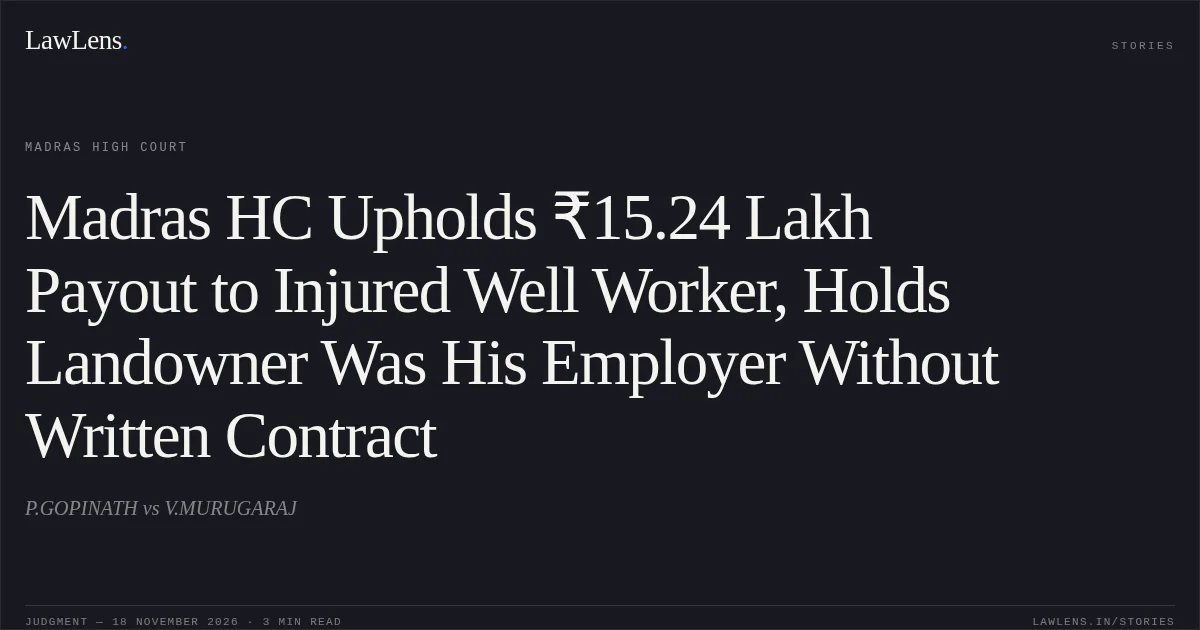
The claimant, V. Murugaraj, was engaged in sludge and silt removal in a well on Survey No. 77, Navaluthu Village, land owned by the first appellant (P. Gopinath) and administered by his father, the second appellant (K.K. Palanisamy).
pp. 2–3 · ¶ 3(a)He was allegedly paid Rs.15,000 per month with a daily wage of Rs.150.
p. 2 · ¶ 3(a)On 23.08.2018, at about 6:00 p.m., while attending motor pipe-setting work, the side wall of the well collapsed, causing serious injuries.
p. 3 · ¶ 3(b)He was treated at multiple hospitals, and an FIR was registered under IPC ss. 228 and 338 against the second appellant.
p. 3 · ¶ 3(c) · p. 11 · ¶ 15 · p. 13 · ¶ 19The appellants denied any employer–employee relationship. They contended that Nachimuthu and Dharmar @ Dharmaraj had been engaged for the work and had brought the claimant, and that the claimant had entered the well at about 6:00 p.m. to steal a motor pump set.
pp. 4–6 · ¶ 4(a)–(d)The Commissioner allowed the claim in part, awarding Rs.6,51,984 with 12% interest plus medical expenses of Rs.8,72,666, totalling Rs.15,24,650.
p. 1 · ¶ 1The Tribunal held that an employer–employee relationship existed and that the accident arose in the course of employment.
pp. 6–7 · ¶ 5The appellants filed this appeal under s.30 of the Employees' Compensation Act, 1923. The Court admitted it on four substantial questions of law.
pp. 7–8 · ¶ 7The quantum of compensation and the 85% disability finding were not challenged.
p. 11 · ¶ 1402Issues
i.1. Whether the Tribunal was right in fixing liability on the appellants in the absence of substantial evidence.
p. 7 · ¶ 7(I)ii.2. Whether compensation can be awarded where no employer–employee relationship exists.
p. 7 · ¶ 7(II) · p. 19 · ¶ 29iii.3. Whether the award is sustainable despite being in violation of s.12 of the Employees' Compensation Act, 1923.
p. 7 · ¶ 7(III) · pp. 17–19 · ¶ 27–29iv.4. Whether the award is valid in the absence of necessary parties (Nachimuthu and Dharmar @ Dharmaraj), and whether the claim petition is maintainable without their impleadment.
pp. 7–8 · ¶ 7(IV) · p. 18 · ¶ 2803Law Applied
The Court relied on s.12(1) of the Employees' Compensation Act, 1923, which makes a principal liable for compensation to an employee of a contractor engaged for work ordinarily part of the principal's trade or business, as if the employee had been immediately employed by the principal.
pp. 17–18 · ¶ 27The party asserting a contractual arrangement must prove it. A failure to prove a contract, or to implead or examine the alleged contractors, permits an adverse inference against the party asserting it.
pp. 18–19 · ¶ 28–29The existence of an employer–employee relationship was determined from the evidence of actual engagement and control, including the land owner's utilisation of the claimant's services.
pp. 16–17 · ¶ 26Section 30 of the Act confines appellate review to substantial questions of law.
p. 7 · ¶ 7No precedents are cited in the judgment.
Provisions in the judgment · 2 · Linked ones open on LawLens
Indian Penal Code, 1860 Section 228Section 338
04Reasoning
The Court found that the claimant's testimony, supported by the second appellant's admissions that he had engaged workers, that wages were paid through intermediaries, and that the claimant was present at the well for pump and foot-valve maintenance, established engagement under the appellants.
pp. 12–16 · ¶ 17–24The Court treated the appellants' theory of theft as unsupported because no FIR was lodged, and it treated the claimed intermediaries as unproven because no written contract existed and neither Nachimuthu nor Dharmar was impleaded or examined.
pp. 13–16 · ¶ 19–24 · pp. 18–19 · ¶ 28–29The Court held that the work of cleaning and refitting the motor and foot valve was incidental to the sludge-removal work and that the injury arose during that engagement.
p. 16 · ¶ 25On s.12, the Court reasoned that the provision applies only where a contractor's engagement is proven. Because no contract was established, the appellants could not shift liability to the intermediaries.
pp. 18–19 · ¶ 28–29The Court did not separately address the necessary-parties objection beyond holding that the non-joinder of the intermediaries did not defeat the claim.
p. 18 · ¶ 2805Holding
The Court answered all four substantial questions collectively against the appellants, holding that the evidence sufficiently supported the findings on relationship, causation and liability.
pp. 19–20 · ¶ 30The Court held that an employer–employee relationship existed between the claimant and the land owner, that s.12 was not applicable because no contract with the alleged intermediaries was proved, and that the Tribunal's findings were supported by the evidence.
pp. 17–20 · ¶ 26–30The appeal was dismissed, the Tribunal's order dated 27.02.2023 in E.C. No. 80 of 2018 was confirmed, and no order as to costs was made.
p. 20, final orderOriginal Court PDF
P.GOPINATHvsV.MURUGARAJ
Click to open original judgment
Original judgment, available to read, download and summarize on LawLens.in