01Facts
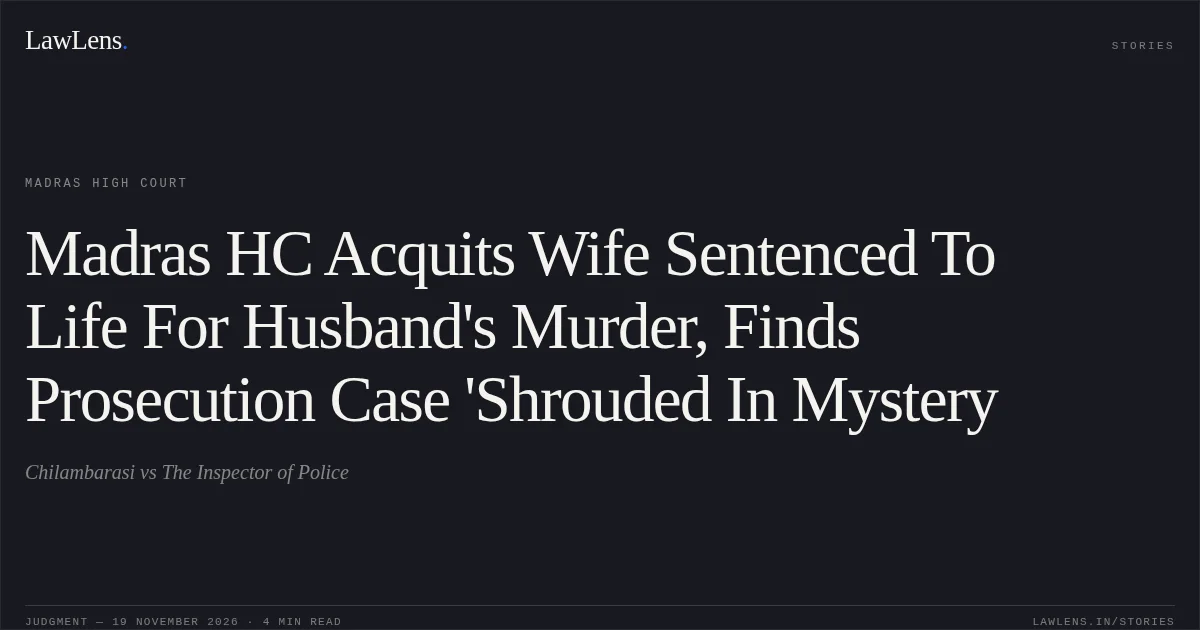
The appellant was the sole accused in S.C. No. 179 of 2019 before the Sessions Judge, Mahalir Neethimandram, Chennai, and was convicted under Sections 294(b), 302 and 506(ii) IPC on 24.02.2023.
¶ 2The appellant received life imprisonment under Section 302, with concurrent terms for the other offences.
¶ 2The appellant had been the landlord of PW1 Kaliyaperumal and his family, who were tenants at Rex Street, Chintadripet. After the appellant's wife left him, he blamed the deceased, Karpagam, and the family vacated the premises but continued to visit the neighbourhood on Sundays.
¶ 4On 09.09.2018, around 7–8 p.m., while the deceased was talking with PW5 and PW6, the appellant allegedly emerged from his house with a hammer and struck her on the head, and abused her in filthy language.
¶ 5–6PW1–PW3 allegedly rushed forward but were threatened.
¶ 6The deceased was admitted to hospital, where no external injuries were noted. She died on 10.09.2018.
¶ 7The post-mortem revealed multiple head injuries, including fractures, and PW9 opined that death was due to head injuries.
¶ 12, 29–30The appellant was arrested on 10.09.2018, allegedly gave a disclosure statement, and produced a hammer (MO1).
¶ 9–10PW4 turned hostile. PW1, PW2, PW3 and PW6 said the blow fell on the back of the head, while PW5 said the right side.
¶ 14PW5 and PW6 stated in cross-examination that PW1–PW3 were absent, and PW5 and PW6 said the hammer was recovered the day after the occurrence.
¶ 22, 24The appellant's Section 313 statement denied the charges and alleged a property dispute; he examined himself as DW1.
¶ 1802Issues
i.1. Whether the prosecution established the cause of death as a result of injuries inflicted by the appellant, given the non-examination of treating doctors and the absence of the viscera report, when these points were not raised at trial.
¶ 25, 29, 32ii.2. Whether the eyewitness testimony of PW1, PW2, PW3, PW5 and PW6 is reliable despite discrepancies regarding the side of the head struck and the presence of PW1–PW3 at the scene.
¶ 21–23, 33–36iii.3. Whether the discrepancy regarding the time and manner of recovery of the hammer (MO1) vitiates the prosecution case.
¶ 24, 38–40iv.4. Whether the appellant's conviction under Section 302 IPC can be sustained, including whether any exception under Section 300 applies.
¶ 41v.5. Whether the offence under Section 294(b) IPC is made out on the evidence of obscene or abusive words.
¶ 42–44vi.6. Whether the offence under Section 506(ii) IPC (criminal intimidation) is made out.
¶ 45–4603Law Applied
The court applied Section 302 IPC for murder and Section 300 IPC, including its exceptions, which were not invoked on these facts.
¶ 29, 41The court relied on the principle that the accused's culpable homicide must be established before culpability is assessed.
¶ 29The court applied the rule that defence objections not raised at trial, especially in cross-examination, cannot be raised for the first time on appeal.
¶ 32The court followed T.G. Krishnamurthy v. State of Karnataka (2023 LiveLaw (SC) 671) and Mahendran v. State of Tamil Nadu (AIR 2019 SC 1719) for the rule that falsus in uno, falsus in omnibus has no application in India, so the court must separate the chaff from the grain.
¶ 35The court relied on Madan v. State of U.P. (2023 SCC OnLine SC 1473) and Darbara Singh v. State of Punjab (AIR 2013 SC 840) for the rule that where eyewitness testimony is trustworthy, motive loses significance.
¶ 37The court relied on Om Pal v. State of U.P. (2025 INSC 1262) and Nankaunoo v. State of U.P. (2016 (3) SCC 317) for the rule that non-recovery or doubtful recovery of the weapon does not, by itself, vitiate a prosecution case supported by ocular and medical evidence.
¶ 39The court applied Mani @ Subramaniyan v. State of Tamil Nadu (2025 INSC 719) for the proposition that mere utterance of swear words does not constitute Section 294(b) unless the words are lascivious, appeal to prurient interest, or cause annoyance in a public place.
¶ 42The court applied Mani @ Subramaniyan v. State of Tamil Nadu (2025 INSC 719) for the proposition that Section 506(ii) requires proof of a threat intended to cause alarm.
¶ 45Provisions in the judgment · 11 · Linked ones open on LawLens
Code of Criminal Procedure, 1973 Section 374Section 313
Indian Penal Code, 1860 9 provisions
Section 294Section 302Section 506Section 341Section 324Section 307Section 509Section 301Section 30004Reasoning
On the cause of death, the court held that the post-mortem certificate (Ex. P5) and PW9's testimony showed fractures and other head injuries consistent with a hammer assault.
¶ 29–31The defence had not challenged the doctor's opinion at trial, and the absence of the treating doctors and viscera report was raised too late.
¶ 32On the eyewitnesses, the court held that the discrepancy about the side of the head was explained by the panic that a sudden attack causes, and the core account of a hammer blow to the head matched the medical evidence.
¶ 33–34On the presence of PW1–PW3, the court held that PW5 and PW6 had first affirmed their presence in examination-in-chief and admitted their absence only under suggestion in cross-examination. This created an inconsistency that required caution, but did not require rejecting the testimony wholesale.
¶ 35PW5 and PW6 were found to be neighbours acquainted with the parties, with no suggested motive to falsely implicate the appellant, and their account was held believable.
¶ 36On motive, the court held that the weak motive pleaded was immaterial given reliable eyewitness testimony.
¶ 37On the hammer recovery, the court treated the discrepancy (the police apparently recovered it on 09.09 or 10.09 at the scene, per PW5 and PW6) as an investigative lapse that could not defeat the case.
¶ 38–40On Section 302, the court found no basis to apply any Section 300 exception.
¶ 41On Section 294(b), the court found that PW1 alleged specific words, PW2 alleged different words, and PW3, PW5 and PW6 said nothing about the words used. Neither the words nor their obscene character were established.
¶ 42–44On Section 506(ii), PW1 was silent about any threat, and PW2's account did not show an intent to cause alarm.
¶ 4505Holding
The ocular evidence of PW1, PW2, PW3, PW5 and PW6 is trustworthy and corroborated by medical evidence, and the hammer-recovery discrepancy does not vitiate the case.
¶ 40–41, 47The conviction and sentence under Section 302 IPC (life imprisonment and ₹10,000 fine) are confirmed.
¶ 40–41, 47The evidence did not establish the essential ingredients of the offence under Section 294(b) IPC or Section 506(ii) IPC.
¶ 44, 46–47The appeal is partly allowed. The conviction and sentence under Section 294(b) IPC and Section 506(ii) IPC are set aside.
¶ 44, 46–47Original Court PDF
G.MOSES SHARAKvsSTATE REP.BY
Click to open original judgment
Original judgment, available to read, download and summarize on LawLens.in