01Facts
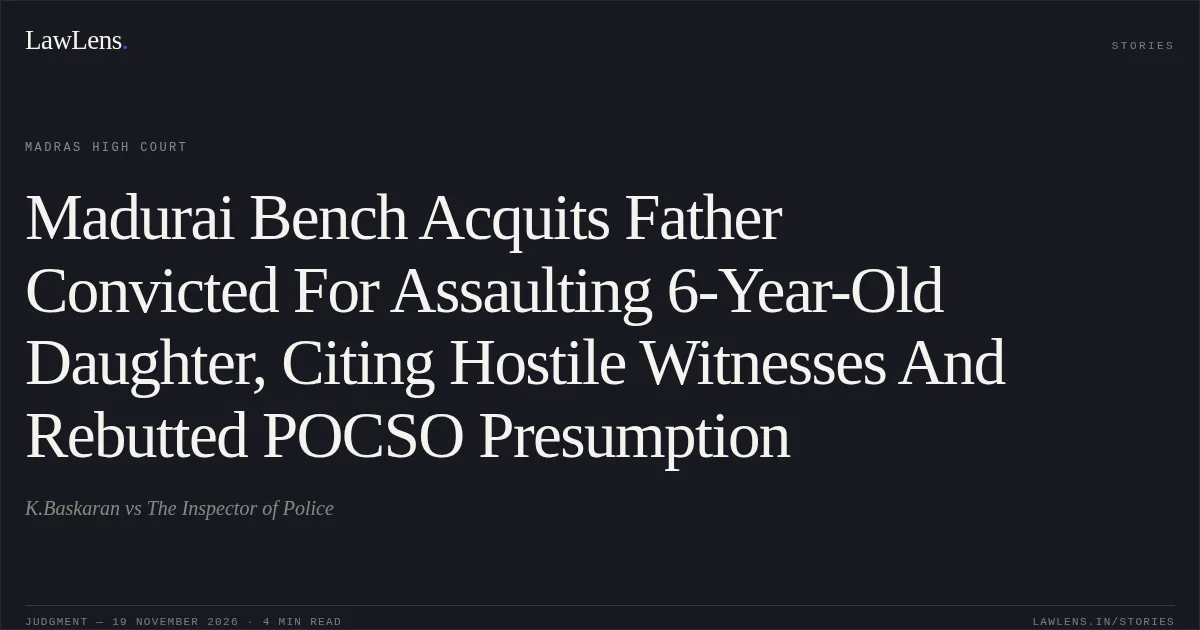
The appellant, the father of a six-year-old girl (the child victim, born 09.03.2013), was convicted under ss. 5(m) and 5(n) r/w s. 6 of the POCSO Act, 2012, and sentenced to life imprisonment and a fine of Rs. 5,000.
p. 2 · p. 11The prosecution alleged that in July 2019 the appellant sexually assaulted the child at his house, including digital and penile penetration, and applied oil to the resulting sores.
pp. 2–3A doctor at a school medical camp on 12.07.2019 noticed the injuries, and the child reportedly disclosed the abuse.
p. 3Child Help Line received a call on 18.07.2019.
p. 3The mother's complaint was lodged on 21.08.2019 (the judgment states "21.08.2018," which appears to be a typographical error), and FIR No. 24/2019 was registered.
pp. 3–4The appellant was arrested the same day.
p. 4Charges were framed under ss. 5(l), 5(m) and 5(n) r/w s. 6, and the appellant pleaded not guilty.
pp. 5–6The prosecution examined PW1–PW22.
pp. 6–8PW1 (mother), PW2 (child victim) and PW6 (maternal aunt) turned hostile.
p. 6 · p. 9The defence led no evidence.
p. 9On appeal, the appellant contended that the core witnesses turned hostile, that the complaint was delayed and disowned, that the medical evidence did not support the prosecution, and that the s. 29 presumption could not arise.
pp. 9–10The State argued that the medical evidence and Child Help Line/medical witnesses corroborated the prosecution and that s. 29 applied.
pp. 10–1102Issues
i.1. Whether there is any dependable portion in the evidence of hostile witnesses PW1, PW2 and/or PW6 supporting the prosecution case.
pp. 12–13 · pp. 13–15 · pp. 15 (para. 20(a)–21)ii.2. Whether there is any other independent evidence proving the guilt of the appellant beyond the hostile witnesses' testimony.
p. 12 · pp. 15–17iii.3. Whether the prosecution established the foundational facts so as to invoke the statutory presumption under s. 29 POCSO Act, and if so, whether the appellant rebutted it.
pp. 17–18 · pp. 23–24iv.4. Whether the delayed complaint and the victim's conduct are admissible and relevant under Illustration (j) to s. 8 of the Indian Evidence Act, 1872, to support the prosecution.
pp. 24–2603Law Applied
The evidence of a hostile witness need not be discarded entirely and any dependable portion may be relied on, per C. Muniappan v. State of Tamil Nadu (2010) 9 SCC 567; a POCSO prosecution may still succeed despite hostile victim and parents if other evidence proves guilt.
p. 12Section 29 POCSO Act requires the Special Court to presume the offence "unless the contrary is proved."
p. 18The presumption arises only once foundational facts are proved by unimpeachable evidence, per Debraj Dutta v. State of West Bengal (2026 LiveLaw (SC) 401).
p. 17The presumption is rebuttable, even on a preponderance of probabilities, and may be rebutted by discrediting witnesses, showing contradictions, mismatch between ocular and medical evidence, or non-corroboration, as laid down in Deepak @ JC v. State (NCT of Delhi) (2026 INSC 1008).
pp. 18–21Courts must not treat the prosecution version as gospel and must not overweigh s. 29 at the cost of objective appraisal.
pp. 19–21Illustration (j) to s. 8 of the Evidence Act makes a complaint made shortly after the alleged rape, and the circumstances of its making, relevant as conduct.
pp. 24–25Provisions in the judgment · 11 · Linked ones open on LawLens
Code of Criminal Procedure, 1973 Section 164Section 228Section 374
Protection of Children from Sexual Offences Act, 2012 Section 2Section 3Section 5Section 6Section 7Section 9Section 29Section 30
04Reasoning
On the first issue, the Court examined the hostile witnesses' testimony. PW1 denied lodging any complaint, said her signatures were taken on blank papers, and denied that police examined her; nothing in cross-examination undermined this. PW2 repeatedly stated that a cousin, not the appellant, inserted a wooden stick into her private part, and that police tortured her into naming her father. PW6 stated she knew nothing of the occurrence. The Court held there was no dependable portion supporting the prosecution.
p. 13 · pp. 13–14 · pp. 14–15 · p. 15On the second issue, the Court found the Child Help Line counsellors' evidence (PW7, PW11) neither credible nor reliable because the two accounts conflicted on who disclosed the abuse. The medical camp evidence (PW12–PW15) was hearsay or lacked personal knowledge, and the record did not clearly establish that the examination occurred at the camp; PW12 and PW13/PW15 gave inconsistent accounts about treatment. The hymen rupture (Ex.P8) was explained by PW16 as possibly caused by cycling or sports. The Court therefore found no other evidence of guilt.
p. 15 · p. 16 · pp. 16–17 · p. 17On the third issue, the Court held that the foundational facts were not proved by unimpeachable evidence, so s. 29 could not be invoked. Alternatively, even if they were proved, the appellant rebutted the presumption: the child's statement under s. 164 CrPC (Ex.P18) implicated the cousin and his mother, not the appellant, and the police did not investigate those imputations; the burn-injury history recorded by PW7 (dated as "22.07.2015," evidently a typographical error) was inconsistent with the prosecution case, and it was unclear who treated the earlier sores; and PW1 disowned the complaint.
p. 17 · pp. 21–22 · pp. 22–23On the fourth issue, the Court held Illustration (j) inapplicable because the complaint came about 40 days after the disclosure at the camp, was disowned by PW1, and the child's testimony about police coercion undermined the conduct-based inference.
pp. 25–2605Holding
The hostile witnesses' evidence contains no dependable portion supporting the prosecution, and there is no other evidence proving guilt. The foundational facts for POCSO offences were not established, and even if they were, the appellant rebutted the s. 29 presumption. Illustration (j) to s. 8 of the Evidence Act does not apply.
p. 15 · p. 17 · pp. 17–23 · pp. 25–26The conviction and sentence under ss. 5(m) and 5(n) r/w s. 6 POCSO Act were reversed and the appeal allowed. The appellant was acquitted, directed to be set at liberty unless required in another case, and refunded any fine paid; his bail bond stands cancelled.
pp. 26–27Original Court PDF
K.BaskaranvsThe Inspector of Police
Click to open original judgment
Original judgment, available to read, download and summarize on LawLens.in