01Facts
The appellant challenged his conviction under Sections 363, 366 and 376 IPC, with concurrent sentences of five, seven and ten years’ rigorous imprisonment respectively.
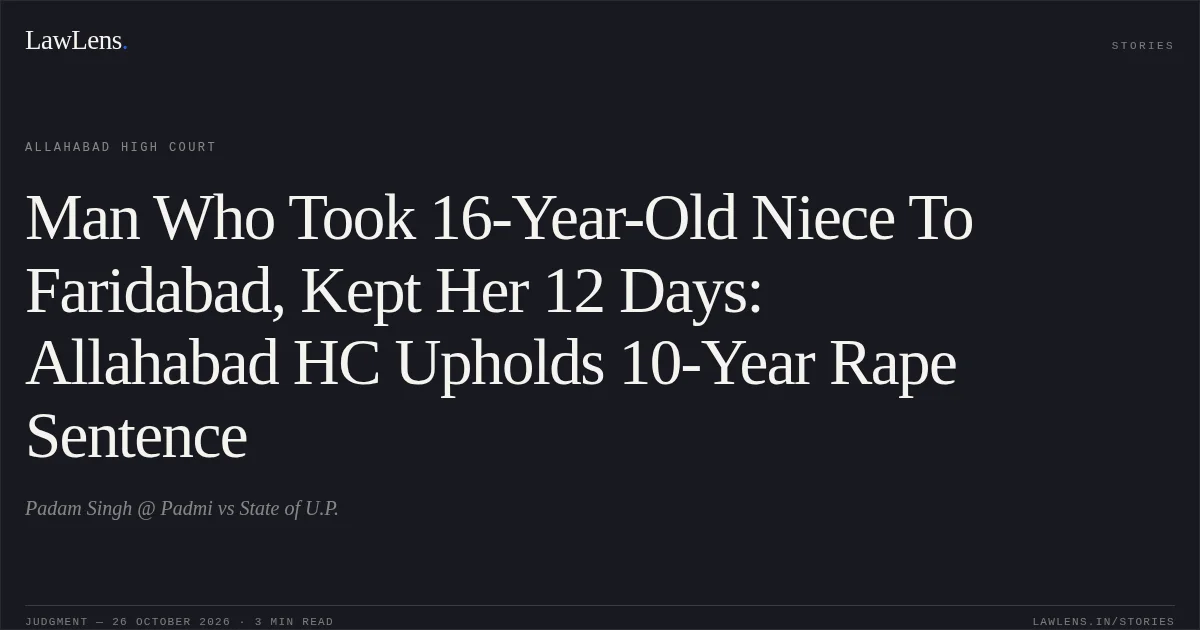
¶ 2The prosecution alleged that on the night of 30–31 March 2014, the appellant took the complainant’s niece from her home to Faridabad, where he kept her for about 12–13 days and repeatedly had sexual intercourse with her.
¶ 4, 23–24The victim’s school certificate recorded her date of birth as 3 March 1998; she was recovered with the appellant on 13 April 2014.
¶ 25, 46–47The trial court convicted the appellant, and he appealed, disputing the victim’s credibility, the absence of independent and medical corroboration, and the delay in lodging the FIR.
¶ 58–6202Issues
i.1. Whether the victim’s testimony, considered with the surrounding evidence, proved the offences under Sections 363, 366 and 376 IPC beyond reasonable doubt, notwithstanding the alleged inconsistencies and absence of medical corroboration
¶ 68–70, 73ii.2. Whether the victim’s age was sufficiently established to make consent legally immaterial to the rape charge
¶ 67, 70iii.3. Whether the delay in lodging the FIR or alleged defects in the investigation warranted interference with the conviction
¶ 71–7303Law Applied
The Court applied Sections 363, 366 and 376 IPC and held that, because the victim was under 18, her consent was not a defence to the rape charge.
¶ 39, 70Relying on State of Punjab v. Gurmit Singh, State of Maharashtra v. Chandraprakash Kewalchand Jain, State of U.P. v. Pappu @ Yunus, Vijay alias Chinee v. State of M.P., Wahid Khan v. State of M.P. and Mohd. Imran Khan v. State (NCT of Delhi), the Court stated that a prosecutrix’s reliable testimony can sustain a conviction without independent corroboration, and that absence of injuries does not by itself discredit that testimony.
¶ 40–44, 68, 70Under Ram Das v. State of Maharashtra, delay in lodging an FIR is assessed in the circumstances of the case and is not automatically fatal.
¶ 15, 71Under State of Karnataka v. K. Yarappa Reddy and Babubhai v. State of Gujarat, investigative defects do not by themselves require acquittal where the substantive evidence establishes guilt.
¶ 48–51, 72Provisions in the judgment · 6 · Linked ones open on LawLens
Indian Penal Code, 1860 Section 363Section 366Section 376
Code of Criminal Procedure, 1973 Section 154Section 164Section 313
04Reasoning
The Court accepted the victim’s High School Certificate, recording her date of birth as 3 March 1998, as supporting the finding that she was a minor; it noted that the radiological certificate recording her age as 18 was not exhibited.
¶ 67It found the victim’s account of being taken to Faridabad and kept there with the appellant for 12–13 days reliable and consistent on the material points, and considered it supported by the evidence concerning her disappearance and recovery.
¶ 69–70The absence of injuries and spermatozoa, and the doctor’s inability to give a definite opinion on forcible intercourse, did not displace that testimony.
¶ 52–56, 70The Court also concluded that the delay and alleged investigative deficiencies, considered with the evidence as a whole, did not create sufficient grounds to reject the prosecution case.
¶ 71–7305Holding
The High Court dismissed the appeal and affirmed the convictions and sentences, finding no material contradiction, illegality, perversity or misappreciation of evidence warranting appellate interference.
¶ 73As the appellant was on bail, it directed him to surrender before the trial court within 15 days; the trial court was authorised to take steps to secure his presence if he failed to do so, and any custody already undergone was to be adjusted in accordance with law.
¶ 74–76Original Court PDF
Padam Singh @ PadmivsState of U.P.
Click to open original judgment
Original judgment, available to read, download and summarize on LawLens.in