01Facts
The 4th respondent, Kallar Kalvi Kazhagam, is a society registered in 1967 that serves as the educational agency of Pasumpon Muthuramalingam Thevar College, Valaiyapatti.
p. 2Its executive committee was superseded and a Special Officer was appointed under G.O. No. 13 dated 22.02.2002.
p. 2The last election was held on 02.03.2020, and no annual general body meeting has been held since.
p. 2The petitioner filed OS No. 13 of 2023 seeking production of title documents and other records.
p. 3In WP(MD) No. 19261 of 2024, the Court on 12.08.2024 appointed Retired Justice V. Bharathidasan to conduct the election; he reported that it could not be held for want of funds.
pp. 3–4By order dated 18.12.2024, the Court recorded that Rs. 30,00,000 was required for the election against available cash of Rs. 1,30,000, and directed the District Registrar to appoint a Special Officer.
p. 4That direction was not complied with.
p. 4The petitioner then submitted a representation dated 08.06.2026, which was not considered, and filed the present writ petition seeking mandamus to consider it and to comply with s. 34B and Rule 33-A of the Tamil Nadu Societies Registration Act, 1975 before conducting the election.
pp. 1–2 · p. 402Issues
i.1. Whether the 4th respondent is under a statutory duty to consider and decide the petitioner's representation dated 08.06.2026 on its merits.
p. 4 · ¶ 6ii.2. Whether the non-consideration of the representation by the statutory authority amounts to dereliction of duty warranting the exercise of writ jurisdiction under Article 226.
pp. 4–5 · ¶ 603Law Applied
The Court relied on Article 226 of the Constitution of India as the source of its power to issue writs of mandamus.
pp. 4–5 · ¶ 6When a representation is made to a statutory authority, the authority is bound to consider it on its own merits and pass an appropriate order, and may not keep it pending indefinitely; failure to do so is dereliction of duty.
pp. 4–5 · ¶ 6The Court may direct consideration of a representation within a stipulated time.
p. 5 · ¶ 6The Court referred to s. 34B and Rule 33-A of the Tamil Nadu Societies Registration Act, 1975 in the prayer, but did not interpret or apply them.
pp. 1–2No precedents are cited in the order.
Provisions in the judgment · 1
Tamil Nadu Societies Registration Act, 1975 Section 34
04Reasoning
The Court accepted that the petitioner's representation of 08.06.2026 remained unconsidered and treated this non-consideration as dereliction of the 4th respondent's duty, which justified intervention under Article 226.
pp. 4–5 · ¶ 6Rather than adjudicating the petitioner's substantive grievances about election preparedness, the Special Officer appointment, or compliance with s. 34B and Rule 33-A, the Court confined itself to a procedural direction that the representation be decided.
p. 5 · ¶ 7The order expressly records that the Court expressed no view on the merits and that the respondents remain free to decide the matter on its own merits.
p. 5 · ¶ 7The order does not address the earlier direction in WP(MD) No. 19261 of 2024 to appoint a Special Officer, which had not been complied with.
p. 4 · ¶ 405Holding
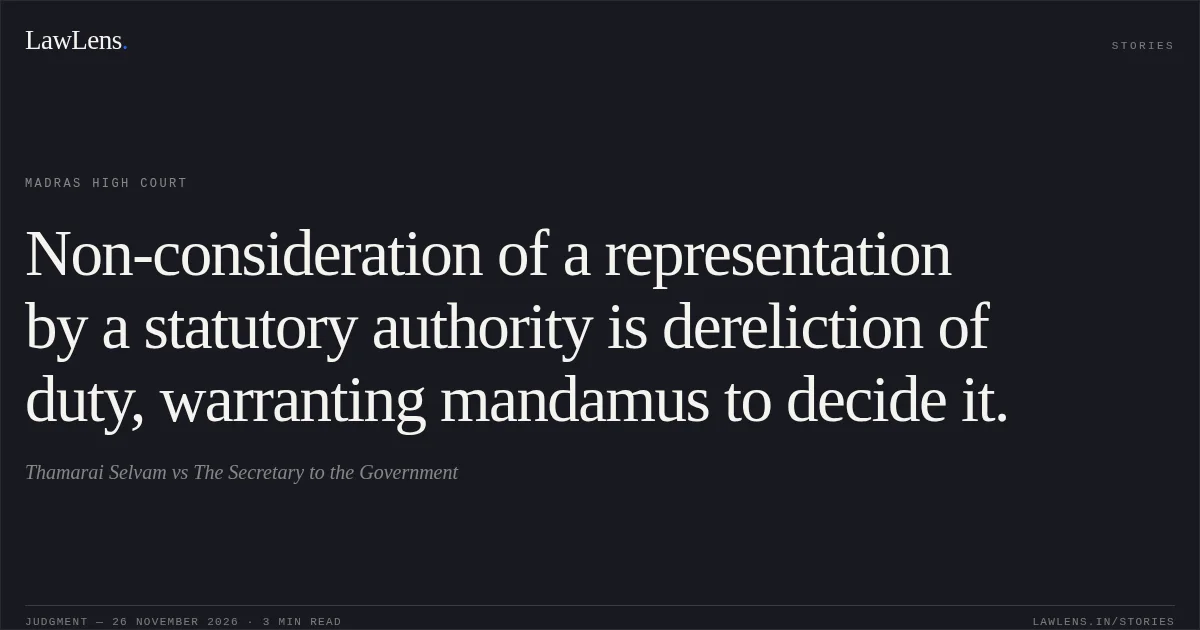
The Court held that a statutory authority's failure to consider a representation on its merits is a dereliction of duty that the Court may remedy under Article 226.
pp. 4–5 · ¶ 6The writ petition was disposed of with a direction to the 4th respondent (Kallar Kalvi Kazhagam, through its Special Officer) to consider the representation dated 08.06.2026 on its own merits, after affording a hearing to the petitioner and other concerned parties, and to pass appropriate orders in accordance with law within four weeks from receipt of a copy of the order.
p. 5 · ¶ 7No costs were awarded, and the connected miscellaneous petition was closed.
p. 5 · ¶ 8No direction was issued to respondents 1 to 3, and no finding was recorded on the merits or on s. 34B and Rule 33-A.
p. 5 · ¶ 7–8Original Court PDF
Thamarai SelvamvsThe Secretary to the Government
Click to open original judgment
Original judgment, available to read, download and summarize on LawLens.in