01Facts
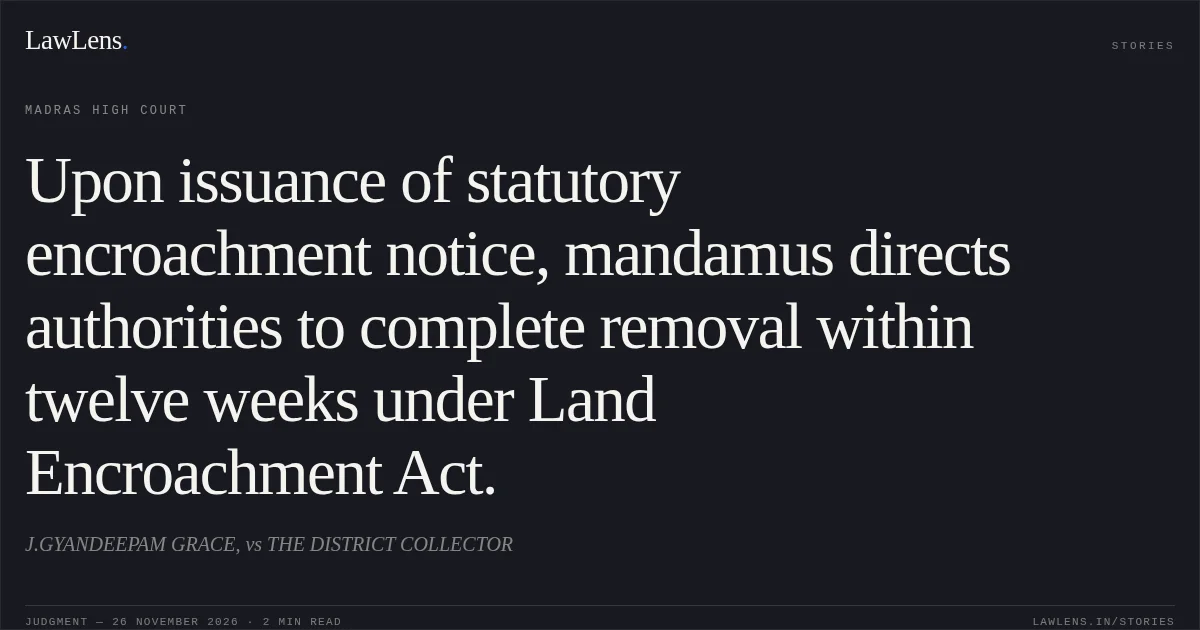
The petitioner sought a writ of mandamus directing Respondents 1 to 5 (District Collector, District Superintendent of Police, Tahsildar, Revenue Department Officer, and Village Administrative Officer, Valam Village) to consider her representation dated 28.04.2025 and remove an encroachment placed on the road directly in front of her house by Respondent 6.
¶ 1 · p. 2On instructions, the Additional Government Pleader submitted that the revenue authorities had conducted a survey, identified encroachments, and issued a notice under Section 7 of the Tamil Nadu Land Encroachment Act, 1905.
¶ 2 · pp. 2-3The court recorded no contested findings on the facts.
02Issues
i.1. Whether the respondents, in light of the survey and the Section 7 notice, are under a legal duty to complete removal of the encroachment on the road in front of the petitioner's house, such that mandamus should issue.
¶ 2 · p. 3 · ¶ 3ii.2. Whether the representation dated 28.04.2025 required a separate, specific adjudication, or was sufficiently addressed by the statutory enforcement process already initiated.
03Law Applied
The Tamil Nadu Land Encroachment Act, 1905, specifically Section 7, provides the statutory procedure for notice and removal of unauthorised encroachments on public land.
¶ 2 · p. 2The court directed that all further procedures "contemplated under the Act and Rules" be followed, thereby applying the statutory scheme and its implementing Rules.
¶ 3 · p. 3The court's power to issue a writ of mandamus under Article 226 of the Constitution of India was the procedural basis of the petition.
p. 1 · p. 2No precedents were cited or discussed.
Provisions in the judgment · 1 · Linked ones open on LawLens
Tamil Nadu Land Encroachment Act, 1905 Section 7
04Reasoning
The court accepted the State's submission that the survey had been conducted and a Section 7 notice issued, and treated this as the operative step in the removal process.
¶ 2 · p. 2Rather than examining the merits of the encroachment or the petitioner's representation, the court converted the grievance into a time-bound statutory direction. It directed Respondents 3 to 5 to proceed with enforcement and to complete removal within twelve weeks of receipt of the order.
¶ 3 · p. 3The reasoning implicitly treats the statutory notice as sufficient response to the representation, so the petition could be disposed of without a separate direction on the representation.
¶ 3 · no citation for the implicit reasoningThe order does not address the petitioner's specific allegations or the identity of the encroachment beyond the survey finding.
05Holding
The court disposed of the writ petition without costs.
¶ 4 · p. 3The court directed Respondents 3 to 5 to proceed with enforcement action under the Tamil Nadu Land Encroachment Act, 1905 and the Rules, and to remove the encroachment within twelve weeks from receipt of a copy of the order. Connected miscellaneous petitions, if any, were closed.
¶ 3 · p. 3 · ¶ 4 · p. 3The order does not contain a separate ruling on the representation dated 28.04.2025.
Original Court PDF
J.GYANDEEPAM GRACE,vsTHE DISTRICT COLLECTOR
Click to open original judgment
Original judgment, available to read, download and summarize on LawLens.in